 Wines of Slovenia
Tasting No 293 – September 29, 2026
-
 Tasting Overview
The objective of this tasting is to explore the Slovenian wine regions and their wines. The tasting will include a sparkling rose, a dry white and two red wines.
Type of tasting: open
Presenters: Patricia Meduña and Laura Bocalandro
Participants: S. Ardila; M. Averbug; L. Bocalandro; J. Brakarz; Y. Cutler; J. Entwistle; C. Estrada; M. Fryer; E. and N. Gochicoa; P. Meduña; A. and C. Perazza; J. and L. Redwood; J. Requena; R. Santiago; G. Smart; and G. Vega.
These are the wines:
- Kobal, Furmint, Podravje, Slovenia, 2025
- Kobal, ‘Roots’, Blaufrankisch, Podravje, Slovenia, 2023
- Rodica, ‘Refosk Classic’, Istria, Slovenia, 2024
- Kobal, ‘Penina Rose’ Brut, Ptuj, Slovenia, NV
The Menu
- Prosciutto and melon
- Flounder with capers and lemon butter
- Hearty stew with pork and potatoes
- Chocolate mousse cake.
-
Background on Slovenia
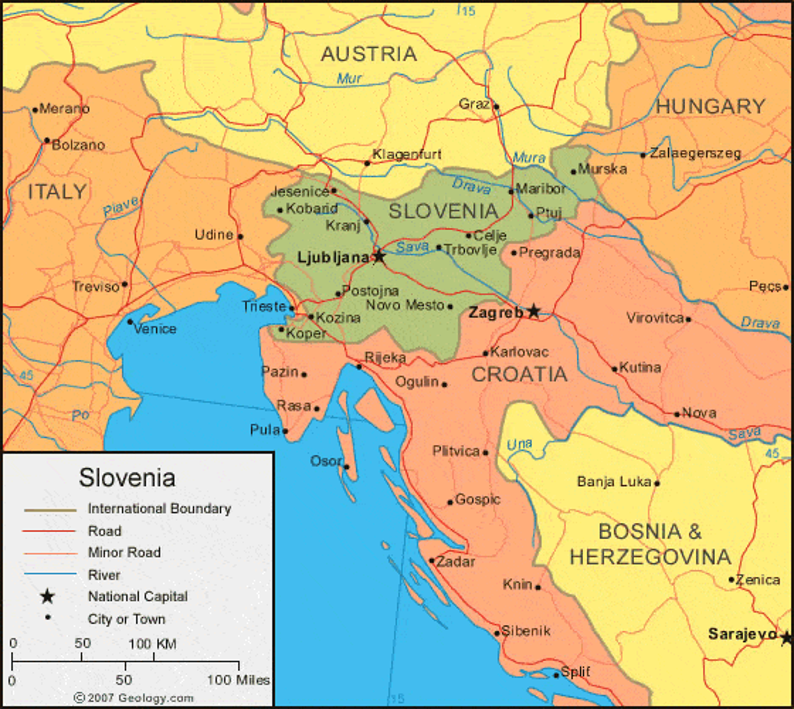
The Republic of Slovenia is in Central Europe, sharing its borders with Italy, Austria, Croatia, and Hungary. Spanning an area of 7,827 square miles, it touches the Alps and borders the Adriatic Sea and has a population of 2.1 million residents.
Slovenia is mostly elevated. It’s the meeting point of four major European geographical/topographical regions: The Alps; The Dinaric Alps / Dinaric Karst; The Pannonian Plain; and the Mediterranean region. The Pannonian Plain — in the east and northeast, consists of a lower, rolling landscape with fertile agricultural areas and important wine-growing regions. The Mediterranean region, along Slovenia’s Adriatic coast and hinterland, has a milder Mediterranean climate, with olives and vineyards.
Slovenia’s history spans from ancient Slavic migration and centuries of Habsburg rule to its modern independence as a European Union member. It was part of the Holy Roman Empire for nearly 1000 years. From the mid-14th century until 1918, most Slovenian lands were ruled by the Austrian Habsburg and later Austria-Hungary. Slovenes retained their language and culture despite strong German political and cultural influence. During the 19th century, Slovene nationalism and demands for greater political and cultural recognition grew. After World War I, the Habsburg Empire collapsed. Slovenes joined with Croats and Serbs to create a South Slavic state that soon became the Kingdom of Serbs, Croats and Slovenes, renamed Yugoslavia in 1929.
After World War II, Slovenia became one of the six republics of socialist Yugoslavia, led for decades by Josip Broz Tito. Yugoslavia was communist but followed a more independent path. Slovenia became Yugoslavia’s most economically developed republic. After Tito’s death in 1980, Yugoslavia experienced increasing economic difficulties and political and nationalist tensions. Slovenia developed a strong movement for political pluralism, democracy, and greater autonomy. It declared independence on June 25, 1991. Unlike Croatia and Bosnia-Herzegovina, Slovenia avoided a prolonged Yugoslav war. Slovenia gained broad international recognition. It developed as a parliamentary democracy and increasingly integrated with Western European institutions. In 2004 Slovenia joined both the European Union and NATO.
-
Wine production in Slovenia
Although a small country, Slovenia’s climate and geology are diverse, resulting in stunning wines that reflect the varied character of their terroir. Wine making in Slovenia existed long before the Romans introduced winemaking to France, Germany and Spain. It traces back to the Celts and Illyrians, who inhabited the region around 400 BC. The Romans arrived in the 1st century BC, expanding viticulture to slake the thirst of the Empire’s growing colonies. Winemaking continued through the Middle Ages, flourishing through the diligence of Monastic orders. A relic of the era, the world’s oldest vine currently ages in Maribor—with a dedicated museum—at 450 years old. Eventually, the Phylloxera crisis, then socialist control in the 20th century—during which time the state took control of the wine industry—would stall artisan and fine wine production. Huge wineries turned out mass-produced wine bottles for supermarket chains.
The independence of Slovenia in 1991 sparked the modern-day wine industry. Winemakers at big companies went independent and started personal brands.
Today Slovenia has more than 28,000 wineries making between 80 and 90 million liters annually from 50 to 60 varieties and from the country’s 22,300 hectares of vineyards. About 75% of the country’s production is white wine. Almost all of the wine is consumed domestically with only 6.1 million a year being exported—mostly to the United States, Bosnia and Herzegovina, Croatia, and lately the Czech Republic. Most of the country’s wine production falls under the classification of premium (vrhunsko) wine, with less than 30% classified as basic table wine . Quality continues to replace quantity as wine makers enhance their skills, which is evident by the growing number of award-winning wines making their way onto tables the world over. The steep growing terrain in Slovenia promotes manual harvesting practices over mechanical for most of Slovenia’s vineyards.
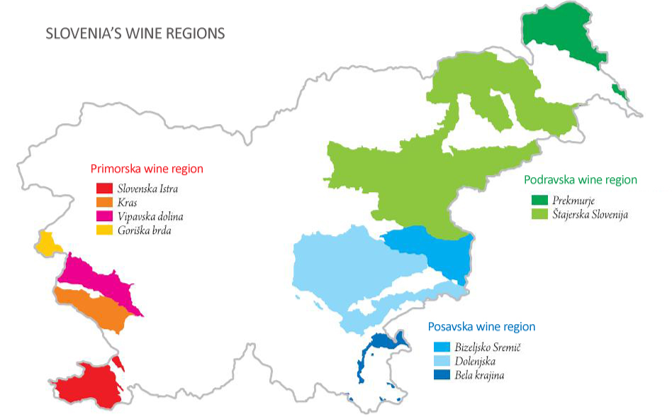
Slovenia is divided into three primary wine-growing regions, each shaped by distinct climates, terrains, and wine-making traditions. Together, they yield a diverse range of styles from crisp, Germanic-style whites to rich, Mediterranean reds. The regions are: Podravska ( Podravje) , Posavska (Prosavje), Primorska.
Podravska/Podravje.
Located in the northeast, bordering Croatia and Hungary, this region is overwhelmingly dedicated to production of white wine, which accounts for 95% to 97% of its total output. It is globally renowned for its elegant aromatic white varietals, premium sparkling wines, and world-class dessert (predicate) wines.
Podravje has a continental climate and is the largest wine region in Slovenia. It spans nearly 10,000 hectares and accounting for roughly 50% of the entire nation’s wine output. Dictated by a temperate continental climate with hot summers and harsh winters, sharp shifts between day and night temperatures yield wines with intense floral and fruity aromas paired with vibrant, crisp acidity.
The Podravje region is split into several subregions, although these are not officially bound yet and the different region naming systems are still in concurrent use. Prekmurje, Stajerska Slovenja, Maribon, Radgona-Kapela, Srednje Slovenska Gorice, Haloze and Ljuotomer-Ormoz are among those areas sometimes cited as subregions of Podravje.
The grape profiles carry strong Germanic and Central European influences. The key varietals are Sauvignon Blanc, Renski Rizling (Rhine Riesling), Laški Rizling (Welschriesling), Pinot Gris, and Traminer. Šipon (Furmint) is a regional white variety that delivers a rich, highly expressive, and punchy acidity. Maribor, in this region, is home to the more than 450-year-old grapevine, the oldest in the world.
Posavska/Posavje:
Located in southeast Slovenia along the Sava River, Posavje has approximately 4,400 hectares of cultivated wine growing land and an annual production of around 10 million liters. It is the smallest of the wine producing regions in Slovenia. For many years, Posavje has had a reputation as a producer of lighter white and red wines, although the region is home to international varieties as well as local specialties. The wines are light-bodied, refreshing, and heavily marked by high acidity and low alcohol volumes, driven by steep limestone/sandstone soils and a mixed continental climate.
The Dolenjska, in the Posavska region is home to Cviček, a specialty of Slovenian viticulture and the region’s flagship creation. It is a dry blend typically featuring red grapes mixed with white grapes. It has a pale ruby-red color, low alcohol content (usually around 9% to 10%), high freshness, and a distinct, slightly tart acidity.
Primorska:
Located in the west of Slovenia near the Adriatic Sea and the Italian border, Primorska enjoys a warm, sub-Mediterranean climate. It is famous for both crisp whites and full-bodied reds. Primorska is the most developed of the three Slovenian wine regions with an annual output of over 25 million liters. There is a very strong Italian influence in this area – in language, food, culture, architecture and viticulture.
The Primorska is the most diverse wine-growing region with its four wine-growing districts: Kras, Goriska Brda; Slovenska Istra and Vipava. Each wine-growing district has its own character and distinctive wines. Owing to the warm Mediterranean climate, the most famous Slovenian red wines originate from this region, as well as the renowned white and increasingly appreciated orange wines. Although not the largest in terms of surface area, the Primorska region leads in wine production in Slovenia and has the most award-winning wines and winemakers.
-
Information on the Wines
Wine #1. Kobal, Furmint, Podravje, Slovenia, 2025
The producer: Kobal Wines is a small, family-run winery in the Haloze district of Lower Styria, in the hills along the Drava River near the town of Ptuj in northeastern Slovenia. The Kobal family has been making wine since 1931, and the estate in its current form was established in 2015 by winemaker Bojan Kobal, who trained in food science at the University of Ljubljana and has worked as a winemaker since 2002. He has since become one of Slovenia’s most decorated winemakers, with his wines earning well over a hundred medals at international competitions. Bojan Kobal, an oenologist who previously worked at Ptujska klet, founded the Kobal label in 2015, and the estate is now run with Špela Kobal from Ptuj and the Haloze hills. The winery produces a wide range of wines and styles, but with a strong emphasis on the indigenous grapes of the region, such as Sauvignon Blanc, Pinot Grigio, Furmint, Yellow Muscat, Traminer, and Welschriesling, thus leaning heavily to the white side with distinct and precise beauty. With each bottle, Bojan strives to capture the dramatic nature of Haloze—its purity, minerality, and intensity—delivering wines that are both sophisticated and nuanced, yet fresh, beautiful, and approachable that nearly everyone can recognize as great wines from a truly great wine region.
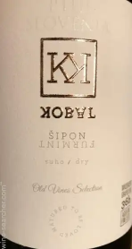 The wine:
- Vintage: 2025
- Grape Variety: 100% Šipon (Slovenian name for Furmint)
- Region/Appellation: Podravje, Haloze/Štajerska sub-region.
- Viticulture: The vineyards spread out over wine-growing sites of Haloze Hills. This Šipon comes from Haloze’s steep slopes, where vines average more than 35 years old in soils dominated by limestone-rich marl. Continental climate, with dry and hot summers, and snowy winters. Organic farming; in conversion to certified .
- Vinification: short cold maceration of roughly 1-3 days to draw extra aromatics and texture from the skins, then ferment and rest on fine lees in stainless steel, with only a light dose of sulfur added at bottling to preserve the wine’s freshness. The grapes of 35 year old vines were harvested manually. After the short skin maceration, the wine was fermented with a combination of indigenous yeasts and select yeasts under controlled cold fermentation between 16°C – 18°C in stainless steel (inox) tanks in order to preserve the varietal aromatics and characteristics. Following fermentation, both wines were matured for 6 months in stainless steel tanks on lees, blended and coarsely fined and filtered before bottling.
- Alcohol: 13% APV
Tasting Notes: Pale straw color with aromas of acacia blossom, wildflowers, and herbal spice, leading to a bright, zippy, mineral-driven palate with a hint of salinity. Furmint in particular reveals the tremendous minerality of Haloze marl-rich vineyards. The bouquet is reminiscent of herbs, white flowers and tropical fruits. Pleasant acidity and minerality on the palate are followed by the discreet creamy aftertaste that is typical of wines matured on lees. For perfect enjoyment within 2 years of bottling. Serve it chilled (6-8°C) with light fish dishes, grilled and steamed vegetables, charcuterie, young cheeses, pasta with white wine sauce, chicken and turkey.
Wine #2. Kobal, Blaufrankisch ‘Roots’, Podravje, Slovenia, 2023
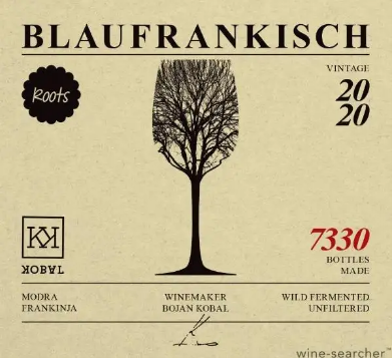 The Wine: The “Roots” line of wines from Kobal represents a deep, emotional commitment to low-intervention winemaking.
- Vintage: 2023
- Grapes: 100% Blaufrankisch (known locally as Modra Frankinja)
- Region/Appellation: Podravje, Stajerska sub-region
- Viticulture: Blaufränkisch thrives on the steep, marl-rich hillsides of Štajerska, which are heavily influenced by cold winds whistling down from the Alps and warm breezes pulling up from the Pannonian Plain.
- Winemaking: Farmed sustainably and hand-harvested from mature vines, the fruit undergoes a spontaneous fermentation with native yeasts and is aged thoughtfully in neutral oak barrels to round out its structure without masking the fruit. The 2023 vintage delivers a vibrant, high-energy red that completely upends the expectation of heavy European varieties, favoring a crunchy, spice-flecked profile that drinks with effortless, bistro-style charm.
Tasting Notes: Blaufrankisch is a dark ruby-colored wine with an aroma which resembles overripened blackberries, chocolate, black mulberries and dried plums. The harmony of fruity aromas is nicely rounded up with wood characteristics both in scent and in flavor, with a moderately long velvet finish. The nose offers crushed blueberry, plum, black raspberry and slight baking spice. It is recommended to allow the wine to decant for up to 45 minutes before consumption. Good pairings are cured and smoked ham, grilled or roasted pork chops, brick-oven pizza, roasted chicken or turkey, grilled chicken salad, grilled burgers and French fries, and any type of game – venison, wild fowl, wild boar, rabbit.
Wine #3. Rodica ‘Refošk Classic’, Istria, Slovenia, 2024
The Producer: Rodica is an organic producer in Truške, in Slovenian Istria. In 1998, Marinko Rodica, a car mechanic by trade, decided to start a new chapter in his life and became a winemaker. Ten years later, the winery had sixty thousand vines and was certified organic. The brand new environmentally friendly and energy efficient wine cellar was completed in 2012. The picturesque hills near Marezige and Truške are located 5 km from the Adriatic Sea, more specifically the Gulf of Trieste. The estate’s vineyards are planted at 250-350 meters asl, terraced, facing South. They enjoy significant day-night temperature swings, constant breezes, which keep the vineyards well-ventilated and naturally healthy for organic farming. Today, Rodica estate organically farms 15 hectares of vineyards, most of them planted with Malvasia and Refošk (Refosco). Refosco grape is technically an ancient group of closely related dark-skinned grape varieties. Their origins – which predate modern-day political borders – include northern Italy’s Friuli-Venezia Giulia, western Slovenia and the Istrian Peninsula of Croatia. It produces dark, densely colored wines with aromas of grass and violets.
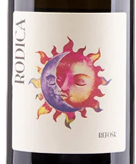 The Wine:
- Vintage: 2024
- Grape: 100% Refošk
- Region/Appellation: Primorska, Slovenian Istria (Slovenska Istra)
- Viticulture: Certified Organic (unirrigated, limestone soil). Every second row of the vineyard is empty and planted with grass. Only natural fertilizer produced from natural manure is allowed. The vineyards are worked without any irrigation. The soil is rich with minerals, consisting predominantly of limestone. The vines are forced to “fight” to get water, which results in better quality grapes. The climate is a mild Mediterranean, with dry and hot summers, and mild winters.
- Winemaking: Seven days of maceration, spontaneous fermentation; aged for 6 months in an oak barrel, 1 year in stainless steel tank. Bottled after 18 months.
- Alcohol: 12% APV.
Winemaker’s notes: Organic Refošk Klasika is of distinct red ruby color with violet shades. On the nose, it surprises us with its herbal (dried grass, hay) and mineral (moist soil) aromas, as well as aromas of fresh and ripe red berries and a hint of spices. In the body, the wine is fresh and elegantly balanced with a noticeable mineral taste and somewhat velvety tannins that hint more pleasant potential of aging. The characteristic acidity of Refošk is harmoniously integrated into the fruity and spicy taste.
Tasting Notes: The wine shows a deep ruby color with violet highlights, layered with warming spice, cracked pepper, and brambly dark fruit, backed by a touch of savory, gamey character that opens with air. Medium-bodied and earthy. It pairs beautifully with Istrian cured meats like pancetta or prosciutto, grilled meats, or tomato-based dishes.
Wine #4. Kobal Penina Rose Brut, Ptuj, Slovenia, NV
The Producer: same as wines #1 and 2.
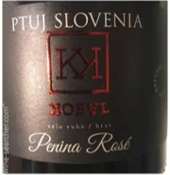 The wine: Penina Rosé Brut Ptuj is a sparkling rosé produced by Kobal Wines from Modra Frankinja, also known internationally as Blaufränkisch. The vineyards are tied to marl-dominant soils and a long viticultural history linked to the Roman and Austro-Hungarian periods; importer material notes many south-facing sites, some reaching 400 meters, and vines averaging more than 35 years, with organic farming at the family estate and work with committed local growers. The cuvée fits Kobal’s work through regional varieties, cold-climate Štajerska sourcing, and a sparkling program built around local grape identity.
- NV
- Grapes: 100% Modra Frankinja (Blaufränkisch)
- Appellation: Podravje, Stajerska Slovenja sub-region
- Viticulture: Blaufränkisch grapes grown on the steep, marl-rich slopes of Haloze. The vines here average several decades in age, and the region is regarded as one of Central Europe’s finer sites for this variety.
- Winemaking: This wine is a Penina, the Slovenian term for a traditional-method sparkling wine. To produce a rosé, the red-skinned Blaufränkisch grapes spend brief contact with their skins before the base wine undergoes secondary fermentation in bottle, building fine, persistent bubbles and a light pink hue.
- Alcohol: 12% APV
Tasting Notes: Pale dried-rose hue with persistent mousse; flavors highlight red berries, toast, baking spices, and a clean, crisp finish. In the glass this Penina shows a pale color reminiscent of dried roses, with a steady, energetic mousse. The nose brings toast and baking spice over cranberry and darker red fruit, while the palate stays dry, with a mineral, stony edge on the finish. The color is a delicate salmon with slight shades of ruby; the bubbles are tiny. The nose and taste are youthful and fruity, reminiscent of small berries, raspberry and wild strawberries. Very dry, medium-bodied, pleasant texture, fine bubbles. Serve it well chilled as an aperitif, or alongside charcuterie, soft cheeses, or roasted poultry.
-
CV Members Rating
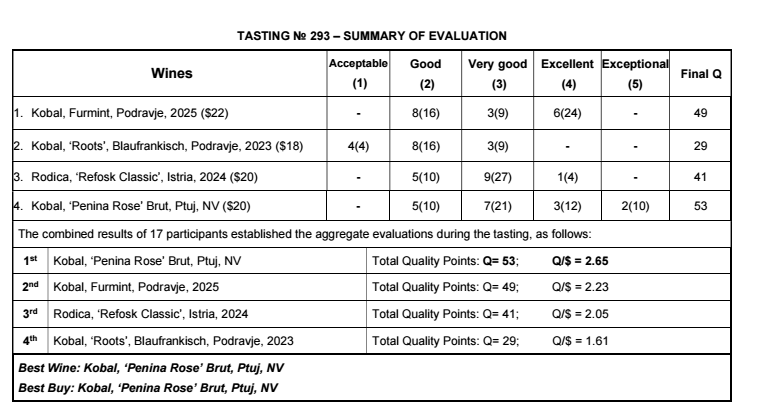
The wine tasting took place before revealing their prices. 17 participants rated the wines tasted individually from Mediocre to Excellent. The combined scores determined the ranking order as shown in the following Table. In the final results, Kobal, ‘Penina Rose’ Brut, Ptuj, NV was the Best wine and Best Buy.
References
https://www.wine-searcher.com/
https://www.cellartracker.com/
https://www.rodica.si/en/wines/
https://www.thinkslovenia.com/
https://vinoteka-sodcek.si/en/
.o0o.
Laughing matter:

.o0o.


