
 Tasting No 291 – July 28, 2026
Wines from Lebanon: An Ancient Legacy Reborn
-
Tasting Overview
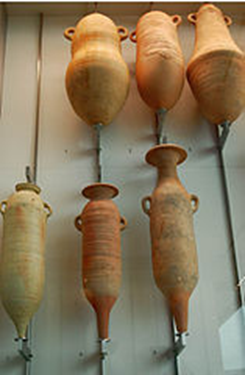
 Lebanon is one of the world’s oldest winegrowing cultures, a place where 7,000 years of viticultural history meet a fiercely modern, resilient, and quality‑driven wine industry. From Phoenician amphorae to high‑altitude organic vineyards, Lebanese wine is a story of continuity, reinvention, and deep connection to land. This tasting aims to explore some of the fine wines produced in Lebanon.
Type of tasting: open
Presenters: Claudia and Agilson Perazza
Participants: TBA
These are the wines:
- Massaya, Blanc Beqaa Valley, 2023
- Massaya, ‘Cap Est Red’, Bekaa Valley, 2018
- Chateau Musar, ‘Hochar Pere et Fils’, Bekaa Valley, 2021
- Chateau Musar, ‘Lebanon Rouge’, Bekaa Valley, 2018.
The Menu
- Arugula and calamari salad
- Agnolotti in pink sauce
- Veal Marsala with potatoes and vegetables
- Dessert, coffee and tea.
-
Brief History of Wine Production in Lebanon
Where Did Wine Come From?
The ancient Egyptians drank wine. Back then, wine was consumed by high society, and beer was the commoner’s drink. The Egyptians got their inspiration from the Levant – a historical-geographical region along the eastern Mediterranean, generally referring to modern-day Syria, Lebanon, Israel, Palestine, Jordan, and often Cyprus -, who had been making wine since 4000 BC. One ancient wine cellar was found in Armenia inside a cave on the side of a hill. The cellar dates back to 3500 BC and shows how ancient winemaking was done.
 Vitis vinifera may have been domesticated in Lebanon, although it probably arrived from the South Caucasus via Mesopotamia or the Black Sea trade routes. The yeast strain crucial to winemaking Saccharomyces cerevisiae may also have originated in Mesopotamia, but a microsatellite-based study also identified a distinct cluster in Lebanon. Wine was cultivated and then domesticated in Lebanon, at least 2000 years before Alexander the Great conquered the Levant in 332 BC.
A 7,000-Year Wine Heritage
The Lebanese wine history dates back more than five millennia. It begins with the Phoenicians, an ancient civilization centered on the coastal cities of Tyre, Sidon, and Byblos in the central coastal strip of the Levant region (modern-day Lebanon, western Syria and northern Israel). Archaeological evidence from Byblos, Tyre, Sidon, and the Bekaa Valley shows that wine was central to daily life, ritual, and commerce. The ancient port of Byblos, just north of the Lebanese capital Beirut, is widely viewed as the world’s oldest continuously inhabited city. It was famous in classical antiquity as a wine center, in terms of both production and trading.
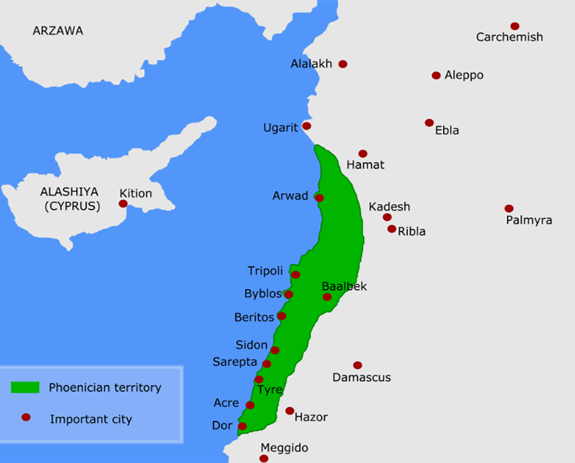 Phoenicians’ strong culture of travel and trade was of considerable importance to the development of early Mediterranean civilization. For more than 1000 years, Phoenician traders consistently extended their influence from their homelands along the north coast of Africa and up into southern Europe – notably Sardinia, Sicily, southern Italy, Greece and Turkey. They traded gold, dyes (including Tyrian purple), metalwork, glass, ceramics and wine. It was this enthusiastic talent for trade and technology that we have to thank for much of Europe’s winemaking history, including the propagation of various members of the Vitis vinifera vine family.
The Romans expanded viticulture dramatically, especially in the Bekaa Valley, where the monumental Temple of Bacchus still stands as one of the world’s most impressive tributes to wine.
This remained the case until the 16th Century, when the Ottoman armies swept southward around the eastern Mediterranean. Wine production and consumption were prohibited under their Sharia law, so the once-thriving wine industry around Byblos, Tyre and Sidon fell silent. Yet, through Ottoman rule, political upheaval, and modern conflict, viticulture never disappeared. Instead, it adapted—quietly maintained by families, monasteries, and later by French‑influenced estates.
Today, Lebanon’s wine industry is a testament to resilience and craftsmanship, producing elegant, terroir‑driven wines that reflect both ancient roots and contemporary ambition.
Modern history of Lebanese winemaking
The modern wine industry here can be traced back to the 19th Century. As non-Muslims living in a Muslim country, Christians living in Lebanon were permitted certain freedoms, one of which was the right to make wine for ceremonial purposes. It was on this basis that, in 1857, a group of Jesuit priests of Taanayel (Tanail), an ancient monastic settlement just down the valley from Ksara, a small town in the Bekaa Valley, the first original winery in Lebanon’s finest wine terroir. Château Ksara had the first vineyard planted in 1857, with Cinsault plants brought from France via the colonies in Algeria.
Château Ksara warrants its own chapter in the annals of Lebanese wine history. The Christian community that founded the original winery effectively founded the modern Lebanese wine industry, and their efforts have been rewarded with the Château’s success as the nation’s largest wine producer. The initial winery was very subdued, and it was not until the French took control of the country after WW1 (under the League of Nations’ French Mandate for Syria and Lebanon) that Bekaa Valley wine production began to expand. Even today, one in every three bottles of Lebanese wine is produced at Ksara. Château Musar and Château Kefraya are among the other notable, long-established wine estates.
The country spent a period under French rule in the early 20th Century, which explains why Lebanon’s wine industry is so closely modeled on its counterpart in France. It is also the reason why Lebanese wineries are described as châteaux and why the national wine authority, the UVL, is the Union Vinicole du Liban.
The wine industry also had to cope with a turbulent period of civil war from 1975 to 1990. As well as causing around 120,000 fatalities, around one million people left the country, and the domestic wine market was decimated. With the end of the conflict, the Beqaa Valley and the wider Lebanese wine industry could at least begin to work towards modernization and expressing its full potential. However, the country has since then had to cope with further challenges such as the spillover of the Syrian War, the explosion at the port of Beirut, civil protests and economic crises, and more recently the ongoing conflict with Israel.
Arak: the Lebanon’s national drink. Arak is an anise liqueur produced in numerous Middle Eastern countries. Its production is thought to date back to at least the 12th Century in Lebanon. It is produced from grape brandy which undergoes a second distillation mixed with aniseeds. It is often served diluted with water or ice, taking on a cloudy appearance.
-
Lebanese Wine Production Today
Wine Industry: location and scale
Modern Lebanese viniculture has moved away from the ancient Phoenician port cities and inland to the fertile Bekaa Valley. There are also a handful of vineyards near Jezzine, a few miles beyond the southern end of the Bekaa, just inland of Sidon. In 2011, roughly six million bottles of Lebanese wine were produced from 2000 hectares (5000 acres) of vineyards. Lebanon’s winemakers produced 15 million bottles in 2024. As of 2025, Lebanon’s wine market generates around US$65M in revenue from at-home sales and US$116M from out-of-home sales, totaling US$180m while at-home revenue is projected to grow annually by 1.06% (CAGR 2025-2029).
Additionally, a growing number of wineries are adopting organic and biodynamic farming methods. Christian Maronite monks introduced the country’s first certified organic wine, labeled Adyar—meaning “monasteries” in Arabic—which has recently caught the attention of connoisseurs with bottles emblazoned with a cross.
The majority of Lebanese wine is exported to the UK, France and the US, where the receptive consumer bases have encouraged healthy growth in Lebanon’s modern wine industry. In 1998, there were fewer than 10 wineries in Lebanon; now there are more than 50.
Despite economic challenges, the wine industry is more dynamic than ever: Organic and sustainable farming is expanding, especially in high altitude vineyards; micro terroir expression is a growing focus, with wineries farming parcels across multiple elevations; modern winemaking blends French influence with local tradition; indigenous grapes are being revived and championed, while family-run estates remain the backbone of the industry. The result is a wine scene that is vibrant, diverse, and internationally respected, producing everything from robust, Bordeaux‑style reds to fresh whites and elegant rosés. Gilbert & Gaillard.
Grape Varieties
Red wines account for most of the output (almost 70%) in the form of red blends made from the classic wine grapes of southern France. White wines account for less than 14% of production. The original Bekaa Valley vineyards were planted with Cinsault, which was subsequently joined by other French varieties. Most of these remain in Lebanon’s vinicultural makeup today: Carignan, Grenache, Syrah, Mourvèdre, Cabernet Sauvignon and Merlot, among the red grapes, and Ugni Blanc, Clairette and Chardonnay white varieties. Cinsault, though not indigenous, has become deeply rooted in Lebanese viticulture, producing fresh, red‑fruited wines and forming the backbone of many blends.
Lebanon does not have native red varieties but do have white indigenous grapes – Obaideh (also written as Obeidi), Merwah (Marwah) and Youssefi grape varieties. Obeideh is a historic white grape believed by some researchers to be related to ancient Levantine cultivars. It is high in sugar and low in acidity, producing full‑bodied whites with stone‑fruit notes, honeyed depth, and a mineral backbone, often oak‑aged. Merwah is a high‑altitude white variety with aromatic lift and complexity. It is valued for its disease resistance and ability to produce wines with vibrant acidity and fruity flavors, specifically subtle citrus and nutty notes. Traditionally used in arak, it is now vinified as a premium still wine, especially from old vines in mountainous sites. More recently, winemakers are increasingly focused on rediscovering and experimenting with other lesser-known native grape varieties, such as the white grapes Tfeifihi, and Zeini, and the red varieties Meksassi, Mourad, and Soubbagh.
Wine Regions
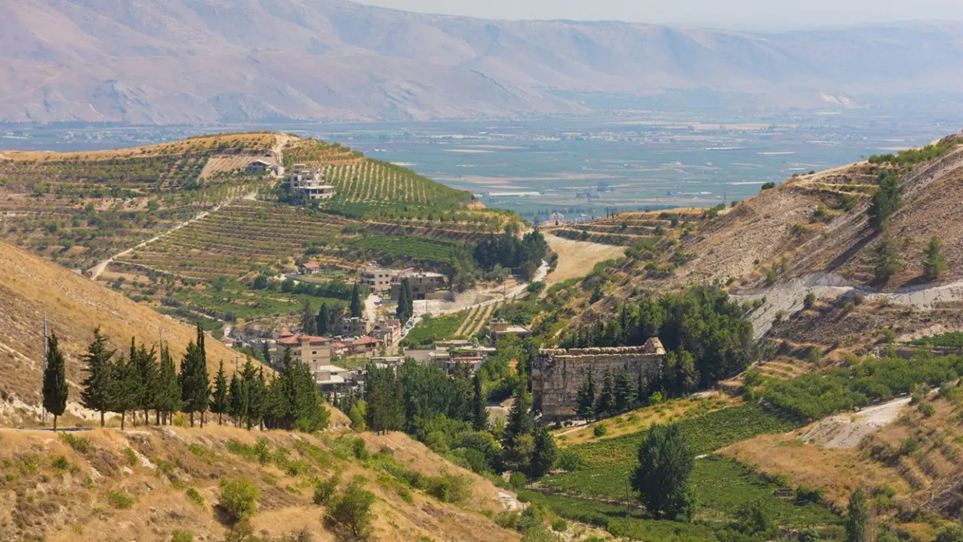
Lebanon’s geography is dramatic: two mountain ranges, a fertile central valley, and vineyards planted at some of the highest elevations in the Northern Hemisphere. This creates a mosaic of microclimates and terroirs.
Bekaa Valley (or Beqaa Valley) —The heart of the Lebanese wine
A high plain nestled between two mountain ranges, he Bekaa is the heartland of modern Lebanese wine. Almost 90 percent of Lebanon’s wine is made here, as is a respectable proportion of its Arak.
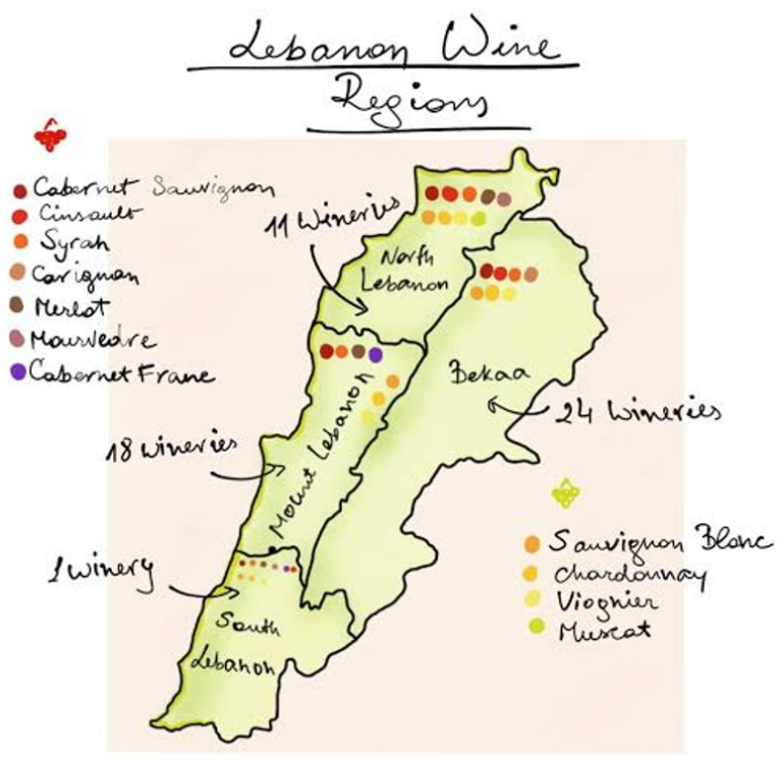 Since Biblical times, the Bekaa Valley has been prized for its soil, climate, and vines, supplying wine to the Phoenicians, Persians, and Roman army. The valley’s conditions remain ideal for vines today: rich soils, protected slopes and valleys, almost year-round sunshine, high altitude with no summer rainfall, guaranteed harvest start dates, and minimal risk of disease.
The long, narrow valley is a high-altitude (1,000m / 3000ft) oasis of agriculture and viticulture that runs north-south for around 65 km (40 miles) between the Mount Lebanon to the west and Anti-Lebanon mountains to the east. The mountains are the key factor in the terroir here. They protect the deserts to the east and the maritime rains to the west. The vineyards benefit from the rain shadow cast by Mount Lebanon (which is a 150-kilometer mountain range).
Moving west, vineyards climb the slopes of Mount Lebanon and the Chouf, an emerging high-altitude terroir, where cooler temperatures and coastal influences shape a different style of wine. These areas are characterized by small-scale terraced vineyards, organic and sustainable practices and boutique producers focused on terroir expression.
The new frontier are Batroun Mountains, a small wine region in northern Lebanon that is home to some of the most innovative vineyards. At very high altitudes (up to 1,800 m), vineyards are spread among the various towns in the mountains which overlook the coastal city of Batroun. International red grape varieties grown here include Cabernet Sauvignon, Merlot, Syrah and Cabernet Franc. White counterparts include Chardonnay, Riesling, Sauvignon Blanc and Muscat Hamburg (Muskat Trollinger).
Local specialties include the Batroun city, one of the oldest cities in the world, founded by the Phoenicians. It is thought to be the “Batruna” documented in the Amarna letters, which date back to the 14th Century BC. It was an important Roman site, was home to a Crusader citadel, and an administrative center in the Ottoman Empire.
-
Information on the Wines
The Wineries:
Massaya Winery is located in the northeast of the Bekaa Valley, in the hills of eastern Lebanon. It is one of Lebanon’s most prominent wine producers, making wines from classic French varieties. The Massaya estate was revived in the 1990s, following Lebanon’s long civil war. The winery, cellars and vineyards were rebuilt and repaired with help and inspiration from France – specifically from winemakers Dominique Hébrard and Hubert de Boüard of Bordeaux, and Daniel Brunier of Domaine du Vieux Télégraphe in the Rhône Valley. Together, the Hébrard and Brunier families own 30 percent of Massaya with the remaining share retained by the Ghosn family.
Massaya has two wineries. The main site in Tanaïl, some 50km east of Beirut, produces red wines and arak, while a higher-altitude site Faqra in Ouyoun el Simane, 50km north of Tanaïl (and close to the ski resorts of Mzaar and Faqra), is given over to white wine and rosé production.
The Massaya’s Tanaïl main estate is less than an hour’s drive from Baalbeck. With such a large spectrum of terroirs, it took the producers around 10 years of experimentation to find the inspiration now expressing in the single vineyard labels, choosing carefully the spots for their vines to capitalize on the Beqaa’s favorable terroir in light of climate change. In the area around Ras Baalbeck to the north-east, where the two mountain ranges recline, Grenache noir and Mourvèdre thrive in the harsh environment with stony soil, daily wind, extreme temperature changes. These grapes are used primarily in the Cap Est label.
The Obeïdi grapes that give character to Massaya Blanc and Massaya Arak are grown by farmers in the northern part of the Beqaa.
The house makes a range of wines, where Classic encompasses Assaya’s entry level, and with Silver or Gold labels denoting reserve-level wines.
Chateau Musar is a renowned wine producer based in Ghazir, Lebanon, just north of the capital Beirut, producing a range of wines from vineyards in the Bekaa Valley, and best-known for its eponymous grand vin: Chateau Musar. Gaston Hochar set up the vinery in 1930 after traveling through Bordeaux, and today the old vineyards are planted to Cabernet Sauvignon, Cinsault, Carignan and indigenous Lebanese grapes Obaideh and Merwah.
In 1959, Hochar’s son Serge took control of the vineyards, having returned from Bordeaux where he was studying enology. The vineyard suffered during the Lebanese Civil War (two vintages were lost or damaged). His efforts to produce and promote his wine during this period – with shells falling around the winery and execution squads setting up roadblocks – made Serge Hochar a major figure in the global wine trade. He was celebrated as the inaugural Decanter Magazine Man of The Year in 1984.
After the civil war Hochar began to look beyond the domestic market. The wine began to gain recognition after Michael Broadbent MW wrote about it in Decanter magazine in 1979 and by the time the war ended in 1990 just a small fraction of Chateau Musar’s production was sold locally.
Musar’s flagship Chateau Musar Red wine, made from a blend of Cabernet Sauvignon and Cinsault, is the most important wine made in Lebanon, from vineyards near the Bekaa Valley villages of Aana and Kefraya on gravelly soils over limestone. Planted from the 1930s onwards, yields are low from these mature bush vines (average age: 40 years) – between 15 to 35hl per hectare. It is fermented in concrete, aged for one year in French oak and then rested in the Musar cellars for at least three years before release – sometimes many more. It is famous for its great (intentional) vintage variation and is highly collectable.
The Hochar Pere et Fils is the estate’s second wine, made from Cabernet Sauvignon, Cinsault, Grenache and Carignan and aged in oak. In its top tier, Chateau Musar also makes a small amount of white wine from Obaideh and Merwah (thought to be related respectively to Chardonnay and Semillon) from high-altitude vineyards in the Beqaa Valley. These are aged in oak barrel, and like the red wine, spend time in bottle before being released. Chateau Musar also produces an arak.
International recognition: In addition to receiving high scores from critics like Robert Parker and Wine Spectator, Chateau Musar achieved international recognition at the Bristol Wine Fair of 1979 and for a long time was the only Lebanese wine widely available in the United Kingdom. Château Musar was ranked among the Top 100 Wineries of 2022 by Wine & Spirits.
Wine #1 – Massaya, Blanc Beqaa Valley, 2023
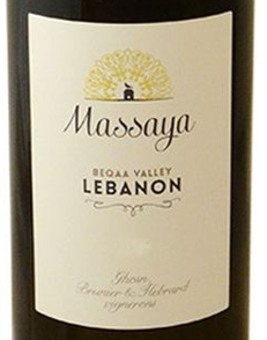
- Vintage: 2023
- Composition: 70% Sauvignon Blanc, 30% Obeïdi;
- Viticulture: Grapes grown on chalky clay soils at the foothills of the Mount Lebanon mountain range between 1,200-1,600 meters above sea level; vines averaging 20 years in age; hand harvested into crates;
- Vinification: conducted at the Faqra winery, direct pressing with a pneumatic press and fermented in 30hL foudres and demi-muids;
- Aging: Aged on the lees for about 8 months;
- 5-13% APV %
Winemaker notes: A well-balanced white with white flower scents, packed with fruit and freshness. It combines depth, roundness, crispiness and a middle-eastern twinkle thanks to the local Obeïdi.
Wine #2 – Massaya, ‘Cap Est Red’, Bekaa Valley, 2018
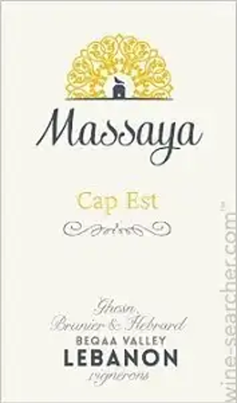
- Vintage: 2018
- Composition: 50% Grenache, 50% Mourvèdre;
- Viticulture: grapes grown on the hillsides of the north-easterly portion of the Beqaa Valley, in Chalky clay soils, at an altitude of 1 200 meters, in the Ras Baalbeck area. An arid and continental environment, where Mount Lebanon and the Anti-Lebanon mountain ranges meet; vines are 18 years old on average;
- Vinification: conducted at our Tanaïl winery; grapes are hand-picked, conveyed in crates, and sorted on tables. They are fully destemmed, then vinified for at least 30 days in temperature controlled oak vats.
- Aging: 22 months in oak vats. Bottled without fining or filtering at 2 years.
Winemaker notes: an elegant distinctive pale ruby wine with a nose that subtly blends violets and ripe red berry fruits leading to a progressive body and a compelling minerality. Seductive velvety elegance overlays an attractive weave of fine tannins, highlighting the minerality of the terroir. Suitable for ageing.
Tasting notes: “Medium carmine-garnet colour, ochre reflections, broad edge brightening. Fresh plums, delicate hint of liquorice, subtle wood savouriness, candied mandarin zest, inviting bouquet. Juicy, fruity sweetness, a hint of figs, ripe tannins, mineral and well adhering, already developed and drinkable.”(Falstaff).
Pairs well with rabbit casseroles, slow cooked lamb and sausages with mashed potatoes.
Wine #3 – Chateau Musar, ‘Hochar Pere et Fils’, Bekaa Valley, 2021
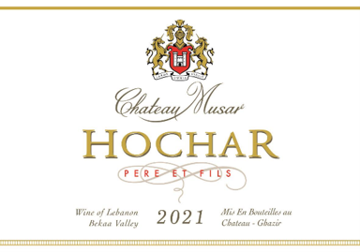
- Vintage: 2021
- Composition: Cinsault 50%; Grenache 40%; C. Sauvignon 10%
- Viticulture: grapes sourced from a single vineyard near the Bekaa Valley village of Aana, characterized by deep soils over limestone. At an average age of 30 years old, yields are low from these mature bush vines at 20-30 hl per hectare;
- Vinification: the three varietal components are fermented in cement vats,
- Aging: 6 to 9 months in French oak barrels (from the forest of Nevers) before blending and bottling (unfined and unfiltered). As with the Chateau Musar Red, the wines are blended to reflect the character of each vintage;
- 5% ABV
Winemaker notes: Dark ruby in color with cherry fruit, sweet spices and a smokiness on the nose. Cherries and blackcurrant follow through to the palate with a hint of rose (from the Grenache of this year). It is an elegant vintage with a long future ahead, from a year with no climatic extremes – from winter pruning to the September harvest. This wine is an ideal choice for casseroles, roasted meats, tuna steaks and Mediterranean dishes.
Wine #4 – Chateau Musar, ‘Lebanon Rouge’, Bekaa Valley, 2018
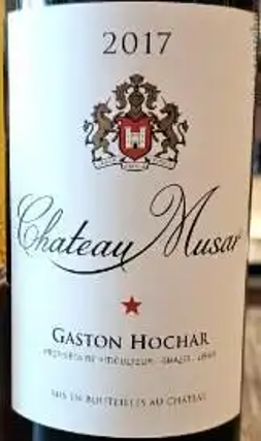
- Vintage: 2018
- Composition: equal blend of Cabernet Sauvignon, Carignan and Cinsault;
- Viticulture: grapes are from vineyards near the Bekaa Valley villages of Aana and Kefraya on gravelly soils over limestone. Planted from the 1930s onwards, yields are low from these mature bush vines (average age: 40 years): Between 15 to 35hl per hectare.
- Vinification: each varietal components in Chateau Musar Red undergo lengthy fermentation with their natural yeasts, in cement vats at temperatures below 30°C , for 6 months;
- Aging: aged for 12 months in French Nevers oak barrels before blending in January 2021; the resulting blend is then placed back in cement tanks before being bottled, without fining or filtration, in August 2021.
- 14% ABV
Winemaker notes: released in the spring 2024, the 2018 vintage has a deep garnet colour in the glass with dried cherries and mature red fruits on the nose. The palate is rich and concentrated with cranberries, raisins, and dates; there is good acidity with fine tannins. It has an enticing smoky, dusty fruit with soft liquorice undertones and at 6 years of age upon release, it is already developed and mature.
Tasting notes: “Musar’s typical blend of Cabernet Sauvignon, Cinsault and Carignan, aged six years before release. I thought this was a fabulous young Musar, brimming with aroma and flavor already which is quite primary in character, so there is surely more to come with cellaring. Plush with cranberry and ripe, rich blackcurrant, a hint of mint in there too. Such sweet and mouth-filling fruit, caressing the tongue with medium-bodied and quite silky texture, hints of earth and smoky minerals, but really all about smooth and plush flavors over moderate tannin and particularly juicy acidity. A fine rendition of this classic in a relatively forward style, but it will age”. (Tom Cannavan, 2025).
Pairings: Moroccan-style lamb tangine; roasted game bird.
References:
https://en.wikipedia.org/wiki/Lebanese_wine
https://cluboenologique.com/story/chateau-musar-in-the-war-years-a-vintage-report-with-a-difference/
https://www.mustseespots.com/lebanon/articles/lebanese-wine-regions-a-guide-to-vineyards-tastings/
https://www.voyageursduvin.com/en/guide-lebanon
https://www.wine-searcher.com/regions-lebanon
https://chateaumusar.com/wines/chateau-musar-red/
https://chateaumusar.com/wines/hochar-pere-et-fils-red/
- CV Members Rating (after the tasting)
.o0o.
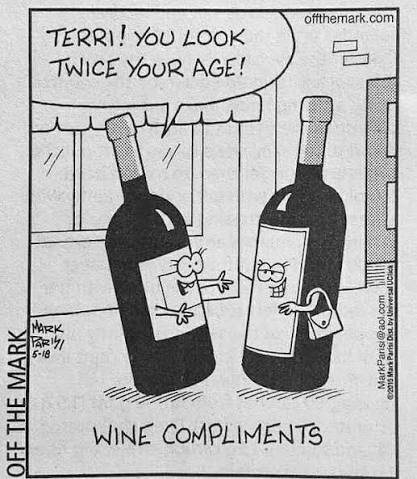
Laughter is strong medicine:
.o0o.


