
Croatian Wines: Origins, Regions, Grapes, and the Character of a Rising Wine Nation
Tasting No 292 – August 25, 2026

-
Tasting Overview
Croatia’s winemaking tradition stretches back more than 2,500 years, beginning with the ancient Greeks who planted vines on the Dalmatian islands and later expanded by the Romans. Despite its long heritage, Croatian wine remained relatively unknown internationally until the 1990s, when independence opened the door for modernization, investment, and global export. Today, Croatia stands as one of Europe’s most exciting emerging wine countries, combining indigenous grapes, dramatic coastal terroirs, and a mosaic of microclimates that produce wines of remarkable diversity.

Type of tasting: open
Presenters: Jorge Requena and José Brakarz
Participants: M. Averbug; J. Brakarz; J. Claro; Y. Cutler; C. Estrada; M. Fryer; J. García; E. and N. Gochicoa; R. Gutierrez; N. Marzella; J. and L. Redwood; J. Requena; C. Santelices; R. Santiago; E. Silva; G.
Smart; P. Turina; L. Uechi and G. Zincke.
These are the wines:
- Saints Hills Mala Nevina, 2024
- Bibich Babić, 2016
- Zlatan Plavac Hvar, 2021
- Fakin ‘Il Primo’, Teran, 2019
The Menu
- Insalata caprese
- Risoto de Fungi
- Lamb chops with roasted potatoes
- Dessert, coffee or tea.
-
History of Croatian Wine
Ancient Beginnings (5th Century B.C.): Formal viticulture took off when Ancient Greek settlers colonized the southern Dalmatian islands, including Vis (Issa), Hvar (Pharos), and Korčula. Coins minted on the island of Vis during this period featured grape clusters and amphorae.
Roman Expansion (1st–4th Century AD): As the Romans took over the region, they organized and industrialized winemaking. The Roman Emperor Marcus Aurelius Probus is famously credited with introducing and expanding grape cultivation into the fertile, continental inland regions around the Danube.
The Middle Ages: Monastic Influence: Similar to the rest of Western Europe, Catholic monasteries played a crucial role during periods of regional instability (and later under Ottoman pressure elsewhere), preserving winemaking knowledge for religious sacraments. Monks in local monasteries protected the vines when wars happened. This kept local, native grapes alive. Many of these unique grapes still grow today.
The Phylloxera Crisis (Late 1800s): In the 18th century, much of present-day Croatia came under control of the Habsburg Empire, where wine production flourished through the 19th and 20th centuries. The history of wine changed dramatically in 1874, when phylloxera started to appear in Europe. Wine production dropped, first in France and Germany, as growers struggled with the blight. For a while Croatian vineyards remained unaffected, and wine exports greatly increased to fill the demand. French companies even planted vines in Croatia with a view to expanding operations in the safe area. However, by the next century, Croatian vines had also succumbed to phylloxera, leading to the destruction of the vineyards and the collapse of the local economy in many areas. Winemakers had to replant using new roots. Scientists later proved that grape cuttings sent from Croatia to America during this time became the famous Zinfandel grape (!!).
The Yugoslav Era: Under the communist system of Yugoslavia, wine production became centered in large cooperatives, and private ownership of vineyards was discouraged. Quantity rather than quality became the main focus. The Croatian War of Independence in the early 1990s saw many vineyards and wineries once again destroyed.
The Modern Renaissance – Independence and Modernization: Following the Croatian War of Independence in the early 1990s, the country rebuilt its wine industry. A new generation of boutique, family-owned wineries emerged, adopting modern temperature-controlled stainless-steel methods alongside traditional oak and clay amphora techniques. It has now over 130 Indigenous Varieties: Croatia turned its focus back to its rich biodiversity, reviving over 130 autochthonous (indigenous) grape varieties. With the move back to small, independent producers, Croatian wines are once again competing with wine makers across the world. Small family farmers took back their land. They focused on growing local, native grapes. Today, Croatia makes over 40 native commercial wines.
-
Major Wine Regions
 Croatia is a Mediterranean country, lying to the east of Italy, across the Adriatic Sea. Towards the north lie the Alps, and to the north-east the country forms the western end of the great Pannonian Plain.
There are two distinct wine-producing regions in Croatia. The continental region in the north-east of the country produces rich fruity white wines, similar in style to the neighboring areas of Slovenia, Austria and Hungary. On the north coast, Istrian wines are similar to those produced in neighbouring Italy, while further south production is more towards big Mediterranean-style reds. On the islands and the Dalmatian coast, local grape varieties, microclimates and the rather harsh nature of the vineyards leads to some highly individual wines, and some of Croatia’s best known.
Continental Croatia (Inland): the interior of Croatia has a continental climate, with cold winters, and hot summers with enough rain to make it a major agricultural area. Winegrowing is concentrated in the hilly areas bordering on the Pannonian Plain. The climate is cooler, with influences from Central Europe. This region includes Slavonia, Hrvatsko Zagorje, Međimurje, and Plešivica. The key subregions are:
-
- Slavonia: Famous for Graševina and oak forests used for aging barrels.
- Plešivica: Croatia’s “Champagne region,” known for high-quality sparkling wines.
Wine Style: Fresh, aromatic whites; elegant, lighter reds; sparkling wines.
Coastal Croatia (Adriatic): this region includes Istria, Kvarner, and Dalmatia. The Dalmatian Coast is typically Mediterranean in climate, though the Dinaric Alps mountain range creates pockets of alpine climate at higher altitudes. The coastline of the Adriatic Sea is ideal for grape cultivation with its hot, humid summers and mild winters. Further down the coast, and on the islands, grapes are grown on the karst hillside, sometimes steep slopes with little rainfall. Some of the best-known wine-production areas are on the Dalmatian islands. Located along hillsides and slopes, wine regions along the coast receive many hours of sunlight, ideal for grape production. Key subregions include:
-
- Istria: Often compared to Tuscany; home of Malvazija Istarska.
- Dalmatia: Rugged vineyards producing Plavac Mali and other ancient grapes.
Wine Style: Full-bodied reds, mineral-driven whites, and powerful dessert wines.
-
Main grape varietals
Croatia’s greatest strength is its indigenous varieties, many of which are found nowhere else in the world.
Croatia produces roughly 600–700 million liters of wine per year, placing it among Europe’s mid-sized producers. About 65% of production is white wine, reflecting the strength of continental regions. The remaining 35% is red, dominated by Plavac Mali and other Dalmatian varieties.
Most Croatian wineries are small, family-owned estates, often working steep, terraced vineyards that require manual labor. This artisanal approach results in limited quantities but high quality, with increasing attention from international critics.
Croatian Whites
- Main White Grapes: Popular white grapes include Malvazija Istriana and Pošip. Graševina is the most widely planted white grape.
- Dominant styles: Dry, crisp, fruity and aromatic (green apple notes), mineral. When aged in oak or acacia wood develops richer texture, nutty depth, and honeyed spic
- Typical profile: Fresh acidity, citrus, orchard fruit, floral notes.
Croatian Reds
- Main Red Grapes: Plavac Mali is the main red grape. It is used to make strong, premium red wines like Dingač and Postup. Also prominent, the Teran and Babić grapes are highly regarded native red grape varieties in Croatia (included in our selection), though they make up smaller shares (about 4%) of the country’s total. Teran wine is considered as one of the highest quality red wines on the market, having rich and robust character. The wine is known for its persistency and slightly higher acidity than other similar wines. Babić is a signature Croatian red grape variety celebrated for producing deeply colored, full-bodied wines with a distinct Mediterranean character.
- Dominant styles: Full-bodied, structured, Mediterranean
- Typical profile: Dark berries, plum, spice, herbal notes, firm tannins
In conclusion, Croatia’s wine identity is defined by its ancient origins, indigenous grapes, and dramatic terroirs stretching from continental plains to sun-drenched Adriatic islands. With rising global recognition, Croatian wines offer a compelling blend of tradition and innovation. Whether tasting a crisp Graševina from Slavonia, a mineral Malvazija from Istria, or a powerful Plavac Mali from Dalmatia, the country’s wines reflect a unique cultural and geographic tapestry that is increasingly capturing the attention of wine lovers worldwide.
-
Information on the Wines
Wine #1. Saints Hills, Mala, Nevina, 2024
 – The Producer: Saints Hills Winery is a premium estate founded in 2006 by husband-and-wife team Ernest and Ivana Tolj. It is located in the heart of the Pelješac Peninsula. The name “Saints Hills” and its underlying vineyard sites reflect a family narrative: the estate’s primary vineyards are named not strictly after traditional saints, but after three of the family’s children: Sv. Lucia (in Dingač), Sv. Roko (in Komarna), and Sv. Ante (located further north in Istria).
– The wine:
- Vintage: 2024
- Composition: 72% Malvazija Istriana, 28% Chardonnay
- Region/Appellation: Istria
- Viticulture: Grapes are grown exclusively in the Ante (St. Anthony) vineyard, located in the village of Radovani. The vineyard is characterized by red limestone soil. The vines benefit from full southern sun exposure balanced by constant maritime airstreams. These sea breezes cause massive temperature shifts between day and night, slowing down grape ripening so the fruit can retain its natural acidity and freshness. all grapes are entirely hand-picked at peak maturity, then immediately cooled to 5°C before undergoing secondary sorting on tables.
- Winemaking and aging: fermented in egg-shaped concrete vats and big wooden vats (32hl); aged 6–9 months in concrete and wood vats, plus 10% in new French oak barriques.
- Alcohol: 12% APV.
Tasting notes: Croatian Malvazija Istarska is the flagship white grape of the Istrian Peninsula, known for producing straw-yellow wines with aromas of acacia flowers, stone fruits, and a distinct, refreshing mineral finish. Palate is dominated by citrus aromas of green apple and peach. Pale yellow in the glass, this wine has a bouquet of caramelized pineapple, orange blossom and a hint of butterscotch. Pineapple transitions to the palate, where it is joined by vanilla bean and white peach flavors with a hint of honeysuckle set into a well-textured wine with touches of white chocolate and lemon zest on the finish
Wine #2. Bibich, Babić, 2016
 – The Producer: Bibich Winery is located in the small village of Plastovo near the coastal town of Skradin, Croatia, is widely recognized as one of the most innovative and culturally significant boutique estates in the Balkans. While the Bibić family’s winemaking lineage in Dalmatia stretches back over 500 years to the late 1400s, its modern chapter is rooted in sheer resilience. During the 1990s Croatian War of Independence, the family’s original estate, ancient wine cellars, and grandfather’s vineyards were entirely decimated. Returning to the war-torn landscape in 1995 with no electricity or running water, winemaker Alen Bibić built the entire operation back up from scratch, reclaiming old vineyards and releasing his first commercial vintage in 1998.
– The Wine:
- Vintage: 2016
- Composition: 100% Babić
- Region/Appellation: Sjeverna Dalmacija (North Dalmatia).
- Viticulture: vineyards are carved out of highly porous limestone bedrocks at a higher elevation. This geography results in dramatic temperature drops at night, allowing the grapes to retain a vibrant, refreshing acidity that balances Babić’s naturally high sugar potential. The vines are managed through aggressive winter pruning and green harvesting, forcing low yields per vine to concentrate sugars, tannins, and complex anthocyanins. Grapes are selected and harvested by hand.
- Winemaking: after fermentation the wine is matured for 12 months in French oak barrels
- Alcohol: 15% APV.
Tasting Notes: Color: deep garnet-red with intense violet reflections. Aroma: Complex nose driven by dark fruit (purple plum, black cherry, dried fig), interwoven with notes of cocoa powder, licorice, candied violets, and a distinct, fine touch of tobacco and mesquite smoke. Palate: Elegant, and heavy-bodied but balanced by a lively, refreshing thread of Mediterranean acidity. It presents downy, well-integrated tannins alongside hints of clove, iron, mint tea, and a subtle stony minerality on a long finish.
Wine #3: Zlatan, ‘Plavac’, Hvar, 2021
 – The Producer: Zlatan Otok (which translates to “Golden Island”) is one of Croatia’s most legendary and highly decorated wineries. Its history is deeply intertwined with the rebirth of modern, independent Croatian winemaking. The winery was started on the Island of Hvar, in 1986, by Zlatan Plenković, a poor local fisherman with no formal enological training. He initially built a modest seaside guesthouse and crafted small batches of rustic wine for his guests. In 1991, following Croatia’s declaration of independence, Zlatan Otok became only the second private winery established in the country, breaking away from the state-controlled cooperative system of the former Yugoslavia. Zlatan Otok has grown to become one of the country’s most prominent premium producers. The estate now manages and sources grapes from over 120 hectares of vineyards spread across unique coastal terroirs.
– The Wine:
- Vintage: 2021
- Composition: 100% Plavac Mali.
- Region/appellation: Island of Hvar, Dalmacija
- Viticulture: grapes are grown on steep southern slopes (35% to 45% inclines) of Hvar Island (particularly around the micro-locality of Sveta Nedjelja), using 100% manual labor and hand-harvesting.
- Vinification: 8 to 14 days of skin maceration in stainless steel tanks, followed by controlled fermentation using native/natural yeasts.
- Aging: 12 months in large, traditional Slavonian and fresh oak barrels (4,000 to 8,000 liters), coarsely fined, and bottled unfiltered to retain its raw character.
Alcohol: 14 % ABV.
Tasting Notes: Color: deep, dark ruby; aromas: rich and highly layered. It features prominent notes of dark fruits like blueberries and plums, interwoven with baking spices, Dalmatian herbs, and a subtle hint of hay. Palate: complex and powerful. It is characterized by well-defined, accented tannins, balanced freshness, and a distinct sea-salt minerality. Long and persistent finish.
Wine #4: Fakin, ‘Il Primo’ Teran, Istria, 2019
 – The Producer: The Fakin Winery has meticulously cultivated its love for winemaking over the years. Their unwavering commitment, coupled with the unique Motovun soil (marl, sandstone, and limestone), a favorable climate blessed with abundant sunshine and refreshing winds, and an unparalleled understanding of their grapes, ensures the creation of exceptional wines of the highest quality. Teran is the most important red grape variety in the Istrian region.
The Wine
- Vintage: 2019
- Composition: 100% Teran
- Region/appellation: Istria
- Vineyard: “Flaminio” single vineyard
- Viticulture: The viticulture relies on old vines, unique microclimates, and distinctive soil structures around the medieval hilltop town of Motovun, Istria. The vines used for this vintage were originally planted in 1972, yielding small amounts of deeply concentrated fruit.
- Vinification: Selection of the best grapes harvested by hand at the start of October. Maceration and fermentation for 21 days
- Aging: 24 months in new oak barrels
- Alcohol: 14,0 % APV.
Members opinions:
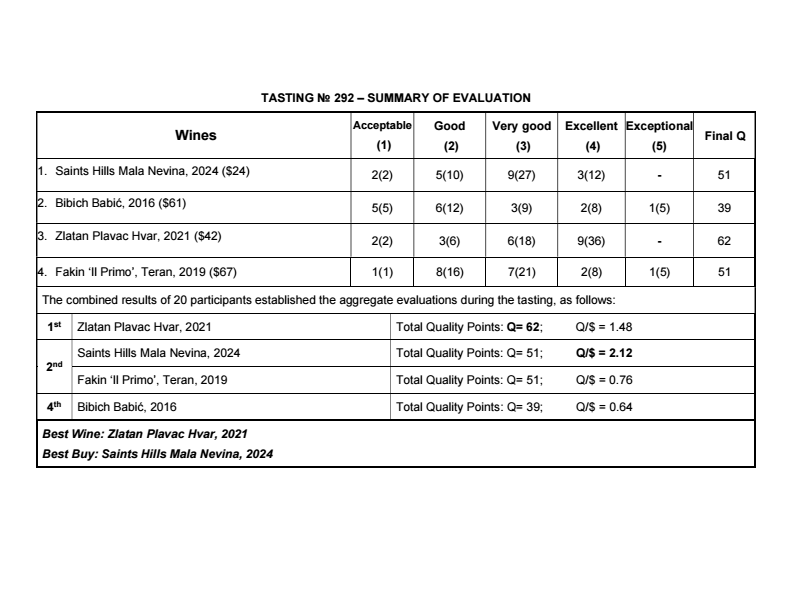
The wine tasting took place before revealing their prices. 20 participants rated the wines tasted individually from Mediocre to Excellent. The combined scores determined the ranking order as shown in the following Table. In the final results, Zlatan Plavac Hvar, 2021 was the Best wine and Saints Hills Mala Nevina, 2024 was the Best Buy.
References:
https://en.wikipedia.org/wiki/Croatian_wine
https://gocroatiasail.com/go-croatia-sail-wine-culture-in-croatia
https://visiteurope.com/experiences/croatias-growing-wine-scene
https://fakinwines.com/en/fakin-single-vineyard/
https://bibich.co/wines/babic/
.o0o.
Laughing matter:
.o0o.


