Tasting No. 160 – October 27, 2014 – Minor Varieties from Spain – Capri Restaurant – McLean VA

Club del Vino


 1. Presenter and Participants

Wines presenters: Jorge García, Italo Mirkow

Participants:

Mario Aguilar, Marcello Averburg,  Hugo Benito, Rolando Castañeda,  Juan Luis Colaiacovo,  Ruth Connoly, Clara Estrada,  Jorge Garcia-Garcia, Emilio Labrada, Orlando Mason, Pedro Turina, Raúl Sanguinetti,  Ricardo Zavaleta.

Type of Tasting: Open

2. Wines Information Abstract

This tasting aims at exploring Spain’s varieties less known that the traditional Tempranillo and its clones.  The presenters choose wines made of Monastrell, Garnacha and Carignan. The wines selected are:

  1. Cava Rondel
  2. Tesoro de Bullas Seleción 2008 – Tinto
  3. Cellers Baronia del Monsant Englora 2008 – Tinto
 

3. Menu

  1. Ensalada de calamri
  2. Rvioli de ternera en salsa marinara
  3. Filet mignon con papas rostisada y vegetales
  4. Postre y café

4. Wines Information

(La información que se suministra a continuación proviene principalmente de Wikipedia y de Wine-searcher.com).

Cava Rondel
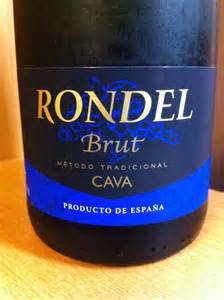
Cava RondelCava is a Spanish sparkling wine made in the traditional method of the French sparkling wine Champagne. The definition of Cava is Vino Espumoso de Calidad Producido en una Región Determinada (VECPRD). It originated in the Catalonia region at the Codorníu Winery in the late 19th century. The wine was originally known as Champaña until Spanish producers officially adopted the term “Cava” (cellar) in 1970 in reference to the underground cellars in which the wines ferment and age in the bottle. The early Cava industry was nurtured by the phylloxera epidemic of the late 19th century, which caused the destruction and uprooting of vineyards planted with red grape varieties. Inspired by the success of Champagne, Codorníu and others encouraged vineyard owners to replant with white grape varieties like Macabeo, Parellada and Xarel·lo to use for sparkling wine production. These grapes are still the primary grapes of Cava today though some producers are experimenting with the use of the Champagne wine grapes of Chardonnay and Pinot noir.[10]

For most of its existence, the production of Cava was not regulated to a particular region of DO but rather to the grapes and method of production. Upon Spain’s acceptance into the European Union in 1986, efforts were undertaken to designate specific areas for Cava production. Today use of the term “Cava” is restricted to production around select municipalities in Catalonia, Aragon, Castile and León, Valencia, Extremadura, Navarra, Basque Country and Rioja. Around 95% of Spain’s total Cava production is from Catalonia, with the village of Sant Sadurní d’Anoia being home to many of Spain’s largest production houses.

Tesoro de Bullas Seleccion 2008 – Monastrell

Tesoro de BullasWine: 2008 Bodegas Del Rosario Bullas Tesoro Selección Bullas

Region: Bullas, Murcia, Spain

Grape Varieties: Monastrell (Mourvedre) 75%, Syrah 25%

Wino4Life Category: Everyday Wine

Aeration before tasting: Just a swirl or two, no special aeration.

Bullas in Murcia Province

(taken from Wine-Searcher)

Bullas is a DO (Denominación de Origen) wine region in the southern part of the Murcia province in south-eastern Spain. This location makes Bullas the southernmost DO wine zone in the Levante (the traditional, collective name for Murcia its northern neighbor, Valencia).The Bullas DO title was created in 1994, and is managed by its own Consejo Regulador (wine authority). It’s named for the small, ancient town of that name, located at the heart of official Bullas viticultural area. Although the area only gained n official DO title relatively recently, it has a long history of winemaking. It is best-known for its rosé and red wines, particularly those made in the fresh, vibrant joven style.

Bullas has a similar climate to Murcia’s other wine regions, with the Mediterranean effects marginalized by the hot, dry conditions of the central Iberian plateau. Summer days tend to be very hot, with temperatures regularly rising to 104°F (40°C). Higher-altitude vineyards in the region’s hilly north-west are noticeably cooler, and it is here that grapes are grown for the majority of Bullas wines. Winters all over Bullas tend to be cooler than in other parts of Murcia, because of the mountain influences, which means that occasional frosts are a threat. Most vineyards sit between 1,650ft and 2,700ft (approx 500-810m) above sea level. The soils here are often so hard they have to be broken up by mechanical means before vines can be planted. This effort is well rewarded, with limestone and chalk soils providing good drainage in the higher areas and alluvial and limestone soils in lower-lying parts also offering good drainage. This is essential, as torrential rains and storms can hit Bullas in September and October.

Monastrell reigns supreme in Bullas and is responsible for the DO’s signature fruity red wines. It accounts for 60% of the vines here. Traditionally, most of these were drunk joven (young), but since Bullas attained its appellation status, many adventurous producers have successfully experimented with maturing the best wines in American oak barrels.

 The Monastrell Grape

Monastrell is known under several names. Monastrell is used in Spain and Mourvèdre is the name used in France, where it is also known as Etrangle-Chien. There are 95 other names, including Mataró, which is used in Portugal and parts of the New World. Mourvèdre (as it appears in Wikipedia) is a red wine grape variety that is grown in many regions around the world including the Rhône and Provence regions of France, the Valencia and Jumilla denominación de origens of Spain, California and Washington State and the Australian regions of South Australia and New South Wales. In addition to making red varietal wines, Mourvèdre is a prominent component in “GSM” (Grenache, Syrah, and Mourvedre) blends. The variety is also used to make rosé and port-style fortified wines. Mourvèdre tends to produce tannic wines that can be high in alcohol. The style of wine produced from the grapes varies greatly according to where it is produced, but according to wine expert Jancis Robinson Mourvèdre wines often have wild game and/or earthy notes to them, with soft red fruit flavors.

Most wine historians agree that Mourvèdre is likely Spanish in origin though its exact history is difficult to pinpoint. The variety was probably introduced to Catalonia by the Phoenicians around 500 BC. The French-adapted name Mourvèdre likely came from Murviedro (Mourvèdre in Catalan, nowadays Sagunt) near Valencia while the Spanish name Mataró likely came from Mataró, Cataluña near the modern-day city of Barcelona. Despite this close association with Murviedro and Mataró, the grape became known in Spain as Monastrell for reasons that are still unknown.

While it likely arrived earlier, Mourvèdre had a well-established presence in Roussillon region of France by at least the 16th century where it spread eastwards towards Provence and the Rhone. There it had a well-established foothold until the phylloxera epidemic of the mid to late 19th century decimated plantings. Mourvèdre arrived in California in the 1860s as part of the Pellier collection.[4] The variety, known as Mataro, was used primarily for bulk produced jug wines. In the 1990s, critically acclaimed bottlings from Bonny Doon Vineyard and Cline Cellars Winery promoted increase demand in the variety and by the mid-2000s, plantings of Mourvèdre in California had risen to 260 ha (650 acres). In Australia, the variety (known there as Mataro) has had a long history in the country with plantings dating back to the mid-19th century. While historically the variety was used mainly as an anonymous blending grape in fortified wines, the variety saw a rise in interest in the 1990s as producers started receiving acclaim for GSM (Grenache, Syrah, and Mourvedre) blends (many from the surviving, low yield old vine plantings).

Viticulture

According to ampelographer Pierre Galet Mourvèdre thrives in warm climates as the variety has a tendency to both bud and ripen very late. While the variety can recover well from late spring frost due to the late budding, it is can be very temperature sensitive throughout its growing season with even low winter temperatures affecting its dormancy. Though the grape can adapt to a variety of vineyard soil types, the most ideal sites are very warm, south facing (Northern hemisphere) slopes with shallow, clay soils that can retain the necessary moisture to keep the vines “feet” wet without letting it grow its foliage too vigorously. In addition to a warm climate, Mourvèdre also does best in a dry climate with sufficient wind to protect it from the viticultural hazards of powdery mildew and downy mildew.

The harvest window for the grape tends to be very short once it reaches peak ripeness, with acidity rapidly fallen and the grapes soon desiccating and developing “prune-y” flavors. One advantage of the thick skins is that Mourvèdre can withstand late harvest rains without the berries swelling and bursting like thinner skin varieties such as Grenache.

Additional Information

In Spain, Mourvèdre (where the grape is known as Monastrell) was the fourth most widely planted red wine grape variety at the turn of the 21st century with around 63,000 hectares (155,000 acres) in 2004. Like many other Spanish varieties, its numbers have been declining in recent years (in 1996 there was over 100,000 ha/250,000 of the vine planted in Spain) as growers pull up older plantings and replant them with popular international varieties such as Cabernet Sauvignon and Chardonnay.

Growing Mourvedre is not recommended for vignerons without a great deal of patience. The vines take several years before they begin to produce fruit of any quality – sometimes five years can pass before a Mourvedre vine yields its first harvest. The variety is also a late ripener, one of the very last to be picked. In the coastal hills of Provence (particularly around Bandol), Mourvedre is deliberately planted on warmer, south-facing slopes to speed up the ripening process, while Syrah and Grenache are planted on cooler, north-facing slopes.

Food Matches. Europe: Rabo de toro (ox tail); gigot à la ficelle (wood-fired leg of lamb on a string) Americas: Pastel de papas (Chilean beef casserole)Australasia/Oceania: Milk-fed veal with baba ghanoushAfrica/Middle East: Khoudar mahshi bil forn (lamb-stuffed baked vegetables).

Cellers Baronia del Montsant  Englora 2008 – Garnatxa

engloraMonsant- Tarragona, Province Cataluña. Contains 47% Garnatxa from 70-year-old vines, 22% Carignan from 50-year-old vines, with the balance Cabernet Sauvignon, Syrah, and Tempranillo

The Garnacha y Cariñena (Carignan) Varieties . 

Garnacha, also known as Grenache, is a red-wine grape grown extensively in France, Spain, Australia and the United States. It is a particularly versatile both in the vineyard and the winery, which may explain why it is one of the most widely distributed grapes in the world.

Grenache is the French (and most internationally recognized) name for the grape, but it has a number of synonyms. In Spain, where it is grown extensively, it is known as Garnacha, and on the island of Sardinia it has been known for centuries as Cannonau. Some believe that the grape originated in Sardinia, and was taken back to Spain by the Aragonese, who occupied the island in the 14th Century.

In Spain, Garnacha is the second most planted red wine grape variety. It is outplanted only by its modern blending partner, Tempranillo. In the 1980s and 1990s, Grenache’s status was reduced, but it survived efforts to eradicate it, returning to international favor in the 21st Century. It is grown in almost every area of Spain, but most notably in the north and east. The arrival of the grapevine pest phylloxera to the Iberian Peninsula, in the 19th Century, brought unexpected benefits to Garnacha; as the native vines were devastated (Rioja was particularly badly affected) it was robust Garnacha that replenished the vineyards and helped to re-energize the wine industry.

Grenache berries have thin skin and ripen late in the growing season. Acid and tannins can be variable depending on growing conditions and cropping levels, but tend towards the low-medium end of the spectrum. However, old-vine Grenache grown in schist or stone, such as in Priorat and Chateauneuf-du-Pape, can produce profoundly concentrated wines capable of aging over many decades.

Produced as varietal wine, Grenache exhibits rich, spicy, berry flavors, particularly raspberry.

Synonyms include: Grenache Noir, Garnacha Tinta, Garnatxa, Lladoner, Tinto Aragones, Cannonau, Alicante, Granaccia, Tocai Rosso.

Cariñena, also known as Carignan, Mazuelo, Bovale Grande, , Samsó, and Carignane is a red Spanish/French wine grape variety widely planted throughout the western Mediterranean and around the globe. Along with Aramon, it was once considered one of the main grapes responsible for France’s wine lake and was a substantial producer in jug wine production in California’s Central Valley.

Ampelographers believe that the grape likely originated in Cariñena, Aragón, and was later transplanted to Sardinia, elsewhere in Italy, France, Algeria, and much of the New World. Carignan was likely introduced to Sardinia sometime between 1323-1720 when the island was under the influence of the Crown of Aragon; here the grape developed in isolation to form distinct clones under the synonyms Bovale di Spagna and Bovale Grande. The varietal was historically a component of Rioja‘s red wine blend. From Spain, it gained prominence in Algeria and fed that country’s export production to France. The popularity of Carignan was largely tied to its ability to produce very large yields in the range of 200 hl/ha (11 tons/acre).

In winemaking, the grape is often used as a deep coloring component in blends, rather than being made in a varietal form with some exceptions. Carignan can be a difficult variety for winemakers to work with being naturally high in acidity, tannins and astringency which requires a lot of skill to produce a wine of finesse and elegance. Syrah and Grenache are considered its best blending partners being capable of performing a softer wine with rustic fruit and perfume.

History of Montsant Wines

Vines were first introduced to the area by the Romans thousands of years ago, and Catholic monks continued the viticultural tradition during the Middle Ages. By the 19th Century, wines from Montsant were receiving praise at universal exhibitions.

The Montsant Region

(Taken from Wine-Searcher and Wikipedia)

Montsant is a wine region in Catalonia, northern Spain. The gently undulating area was formerly categorized as a viticultural sub-zone of Tarragona, but local growers felt the high-altitude vineyards here earned the region recognition as a DO in their own right. As a result, the Montsant DO was created in 2001, its name taken from the Montsant massif (‘holy mountain’) that dominates the region’s landscape. Montsant lies west of Tarragona city and forms a ‘C’ shape that almost completely surrounds the prestigious Priorat region. The vineyards extend along the mountainsides among olive groves, forests and rocky outcrops. The denomination covers the area of Priorat comarca that is not part of DOQ Priorat as well as part of the neighboring comarca of Ribera d’Ebre. In total, 17 villages are included.

Montsant has earned a reputation for its high-quality red wines, particularly those based on old Garnacha and Cariñena (Carignan) vines. Ull de Llebre (Tempranillo), Spain’s darling, and international varieties such as Cabernet Sauvignon, Merlot and Syrah also perform very well here. Most red wines are typically intended for aging and exhibit velvety textures even after a short time in oak. The old vines offer particularly complex examples.

Praise for Montsant’s high-quality wines is getting louder as the international market realizes the region’s potential.

Montsant DO almost completely surrounds the more famous Priorat (DOQ). The region has 57 wineries and 1857 has of vineyards. Approximately 94% of the production is of red wine with 62% exported, 28% consumed in Catalonia, and 10% sold to the rest of Spain

Food and wine matching suggestions (from wine-searcher):Europe: Polbo a feira (octopus with olive oil and paprika) (rosé); roasted squab (pigeon) with quince purée; black forest cake (schwarzwälder kirschtorte) (fortified)Asia: Tuna tataki (rosé); beetroot curry (thel-dala)Americas: beef, potato and cheese stew (locro)Australasia/Oceania: Lamb cutletsAfrica/Middle East: Spicy lamb meatballs in a tomato and cilantro sauce


5.  Club del Vino Members Tasting Notes: (TBA)

prepared by the the Club Secretary Ricardo Zavaleta. 

Criterio para calificar:

Excepcional: 96-100 puntos; Excelente: 90-95 puntos; Muy Bueno: 86-89 puntos; Bueno: 81-85 puntos; Aceptable: 75-80 puntos.

Tipo de Degustación:  Abierta

Resumen:

El primer vino, Blanco fue calificado como  Muy Bueno con Average de 87 puntos; el primer tinto, como muy Bueno  con una Media de 88 puntos y el segundo (tinto)  ultimo vino,   tambien como Muy Bueno  con una calificacion media de 89 puntos.  En resumen todos  fueron calificados de Muy Buenos.

Vinos degustados:

  1. 2008 Rondel Cava – Tesoro de Bullas, Seleccion. Bodegas del Rosario Bullas, Murcia.

Calificacion Media: 87

Desviacion Estandar: 4.2

Mediana: 87

Moda: 87

Impresion General:  Es un Blend muy bien calificado cuya mezcla de las sepas: Macabeo, Xarello y  Parellada, resulta un producto  muy elegante en su aroma, sabor y frescura. Es un vino blanco seco de un sabor afrutado y un agradable final. Muy bien balanceado.

  1. 2008 Englora Rojo – Baronia del Montsant Englora, Tarragona.

Calificacion Media: 88

Desviacion Estandar: 3.5

Mediana: 88

Moda: 88

         Impresion General: Excelente vino, las sepas para la elaboracion de este son de mucha edad asi: 70 anos de vejez para la Garnacha, 50 anos para la Carignen y cerca de 25 anos para las otras variedades, que componen este blend. Hay muchas caracteristicas buenas resultantes de esta combinacion de un color rojo violeta, excelente aroma y final largo. Aroma agradable afrutado y especies, que detallan una agradable sensacion.

  1. 2008 Tesoro de Bullas – Seleccion Bodegas del Rosario, Bullas, Murcia.

Calificacion Media: 89

Desviacion Estandar: 2.0

Mediana: 89

Moda: 89

Impresion General: Gran impresion, es un vino muy acceptable, con un color rojo oscuro, elaborado con uvas selectas que son: Monastrell (Mourvedre) y Syrah. Los suelos de sus plantaciones son muy duros y hay que usar maquinaria para plantar las vides, son madurados en barricas de Madera de roble. Bastante bien balanceado excelente sabor con un final fuerte y agradable al paladar.

El Mejor Vino:  Tesoro de Bullas – Selección Bodegas del Rosario – 2008 Murcia.


Posted in Meeting Abstract | Tagged , | Leave a comment

Tasting #159 – September 29, 2014 – Blends from Italy – Capri Restaurant – McLean VA

Club del Vino

Tasting #159 – September 29, 2014 –  1:00 PM  – Italian Blends-    Capri Restaurant – McLean VA

 Italian

1. Presenter, Participants and Birthdays of the Month of June


Wines presenters: Ginger Smart, Ruth Connolly

Tasting Type:  Blind for the reds

Participants:  Hugo Benito, Alfonso Caycedo, Ruth Connolly, Clara Estrada, Jaime Estupiñan, Jorge Garcia-Garcia, Emilio Labrada, Alvaro Lopez, Orlando Mason, Alfonso Sanchez, Jairo Sanchez, Pedro Turina, Ginger Smart, Carlos E. Velez, Ricardo Zavaleta, German Zincke. 

2. Wines Information Abstract

The wines presented all Italian blends.

The wines selected for ” Degustación No. 159″ come from three of Italy’s 14 designated wine regions, namely  Tuscany, Tre Venezie and Umbria.  The second of these regions has three sub-regions — The Veneto, Trentino-Alto Adige, and Friuli-Venezia Giulia.  All three are located in Northern Italy and all produce blends.  The information presented was taken from a web site called The Wine Searcher ( www.wine-searcher.com  ) that also has information on many other regions.

  • Dogajolo Bianco Rossi, I.G.T. Toscano – Carpineto. 2013
  • Corte Adami Valpolicella Ripasso Superiore. 2009
  • Cantina dell’ Alunno Rosso Indicazione Geografica Tipica.   2011.   Umbria 

3. Menu

1. Lobster Bisque

2. Pasta Linguini “Steve Yeonas”

3. Lamb in Rosemary Sauce with Mashed Potatoes and Buttered Carrot Coins.

4. Postre y cafe


4. Wines Information

The wines selected for this tasting are:

Dogajolo Bianco Rossi, I.G.T. Toscano – Carpineto. 2013.  12.5%

CarpinetoThe product of a careful “terroir” study and one of its vineyard’s most innovative products, this fresh strong-bodied dry white wine comes from the  dry-farmed hillside Chianciano vineyard of Central Truscany.  Pleasantly fruity and elegantly aromatic.  Its multiple grape composition (chardonnay 40%, grechet’to 30%, sauvignon blanc 30%) enables this prize-winning wine to shine as an appetizer.

Alcohol 12.5%

Price: $16

Members Ratings/ Comments: TBA

Corte Adami Valpolicella Ripasso Superiore. 2009.  

Corte ad valpoPlucked from the Mezzomonte estate’s 40 year-old vines in the village of Ferrazze, Municipality of San Martino Buon Albergo, this wine’s blend of Corvina, Corvinone and Rondinella grapes  combines youth and old age. The freshness of Valpolicella combines with the austere sagacity of the lees of Amarone to create a wine in which fruitiness and spiciness encounter exceptional mellowness and tannicity in an extremely elegant whole with great ageing potential.

Alcohol 14%

Price: $15

Members Ratings/ Comments: TBA

Cantina dell’ Alunno Rosso Indicazione Geografica Tipica.   2011.   Umbria, Italy

Sagrantino GrapesMade from selected grapes with six months of oak barrel time, this ruby red dry and slightly acidic wine pairs harmoniously with meat and cheese-backed dishes.  Composed of sagrantino (80%) and merlot grapes (20%) , the wine was bottled by ICRF  PG 2895 in Soligno, Italy.  Red wines in the styles Normale, Frizzante, Passito and Novello are produced throughout the region of Umbria.

Alcohol 14%

Price: $18

Members Ratings/ Comments:

 Criterio para calificar:

Excepcional: 96-100 puntos; Excelente: 90-95 puntos; Muy Bueno: 86-89 puntos; Bueno: 81-85 puntos; Aceptable: 75-80 puntos.

El primer vino, Blanco fue calificado como  Muy Bueno con Average de 89 puntos; el primer tinto, como Excelente  con una Media de 91 puntos y el segundo (tinto)  ultimo vino,   como Muy Bueno  con una calificacion media de 88 puntos.  En resumen todos fueron muy bien calificados.

Vinos degustados:

  1. 2013 Carpineto Dogajolo Bianco Rossi.

Calificacion Media: 89

Desviacion Estandar: 1.3

Mediana: 90

Moda: 90

Impresion General:  Es uno de los productos mas innovativos  elaborado despues de un cuidadoso estudio, resulta un producto de mucha frescura y fuerte cuerpo. Es un vino blanco seco de un placer a frutas y con mucha elegancia. Elaborado con tres diferentes tipos de uvas y bien balanceado.

  1. 2009 Corte Adami, The Veneto(a part of of the tres Vinizies) Pinot Noir, Rojo.

Calificacion Media: 91

Desviacion Estandar: 3.2

Mediana: 91

Moda: 89

         Impresion General: Excelente vino que arranca del Estado de Mezzomonte, desde hace 40 anos. Es un blend preparado con Corvina, Corvinone y Rondinella, con una combinacion de uvas viejas y jovenes. Un aroma agradable a frutas y especies, una combinacion muy sagaz que resulta en una extrema elegancia y un gran potencial de sabores.

  1. 2011 Cantina del’ Alunno Rosso

Calificacion Media: 88

Desviacion Estandar: 3.4

Mediana: 88

Moda: 83

Impresion General: Rosso Dell’Alunno es un vino muy acceptable, elaborado con uvas selectas con seis meses en barriles de oak, con un color rojo rubi, seco y con una ligera acidez. Preparado con dos tipos de uvas (Sagrantina y Maerlot) y bueno para degustarlo con carnes y quesos.

El Mejor Vino: 2009 Corte Adami, The Veneto(a part of of the tres Vinizies) Pinot Noir,

5 – Italy’s Main Wine Blends

History

Although vines had been cultivated from the wild Vitis vinifera grape for millennia, it wasn’t until the Greek colonization that wine-making flourished. Viticulture was introduced into Sicily and southern Italy by the Mycenaean Greeks,[nband was well established when the extensive Greek colonization transpired around 800 BC.[4][5] It was during the Roman defeat of the Carthaginians (acknowledged masters of wine-making) in the 2nd century BC that Italian wine production began to further flourish.

During this time, viticulture outside of Italy was prohibited under Roman law. Exports to the provinces were reciprocated in exchange for more slaves, especially from Gaul where trade was intense, according to Pliny, due to the inhabitants being besotted with Italian wine, drinking it unmixed and without restraint.[6] It was customary to mix wine with a good proportion of water which may otherwise have been unpalatable, making wine drinking a fundamental part of early Italian life.

Depending on the vintage, modern Italy is the world’s largest or second largest wine producer. In 2005, production was about 20% of the global total, second only to France, which produced 26. Along with Australia, Italy’s market share has rapidly increased in recent years.

 Italian Appellation System

In 1963, the first official Italian system of classification of wines was launched. Since then, several modifications and additions to the legislation have been made (a major one in 1992), the last of which, in 2010, has established four basic categories, which are consistent with the last EU regulation in matter of wine (2008–09). The categories, from the bottom level to the top one, are Vini (Wines – informally called ‘generic wines’): These are wines that can be produced anywhere in the territory of the EU; no indication of geographical origin, of the grape varieties used, or of the vintage is allowed on the label. (The label only reports the color of the wine.)

  • Vini Varietali (Varietal Wines): These are generic wines that are made either mostly (at least 85%) from one kind of authorized ‘international’ grapes (Cabernet Franc, Cabernet Sauvignon, Chardonnay, Merlot, Sauvignon blanc, Syrah) or entirely from two or more of them. The grape(s) and the vintage can be indicated on the label. (The prohibition to indicate the geographical origin is instead maintained. These wines can be produced anywhere in the territory of the EU.)
  • Vini IGP (Wines with Protected Geographical Indication): This category (also traditionally implemented in Italy as IGT – Typical Geographical Indication) is reserved to wines produced in a specific territory within Italy and following a series of specific and precise regulations on authorized varieties, viticultural and vinification practices, organoleptic and chemico-physical characteristics, labeling instructions, etc. Currently (2014) there exist 118 IGPs/IGTs.
  • Vini DOP (Wines with Protected Designation of Origin): This category includes two sub-categories, i.e. Vini DOC (Controlled Designation of Origin) and Vini DOCG (Controlled and Guaranteed Designation of Origin). DOC wines must have been IGP wines for at least 5 years. They generally come from smaller regions, within a certain IGP territory, that are particularly vocated for their climatic and geological characteristics and for the quality and originality of the local winemaking traditions. They also must follow stricter production regulations than IGP wines. A DOC wine can be promoted to DOCG if it has been a DOC for at least 10 years. In addition to fulfilling the requisites for DOC wines (since that’s the category they come from), before commercialization DOCG wines must pass stricter analyses, including a tasting by a specifically appointed committee. DOCG wines have also demonstrated a superior commercial success. Currently (2014) there exist 332 DOCs and 73 DOCGs for a total of 405 DOPs. It is important to remark that looser regulations do not necessarily correspond to lower quality. In fact, many IGP wines are actually top level products, mainly due to the special skills of their producers (e.g. so called “Super Tuscan” wines are generally IGP wines, but there are also several other IGP wines of superior quality).
  • Italian wine regions
  • Within the DOP category, ‘Classico’ is a wine produced in the historically oldest part of the protected territory. ‘Superiore’ is a wine with at least 0.5 more alc%/vol than its correspondent regular DOP wine and produced using a smaller allowed quantity of grapes per hectare, generally yielding a higher quality. ‘Riserva’ is a wine that has been aged for a minimum period of time, depending on the typology (red, white, Traditional-method sparkling, Charmat-method sparkling). Sometimes, ‘Classico’ or ‘Superiore’ are themselves part of the name of the DOP (e.g. Chianti Classico DOCG or Soave Superiore DOCG).

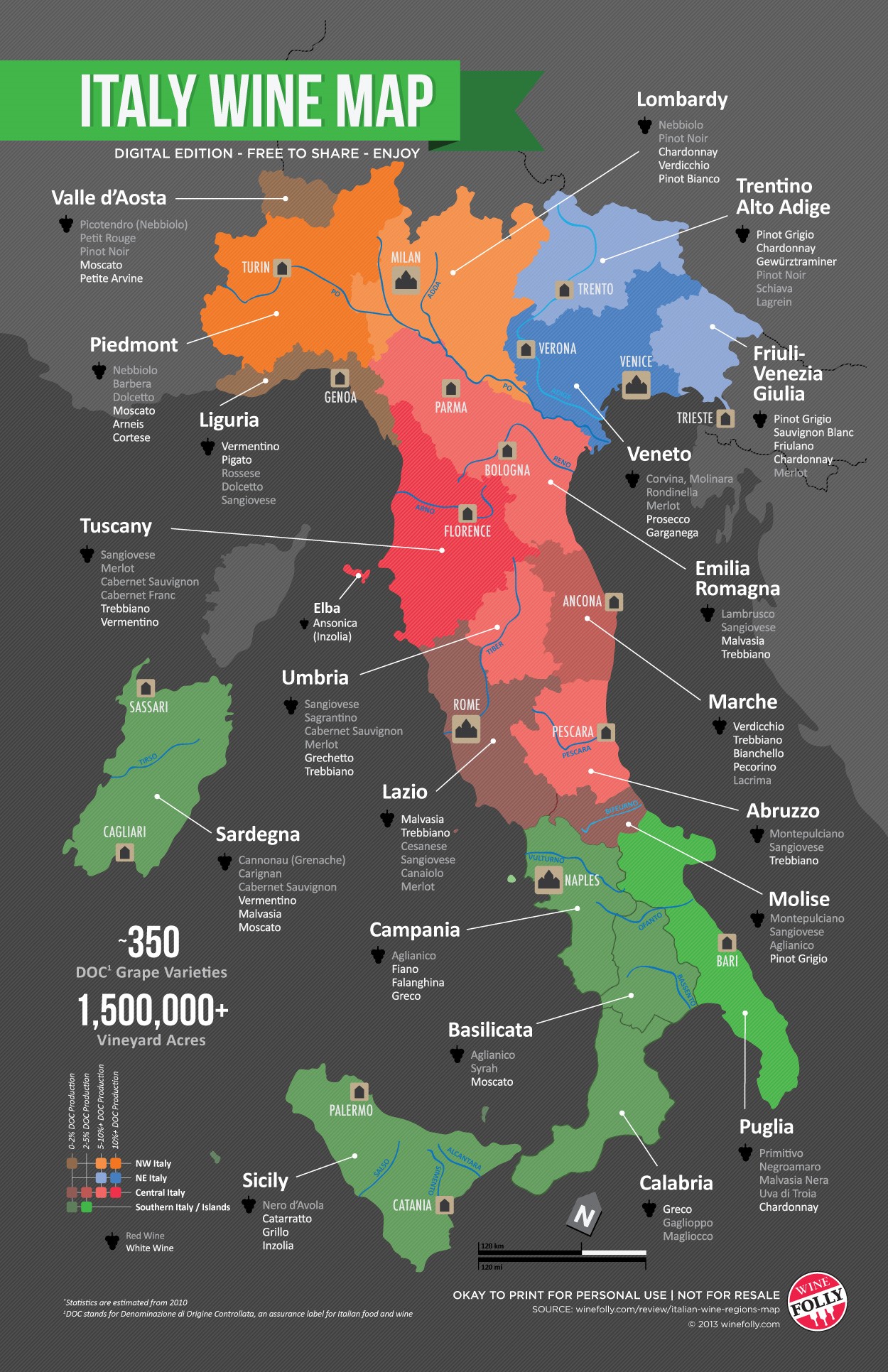
Italy’s twenty wine regions correspond to the twenty administrative regions. Understanding of Italian wine becomes clearer with an understanding of the differences between each region; their cuisines reflect their indigenous wines, and vice-versa. The 73 DOCG wines are located in 15 different regions but most of them are concentrated in Piedmont, Veneto and Tuscany. Among these are appellations appreciated and sought after by wine lovers around the world: Barolo, Barbaresco, and Brunello di Montalcino (colloquially known as the “Killer B’s”).  

mapa de Italia

Italian Main Blended Wines and Varietals

  • Valpolicella and Amarone
    • Corvina Rondinella and Molinara: This Red Varietals are used to make the famous blended wines of the Veneto, Valpolicella and Amarone. Valpolicella wine has dark cherry fruit and spice. After the grapes undergo passito (a drying process), the wine is now called Amarone, and is extremely high in alcohol (16% and up) and full of raisin, prune, and syrupy fruits. Some Amarones can age for 40+ years and command spectacular prices. In December 2009, there was celebration when the acclaimed Amarone di Valpolicella was finally awarded its long-sought DOCG status. The same method used for Amarone is used for Recioto, the oldest wine produced in this area, but the difference is that Recioto is a sweet wine.
    • Vino Nobile di Montepulciano
    • This red wine with a Denominazione di Origine Controllata e Garantita status produced in the vineyards surrounding the town of Montepulciano, Italy is made primarily from the Sangiovese grape varietal (known locally as Prugnolo gentile) (minimum 70%), blended with Canaiolo Nero (10%–20%) and small amounts of other local varieties such as Mammolo. The wine is aged in oak barrels for 2 years; three years if it is a riserva. The wine should not be confused with Montepulciano d’Abruzzo, a red wine made from the Montepulciano grape in the Abruzzo region of east-central Italy.
  • Super Tuscans
    • Sangiovese and Bordeaux mix. Sangiovese grape, Italy’s claim to fame and the pride of Tuscany, traditionally make wines full of cherry fruit, earth, and cedar. It produces Chianti (Classico), Rosso di Montalcino, Brunello di Montalcino, Rosso di Montepulciano, Montefalco Rosso, and many others. Sangiovese is also the backbone in many of the acclaimed, modern-styled “Super-Tuscans“, where it is blended with Bordeaux varietals (Cabernet Sauvignon, Merlot, and Cabernet Franc) and typically aged in French oak barrels, resulting in a wine primed for the international market in the style of a typical California cabernet: oaky, high-alcohol, and a ripe, jammy, fruit-forward profile. The term “Super Tuscan” describes any wine (mostly red, but sometimes also white) produced in Tuscany and that generally does not adhere to the traditional local DOC(G) regulations. As a result, Super Tuscans are usually Toscana IGP wines, while others are Bolgheri DOC, a designation of origin rather open to international grape varieties. Instead, traditional Tuscan DOC(G)s require that wines are made from native grapes and mostly Sangiovese. While sometimes Super Tuscans are actually produced by Sangiovese alone, they are also often obtained by (1) blending Sangiovese with international varietals (such as Cabernet Sauvignon, Merlot, Cabernet Franc, Syrah), (2) blending international varietals alone (especially classic Bordeaux grapes for reds; Chardonnay and Sauvignon blanc for whites), or (3) using one single international variety. In a sense, red Super Tuscans anticipated the Meritage, a well-known international category of USA origin. Because these wines did not conform to strict DOC(G) classifications, they were initially labeled as vino da tavola, meaning “table wine,” an old official category ordinarily reserved for lower quality wines. The creation of the Indicazione Geografica Tipica category (technically indicating a level of quality between vino da tavola and DOC(G)) in 1992 and the DOC Bolgheri label in 1994 helped bring Super Tuscans “back into the fold” from a regulatory standpoint. Since the pioneering work of the Super Tuscans, there has been a rapid expansion in production of high-quality wines throughout Italy that do not qualify for DOC or DOCG classification, as a result of the efforts of a new generation of Italian wine producers and, in some cases, flying winemakers.
  • Sagrantino

Sagrantino, a varietal native to Umbria, is only planted on 250 hectares, but the wines produced from it either blended or as a pure Sagrantino, are world-renowned. Inky purple, with rustic brooding fruit and heavy tannins, these wines can age for many years.

6. – The Appellations

Tuscany Wine – Tuscany, evaluated on the merits of its wines alone, Tuscany stands tall, its reputation founded on such iconic wines as Chianti, Brunello di Montalcino and Vino Nobile di Montepulciano.

Situated in central Italy, Tuscany’s neighbors are Emilia-Romagna to the north and Umbria and Lazio to the south and east. It also shares a short border with Liguria as it stretches up the Tyrrhenian coast, and Marche as it pushes eastwards towards the Apennine Mountains and the Adriatic Sea on the other side of the Italian Peninsula. As is the case with almost all of Italy’s 20 regions, Tuscan wine has a rich, diverse history and origins which can be traced back as far as the fifth century BC. (Wine-Searcher)

Today, Tuscany is at the forefront of oenological excellence, and offers the world an array of internationally acclaimed wines such as the archetypal Chianti, as well as the renowned Brunello di Montalcino and Vino Nobile di Montepulciano. Alongside Piedmont and Veneto, this region houses a strong complement of DOCGs and more than 30 DOCs, including the likes of Rosso di Montalcino, Bolgheri and Pomino.

Key to the area’s prestige is its distinctive terroir. Several factors contribute to an ideal environment for the cultivation of grapes: coastal and mountain climates, a a mixture of well-drained and dry soils, predominantly rich in sand and clay, moderately hilly terrain extending towards the Apennine Mountains and excellent topography.

The warm temperatures coming off the coast, combined with the cool breezes from the hills, create a multitude of microclimates. The vineyards planted on hillsides at altitudes of 500–1600ft (150–500m) enjoy increased diurnal temperature variation, thus helping maintain the grape’s balance of sugars, acidity and aromatic qualities. One such variety that particularly thrives on these hillside vineyards, performing best in direct sunlight, is Tuscany’s signature red grape Sangiovese.

Considered one of Italy’s ‘greats’, Sangiovese is the mainstay in all but one of Tuscany’s seven red-wine DOCGs. In Montalcino it goes by the name Brunello, whence Brunello di Montalcino, and when used to make Vino Nobile in Montepulciano it is called Prugnolo Gentile. Sangiovese also features in Chianti, in which it is joined by small amounts of Canaiolo and Colorino, as well as increasing quantities of Cabernet Sauvignon and Merlot. Under the name Morellino, it also provides the basis for Morellino di Scansano.

With the rise of the ‘Super Tuscans‘, Cabernet Sauvignon has become a much more prominent variety in Tuscany. Despite the international varieties finding their way into Tuscan wines, native varieties still reign. Another Tuscan treasure is the notable sweet red wine Elba Aleatico Passito, which features the Aleatico grape.

As well as being famed for its reds, Tuscany produces some distinguished whites, one of which has achieved DOCG status (Vernaccia di San Gimignano). The region is also home to the eminent dessert wine Vin Santo (‘holy wine’), usually comprising Trebbiano grapes which have been air-dried until the start of Holy Week before being made into wine. (Wine Searcher)

Tre Venezie –The Veneto.  Corte Adami Valpolicalla Ripasso Superiore. 2009. 14%.

Delle Venezie IGT Wine

IGT delle Venezie, one of Italy’s best-known wine appellations, has been made famous by the ocean of crisp, light Pinot Grigio delle Venezie that makes its way westwards to the United Kingdom and the United States from north-eastern Italy each year.

The Venezie in the title is not Venice (the historic city of canals, islands and bridges) but the Tre Venezie (the ‘three Venices’) – Venezia Euganea, Venezia Giulia and Venezia Tridentina. These are the names of three Italian administrative regions which existed between 1866 and 1919 and correspond to the modern-day regions of Veneto, Friuli-Venezia Giulia and Trentino-Alto Adige. The IGT delle Venezie appellation covers this whole area, with the exception of Alto-Adige

Roughly seven bottles in every 10 of delle Venezie wine are varietal Pinot Grigio. Pinot Grigio is more than just the Italian name for Pinot Gris – it has become a wine style in its own right, wholly Italian. And here in the Venezie, it continues to confidently hold back the invasion of French varieties Pinot Noir, Merlot, Cabernet Sauvignon and Chardonnay, each of which is restricted to between 3% and 10% of all IGT delle Venezie wine.

From this narrow perspective, it might seem that Pinot Grigio has also pushed Garganega (which accounts for just 2%) into the shadows, but Garganega remains the key variety behind the prolific Soave and Gambellara DOCs, and is more a grape of the traditional DOC and DOCG world than of the modern, forward-looking IGT category.

Despite the obvious dominance of Pinot Grigio here, and the smaller (but increasing) presence of internationally popular varieties of French origin, the list of grape varieties sanctioned for use in delle Venezie wines is long. It includes Durella, Muller-Thurgau, various kinds of Malvasia, Sauvignon Blanc, Riesling, Verduzzo and Incrocio Manzoni (the crossing of Riesling and Pinot Bianco created by Italian enologist Professor Luigi Manzoni).

As might be inferred from the list above (all of which are light-skinned varieties), this is an appellation which specializes in white wines – a product of tradition as much as of north-eastern Italy’s long, cool growing season. Cabernet Sauvignon, Marzemino and Refosco are all included on the list of permitted varieties, but it is not surprising that they are far less commonly used than their white-wine counterparts. (Wine-Searcher).

Umbria — Cantina dell’ Alunno Rosso  Indicazione Geografica Tipica.  Rosso dell’ Alunno.   2011. 14%

Umbria IGT Wine

Umbria IGT is the region-wide Indicazione Geografica Tipica (IGT) title for Umbria, central Italy. It covers every part of the region, from the tiny village of San Giustino in the north to Santa Maria delle Neve in the south.

Umbria is situated right in the middle of Italy (if this boot-shaped peninsula can be said to have a ‘middle’) and is the only Italian region with neither a coastline nor an international border. Its neighbors on the Tyrrhenian coast are Tuscany and Lazio, and it is separated from the Adriatic coast only by the Marche region. The coat of arms of Umbria

Umbria’s annual wine production of one million hectoliters (26 million gallons) makes it Italy’s fourth-smallest wine-producing region by volume. By mid-2012, just one fifth of the region’s wine was sold under its 15 DOC titles. Compare this to Piedmont, which had 15 DOCGs at that time, and more than 45 DOCs, which together covered almost half of its wine.

The majority of Umbrian was traditionally sold as Vino di Tavola (which commands neither respect nor high prices) so the arrival in the mid-1990s of the IGT category, with its modern, flexible approach to wine styles, was warmly welcomed here. IGT is widely viewed as a practical compromise – a ‘middle ground’ between the stringent DOC/G production conditions, which are balanced out by higher market prices, and the almost non-existent conditions of Vino di Tavola, for which the penalty is low market prices.

IGT wines from Umbria embrace the traditional as well as the modern, both in terms of grape varieties and winemaking techniques; traditional Italian varieties such as Sangiovese and Montepulciano are found in the wines alongside the internationally successful French varieties Cabernet Sauvignon, Merlot and Pinot Noir. This is visible not only in the appellation‘s single-variety wines, but also in its more popular blends. The quality of the wines is rising, due largely to the engagement of consulting oenologists from other regions and even other countries. This investment has led to improvements particularly in the local Sangiovese.

White Umbria IGT wines tend to be made up of the ubiquitous Chardonnay and lesser-known Grechetto (the variety behind Umbria’s most famous wine, Orvieto).

In addition its generic, regional IGT title, Umbria also has several more location-specific IGTs. These include Allerona IGT, Bettona, IGT, Cannara IGT, Narni IGT and Spello IGWine

Posted in Meeting Abstract | Tagged , | Leave a comment

Wine: Is it ok to refrigerate reds?

Wine: Is it ok to refrigerate reds?


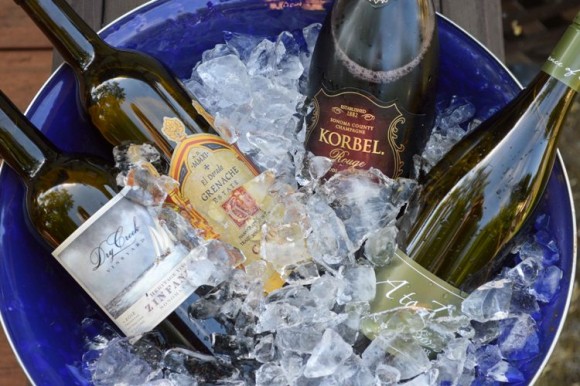
Red wine in hot day?  Well, there are some that believe you can do it and you’ll like it.

chilledCheck this article out. It is by Tina Caputo at ZesterDaily.com. She proposes that a number of reds after a period in the fridge will be better than beer when barbecuing.  Click here to read the article                                                                                                                                 Some of the suggested chill-able reds are: 2012 Dry Creek Vineyard Heritage Vines Zinfandel ($20), 2011 Cantiga Wineworks Grenache ($28) and 2012 MacRosties Pinot Noir ($(34).

 An asbtract is also available in The Week. Only for iOS (iPad, iPhone) and Android tablets and phones.

 Are you ready to give it a try? Share the results, please.

caputo-chilledred


Posted in Magazines and Books wine related, Wine - Vino - Vinho | Tagged , | Leave a comment

Tasting #158 – August 25, 2014 – Wines from New Zealand – Capri Restaurant – McLean VA

Club del Vino

Tasting #158 – August 25, 2014 –  1:00 PM   Wines from New Zealand –   Capri Restaurant – McLean VA

 New Zealand

1. Presenters, Participants and Birthdays of the Month of June

Wines presenters: Alfonso Caycedo, Ricardo Zavaleta

Participants:Mario Aguilar, Hugo Benito, Rolando Castaneda, Alfonso Caycedo, Ruth Connolly, Emilio Labrada, Alvaro Lopez, Alfonso Sánchez, Jairo Sanchez, Ginger Smart, Carlos Velez, Ricardo Zavaleta, German Zincke.

Birthday of the Month:  Alfonso Caycedo, Ginger Smart

2. The Wines

 The presenters explained the difficulty of getting NZ wines in the local market different from the Sauvignon Blanc and the Pinot Noir of an acceptable quality.  Therefore they decided to present a German Riesling and two NZ PNs.  These are the wines for this tasting:

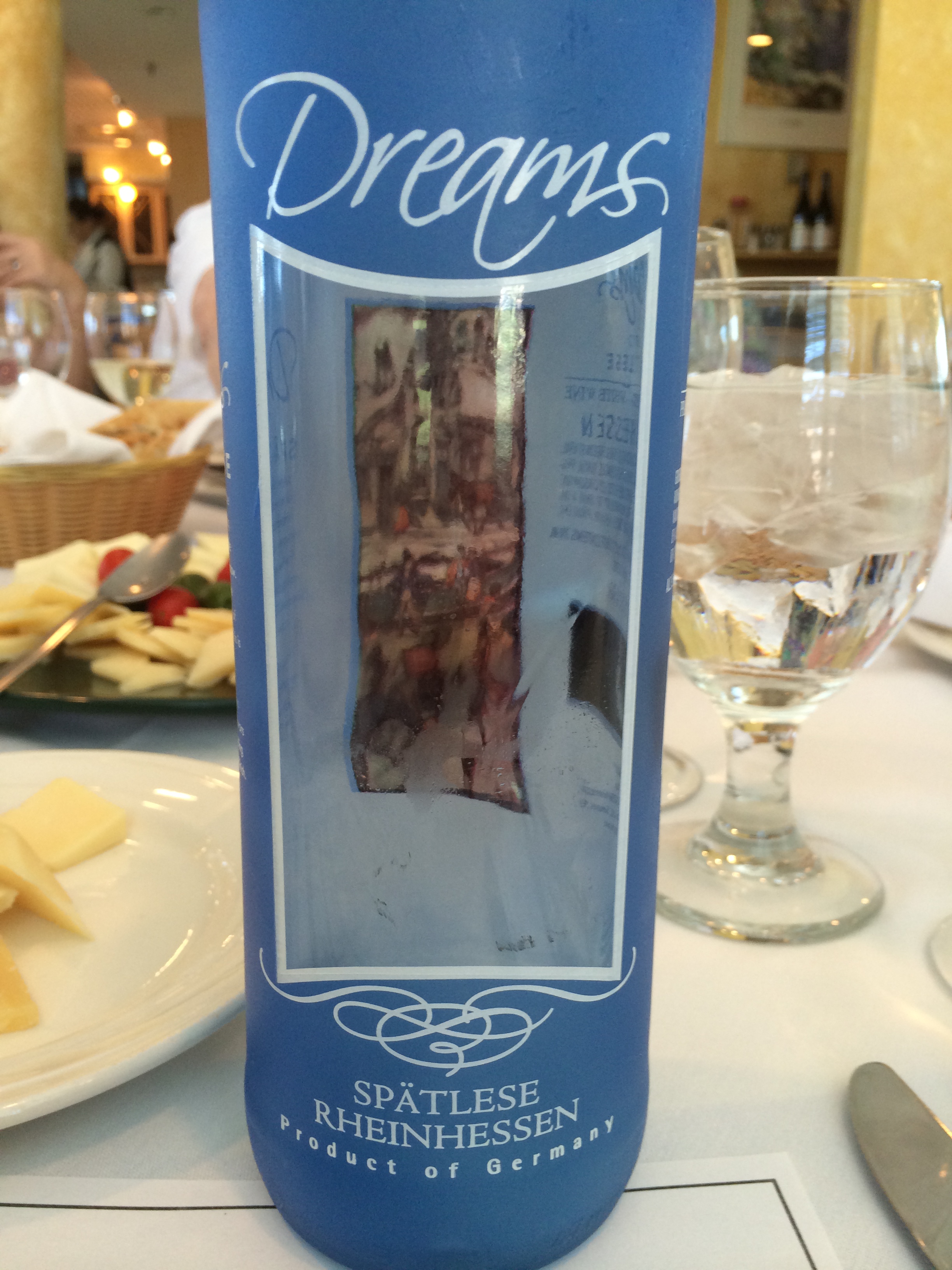
  1. Dreams Spatlese – Rheinhessen 2012
  2. Framinghan Pinot Noir – Maklborough 2012 
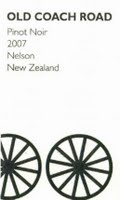
  3. Coach Road Pinot Noir – Nelson 2011
 

3. Menu

  1. Plato de fríos
  2. Mussell en Salsa Roja
  3. Noquis en Salsa combinada
  4. Medallones de carne, Portobello con Salsa Rosemary
  5. Postre y Café

4. – Wines Information (TBA)

Dreams Spatlese – Rheinhessen 2012

dream

Framinghan – Pinot Noir -21012.

FramiganFragrant, featuring lavender, white pepper and sage aromatics that mingle with the pure, fresh and crisp raspberry and pomegranate flavors. This elegant wine shows plenty of intensity and focus.  90 points Wine Spectator.


Coach Road Pinot Noir – Nelson 2011

 Old CoachThis 2012 Pinot Noir is made in an elegant style, with supple tannins and savoury complexity . Flavours of dark cherry, plum and lighter red fruits,with some smoky oak notes.Harmless sediment may form in the bottle.

LOS VINOS DE NUEVA ZELANDIA

(Ud. puede tener informacíon adicional en el post de 28 de Abril de 2011 en nota preparada por Alfonso Sanchez. Haga click aqui)

(Con información de Wikipedia, Sitio Oficial nzwine.com y  Biblia del Vino)

Jairo Sanchez

Jairo Sanchez

Material preparado por Jairo Sachez

Contenido:

  1. Localización  y Clima y Estructura de Producción
  2. Varietales de Uva Mercados y estilos de Vino
  3. Wine Styles

1.     Localización  y Clima y Estructura de Producción

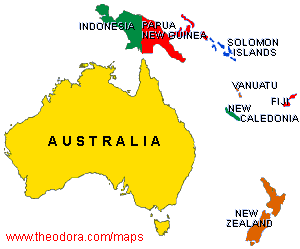
New ZealandNueva Zelandia tiene condiciones geográficas, climáticas y de suelos propicias para el cultivo de la vid, lo que junto a las características  de su tradición agroindustrial y a los incentivos fiscales han podido desarrollar la industria  de vitivinícola en forma muy rápida y exitosa. En efecto, su localización geográfica entre los paralelos 36º S y 45º S la ubica en una posición, en el hemisferio sur, equivalente  a la comprendida en el hemisferio norte entre el sur de España y Burdeos; la condición insular, en la que ningún sitio esta a mas de 70 millas de las costas crea un clima marítimo fresco; la amplia variedad de suelos aluviales y;  la estructura y métodos de producción crean una plataforma que facilita la producción de vinos de calidad, sobre todo en algunas áreas (ver  zonas vinícolas) con microclima y precipitación moderados.

Regiones. Nueva Zelandia tiene 10 Regiones Vinícolas principales en las dos islas  mayores que forman el País. Las regiones líderes son Auckland,  Gisborne, Wairarapa (Martinsborough) y Hawke’s Bay, en la Isla Norte y Marlborough, Central Otago y Canterbury  en la Isla Sur, siendo Hawke’s Bay y Marlborough las consideradas Premium por el volumen de producción y la calidad y variedad de los vinos producidos.  (ver mapa y regiones en las notas para la degustación No. 120 de abril 2011)

australia_new_zealand_mapIndustria del Vino

En los 70s la bodega Montana  comenzó a producir en Marlborough vinos etiquetados por año de producción y por varietal de uva, como en Australia. En 1977 se produjo un primer Sauvignon Blanc, junto con vinos de varietales Miller-Thurgau, Riesling y Pinotage. El éxito de estos vinos, sumado a los resultados con Cabernet Sauvignon establecidos anteriormente en Auckland y Hawke’s Bay, creo un gran interés de los vitivinicultores e inversionistas y generaron un gran aumento en el área plantada con vitis vinifera, principalmente Chardonay y Sauvignon Blanc.

En os 1980s, los fabricantes de vino, particularmente en la región de Marlborough, comenzaron a producir  vinos Sauvignon Blanc con aromas exóticos de algunos vinos del nuevo mundo y la intensidad y acidez de los vinos Sancerre del Valle de Loire en Francia. Algunos críticos consideraron que no había otra región en el Mundo que igualara los vinos Sauvignon Blanc de Marlborough en la Isla sur. Así, temprano en los 90s, comenzó la explosión vinífera de Nueza Zelanda.

Regulaciones

Las regulaciones para el vino en NZ se limitan a definir el contenido de las etiquetas y han sido actualizadas en 2006 en la Ley Alimentos y Regulaciones Alimenticias donde también se han incluido normas sobre insumos, mantenimiento y equipos aplicables.

Para las etiquetas se aplica la regla del 85% que establece que cuando etiqueta de vino de uva incluye una referencia a una variedad de uva, año de cosecha o área de origen, por lo menos el 85% del vino referido debe ser de la variedad, año de cosecha o área de  origen. Esta regla se aplica también a los vinos de mezcla, en cuyo caso las variedades de uva que se mencionen en la etiqueta, deben indicarse de mayor a  en orden de importancia y deben participar en el vino por lo menos en un 85%. Si en una mezcla se singulariza en el vino una sola variedad, esta debe ser la de mayor importancia.

2.    Varietales de Uva Mercados y estilos de Vino

Nueva Zelanda ha adaptado su estructura de producción de uvas y vinos a su propia experiencia, a las condiciones del mercado y a las preferencias del consumo local.

Los estilos del vino producido han sido en respuesta a las principales ventajas competitivas de NZ, lo que ha  resultado en una concentración de vinos blancos y una menor participación de los vinos tintos varietales, de corte y de vinos espumosos. Los vinos Blancos producidos son casi exclusivamente varietales sin añejamiento en madera y con una minima participación de mezclas.

 El cuadro continuación contiene las principales variedades de uva producida en NZ en 2012 con los  volúmenes, (miles de toneladas), las áreas cultivadas, (hectáreas) correspondientes y su participación en las exportaciones.

Principales Variedades de uva en Nueva Zelanda

                                           Área Cultivada           Producción                     Exportación

                                                    (Hectáreas)            Toneladas                         %

Tintas

Pinot Noir                               5.000++                      31   (9%)                                6 +

Corte Merlot Cabernet       1.500–                        11   (4%)-                               1-

Sirah                                             400+                            2   (0.6)+                            0.6 +


Blancas

Sauvignon Blanc                  20.000 +                      228  (68%)                           83 %

Chardonay                                 3.200 –                         27  (9%)                                6 %

Riesling                                            740-                           2  (%)  –                              1 %-

Pinot Gris                                   1.800 ++                      15  (6%)                              2 % ++

Gewurstraminer                            N/A                                  N/A                             N/A

Espumantes                                     N/A                                  N/A                             N/A


Mercados

Los principales mercados para los vinos de NZ son: abastecimiento interno (30%),  Gran Bretaña (24%), Australia (20%), USA (15%), Canadá (3%) y una variedad de otros países que juntos representan el 3%.

3 .    Wine Styles

Red Wines 

Merlot Cabernet Sauvignon Blends. Predominantly grown in the warmer regions of Auckland/Northland and Hawke’s Bay, which get extended heat accumulation due to lower diurnal temperature variation.

Complex, powerful, approachable, Cabernet Sauvignon’s structure and finesse meets with the vibrant, ripe fruit of Merlot. Winemakers in New Zealand’s warmer northerly regions are creating elegant, yet powerfully intense, red wine blends. Increasingly Merlot dominant and notable for their purity of fruit expression, these blends are exciting and approachable when enjoyed young, but are also worth holding onto as they acquire complexity with age. There are other blends using Syrah, Montepulciano and Tempranillo tried in small scale with little commercial impact.

Pinot Noir. Grown mainly in Marlborough Central Otago and Wairarapa- Wellington, which produce intense, expressive, fruit-driven wine with Old World structure and elegance and meets New World power and intensity.

Native to Burgundy and notoriously fickle (it is world class only in cool-climate regions), the Pinot Noir grape has found in New Zealand a home away from home. Our winemakers tease a tantalizing array of distinctive regional and terroir-driven styles from the land. Common to all, however, are Old World structure and elegance overlaying New World power and fruit-driven intensity.

Pinot noir is predominantly grown in the cooler southerly regions. The huge diversity in climates and soils enables a wide range of styles from the five main Pinot producing regions.

Elegant and fruit-driven, the classic New Zealand Chardonnay is mouth- filling, with concentrated citrus and tropical fruit. A crisp acidity balances the flavors, which are often perfectly rounded with oak.

Syrah. Predominantly grown in Hawke’s Bay, Oakland/Northland. It has a long history in New Zealand, dating back to the mid 1800s.

Complex, spicy, supple, distinguished by its bright, spicy flavors and elegant texture, akin to elegant Northern Rhône style. You’ll instantly appreciate the intense varietal distinctiveness of New Zealand Syrah, crammed full of plum and savory black pepper flavors and sometimes even a hint of violets.

White Wines

Sauvignon Blanc. Sauvignon Blanc is New Zealand’s most widely planted varietal. The first wine made in commercial quantities was produced in 1979. Mostly cultivated in Marlborough, Hawke’s Bay and Nelson. This is a unique, exuberant, intense and explosive varietal that awoke the world to New Zealand wine. In 1973, Marlborough’s first Sauvignon Blanc vines were being planted.  The flavors of New Zealand Sauvignon Blanc have dazzled wine critics throughout the world, setting the international benchmark for the style.

Pungently aromatic, New Zealand Sauvignon Blanc assails the senses with red capsicum/bell pepper and gooseberry characters through passion fruit and tropical fruit overtones. Other notes include fresh cut grass, tomato stalks, grapefruit or limes.

Chardonnay. During the 1990s, plantings of this internationally fashionable variety exceeded those of every other grape in New Zealand. Chardonnay remains planted in every region, predominantly in Marlborough Hawke’s Bay and Gisborne

As a wine, Chardonnay Balanced, fruit-laden, concentrated. Ever-evolving, yet eternally elegant with its balance of minerality and fruit strongly reflects New Zealand’s unique terroir and the huge diversity within its regions. Its versatility makes Chardonnay a perfect canvas for viticulturists and winemakers eager to craft a masterpiece. A range of Chardonnays is produced in New Zealand from fruit-driven, unoaked styles to concentrated Burgundian styles.

Elegant and fruit-driven, the classic New Zealand Chardonnay is mouth- filling, with concentrated citrus and tropical fruit. A crisp acidity balances the flavors, which are often perfectly rounded with oak.

Riesling. The South Island, where the climate is ideally suited with cool, long, dry, sunny autumns, large diurnal variance and low humidity create the perfect climate for Riesling and is currently the home to 90% of this grape varietal at Marlborough, Canterbury-Waipara Valley and Central Otago regions.

Though present in the 1800s, it is only since the 1980s that Riesling began to be planted in volume, rising to the fourth most popular white varietal planted in recent years.

Balanced, fruit-laden, concentrated, ever evolving, and yet eternally elegant with its balance of minerality and fruit.

Racy, aromatic, diverse, naturally vibrant with a zesty acidity: The wine for Asian cuisine. Styles range from bone dry to lushly sweet. You’ll find stonefruit and spice characters from sunny Nelson; lemon, lime and spice from Marlborough; and green apples and citrus from the cooler Waipara Valley and Central Otago regions.

  • Pinot Gris.
  • Grown throughout the country mainly in Marlborough, Hawke’s Bay and Gisborne, New
  • Zealand Pinot Gris is more akin to Alsace in style than the drier Pinot Grigio, with notes
  • of apple, pear, honeysuckle, spice and bread. The warmer north island climate tends
  • to create ripe, fat, oily styles whilst the cooler south island produces tighter wines
  • with great structure. Much new Zealand Pinot Gris undergoes a small amount of barrel
  • ageing, with wild yeasts and lees stirring for complexity.

Mouth-filling, rich, refreshing, Pinot Gris is an intense pleasure, whether refreshingly light or richly complex. With the first serious plantings only appearing in the early 1990s, Pinot Gris has enjoyed a dramatic rise to fame and is now the third most popular white variety in NZ. Much winemaking effort with new Zealand Pinot Gris is focused on building texture mouth feel and complexity.

Sparkling Wines

 New Zealand Sparkling wines have been acclaimed worldwide for its complexity and elegance. It shows all the hallmark characters of nutty, biscuity aromas, balanced with fresh acidity and fruit. Produced using the classical Champagne varieties and using Méthode Traditionelle techniques, NZ Sparkling wines are a fantastic value-for-money alternative to Champagne.

Marlborough produces the highest volume of Sparkling Wine, where the cool climate creates elegance and structure with spritely natural acidity. Hawke’s Bay and Gisborne produce typically weightier, richer wines. Wines from the North and South Islands are often blended to achieve the best of both worlds: richness and structure. Pinot Noir and Chardonnay are usually the basis for sparkling wines in NZ. Marlborough still produces a number of high quality sparkling wines, and has attracted both investment from Champagne producers (Deutz) and also champanois wine-makers (Daniel Le Brun). Other sparkling wines from Marlborough include Pelorus (from Cloudy Bay), and the now venerable Lion Nathan brand, Lindauer. 

Posted in Meeting Abstract | Tagged , | Leave a comment

Never Pick Another Bad Wine

Never Pick Another Bad Wine:   Vivino will help

vivino1That is what says the Vivino web site (vivino.com). Vivino is an application (app for short) that works well on a smart phone. It has versions for the Apple iPhone, for all Google Androids and for the Windows Phone.  A couple of short clips on the app are embed at the bottom of this post.

Let’s suppose you are in a store looking for a wine to drink while dinning. A new wine is in the shelve. You never saw this before, but the region, the varietal or the price look good. Before buying it you could use Vivino. Just open the Vivino in your smart phone take a picture of the label and voilá! A description, evaluation and price will come along in seconds.

Vivino also shows the wine ranking and let’s you give your own opinion. It is fast and fun.

It serves as record keeper of the wines you tasted, you liked or you feel like keeping the name for a purchase or recommendation later on. Next tasting of the Club you don’t have to make a note of a wine you liked. Just ask Felipe to lend you the bottle for a moment take a shot of the label and you have a record of it.

And the price of the app? I am sure you can afford it!   There is a Vivino Pro version that costs a few bucks. I use the free one and I am happy with it. Five million users around the world and counting. Vivino is many languages enabled. It is Facebook and Twitter connected.

vivino_images

Vivino is considered one of the best apps useful for wine lovers by: refugeeks.com     The Guardian      Forbes      About.com       iTunes    Amazon.com    Play Google.

Vivino: app review:

Vivino: Never forget the name of a good wine


Posted in General, Magazines and Books wine related, TV, Video, Film on wine, Uncategorized | Tagged , , , , , , , , , , | Leave a comment

Blended Wines – An Overview


By Alfonso Sánchez

Red BlendThe tasting program of the CV for 2014 includes five sessions dedicated to blended wines from various countries.  Why blends?  What blends are?

As the name implies, blended wines are those made using different varieties of grapes.  The emphasis is on varieties because for example blends of the same variety (e.g. cabernet sauvignon) form various vineyards is not recognized as a blend by the major existing regulations on the subject.

Blended wines are predominant in the old world (Europe) while varietals (wine made mostly from a single variety) are prevalent in the new world.  However it seems that blended wines are as old as wine itself.  Unfortunately many blended wines in the XX century gained a bad reputation because certain producers used blending to produce inexpensive low-quality red table wines to get rid of inferior crops or wine surpluses.  Hence the new world merchants opted for the varietal type as a way to convey to the consumers the notion of superior quality.  This bad reputation is far from reality and no longer the case.  In fact, the world’s most famous wines are blends and blends are more widely sought after today including in the new world (Champagne, Sherry and Bordeaux wines are just a few prominent examples).

Blending of different varieties when properly done may result in a wine of a quality superior to those made from the individual varieties. Blending is used to enhance color, aromas, balance, flavors, structure and finish.  As they say the whole is better than the simple sum of the components’ attributes.  Blending is thus an art and the winemaker is the king as he or she selects the best fruit and the proportions of varieties that go into the blend.  It is like cooking a good dish, where the chef selects the main ingredients and condiments to maximize pleasure.  Besides improving the wine, blending is used also to maintain consistency over time (Champagne and Sherry) or across bottles of a particular batch from various vineyards.

Even though almost all wines (mainly reds but also many whites) are blends, there are certain regulatory requirements to label wines as varietals or blends.  Most regulations for example require that a wine contains around 80 to 85 percent of single variety to be labeled as a varietal (in the USA the allowable limit is 75 percent). Wines with a lower proportions of a single variety than the minimum required for varietals can be labeled as blends.  In the USA certain  blends are under a special category called Meritage subject to specific regulations (click here for more on Meritage).

Blending generally involves fermenting different varieties separately and then blending them.  Alternatively, the varieties may be fermented together from the beginning, a technique called co-fermentation  (for example in the Rhône wines the Grenache and Syrah are co-fermented with roughly 5 percent of Viognier).  While many blends are vintage blends, meaning that they are made of different types of grapes that were all grown in the same year, some are non-vintage blends. These latter blends are most commonly found in port or sparkling wines such as Champagne, and use grapes grown in different vintages in order to utilize their different tastes and tannins.

These are some examples of blended wines:

France’s Bordeaux and Southern Rhone regions are two of the most famous regions for blended wines. Bordeaux wines are a blend of Cabernet, Merlot, Cabernet Franc, Melbac and Petite Verdot grapes. Each wine is different and hand crafted by the winemaker. Cabernet and Merlot predominate with the other varietals included for adding subtle distinction. In the Southern Rhone, the main grape varietals are Grenache, Syrah and Mouvedre. With up to 10 other varietals allowed, Rhone style wines can be diverse and intriguing. Southern Rhone’s most famous blend is Châteauneuf-du-Pape. This blend traditionally allowed up to 13 different grape varietals, but recently has been allowed up to 18 different varietals.

Italy Chianti (Sangiovese with Canaiolo Nero, Malvasia and Trebiano) and Super Tuscans that blend Sangiovese with Bordeaux traditional varieties.

Most Argentinian blends use Malbec as the dominant grape; Cabernet Franc or Sauvignon can add tannins and body to the wine, while Merlot may be used to add color and smoothness.

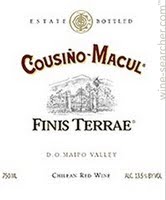
Chilean Primus and Finis Terrae are excellent examples of new world Bordeaux-type blends.

Blending can create unbelievably complex and delicious wines worth trying and keeping in our cellars as shown in the recent Wine Club tastings.  Let’s be adventurous and explore them.

7/29/14

Posted in Wine - Vino - Vinho | Tagged | Leave a comment

Tasting #157 – July 28, 2014 – Blend Wines from Chile

Club del Vino

Tasting #157 – July 28, 2014 –  1:00 PM   Blend Wines from Chile-    Capri Restaurant – McLean VA

wines from chile1


1. Presenters, Participants and Birthdays of the Month of July


Type: Blind

Wines presenters: Orlando Mason, German Zinke

Participants:  Mario Aguilar, Marcello Averburg, Hugo Benito,  Ruth Connoly, Alfonso Caycedo, Clarita Estrada,  Jaime Estupiñán,  Albertina Frankel, Jorge García, Alvaro López, Orlando Mason, Ítalo Mirkow,  Alfonso Sánchez, Jairo Sánchez, Ginger Smart, Carlos Velez, Ricardo Zavaleta, German Zincke, two guests .


Birthday of the Month: Alvaro López, Germán Zinke

2. The Wines

  These are the wines for this tasting:

  1. Anakena Ona 2013, Blanco Reserva especial (Blend)
  2. Veramonte Primus 2011. “The Blend” Valle de Colchagua.
  3. Finis Terrae 2009 Causino Macul.(Blend)

3. Menu

  1. Calamari en salsa blanca y crostinos
  2. Noquis con salsa de pesto
  3. Medallones de carne Portobello con salsa Rosemary
  4.  Postre
  5. Cafe

4. Wines Information

(This information was collected from various publications and Internet materials)

Anakena Ona 2013, Blanco Reserva especial (Blend)

Anakena blancoAnakena is a privately owned winery based in the Alto Cachopoal area of the Rapel Valley in Chile. It produces a wide variety of styles, but has perhaps become best known for its ONA range of unusual blendsRare

White Blend is a term Wine-Searcher uses to group together white wines made from uncommon or unusual grape variety blends (see also Rare Red Blend). The category also provides a convenient home for wines whose blend is either unknown or not published by the winery.

There is no particular pattern or formula for establishing which grape varieties will features in these rare blends, nor the proportions in which they will be used. Some will consist of just two components, others may contain ten or more.

This wine is 35% Riesling, 35% Viognier and 30% Chardonnay are fermented separately and blended after 4 months. This aromatic white combines the individual qualities of each grape varietal into a very complex white. The Riesling gives mineral tones, the Viognier floral and ripe apricot flavors, and the Chardonnay gives tropical aromas and balance. Pair with marinated seafood dishes, crab and lobster.

Leyda Valley is a small sub-region of the San Antonio Valley wine region in Chile, located just 55 miles (90km) west of the Chilean capital, Santiago. This cool-climate region enjoys the effects of the cold Humboldt Current of the Pacific Ocean, and consequently produces bright, vibrant wines made from Pinot Noir and Chardonnay.

Leyda Valley has traditionally been associated with wheat and barley production, but is rapidly gaining a reputation for high-quality viticulture. The first vignerons appeared in Leyda in the late 1990s, attracted by a terroir that was almost perfect for the production of premium grapes, save for the lack of an abundant source of water for irrigation. A significant investment by a wine-producing family in the area saw the construction of a pipeline five miles (8km) long to channel water from the Maipo River in the south. This opened a world of potential in the area, but the planting of new vineyards has since been limited by the capacity of this pipeline.

Alohol: TBA;  Price : $ (TBA)

Experts Ratings: TBA

Veramonte Primus 2011. “The Blend” – Valle de Colchagua

PrimusFor over 10 years, The Blend has been one of Chile’s top red wines, expressing power and finesse by merging Cabernet Sauvignon, Syrah, Merlot and Carmenère, the “lost” Bordeaux varietal.  Agustin Huneeus, creator of some the world’s best red blends including Magnificat and Quintessa, developed Primus, which leverages winemaking techniques used by Napa Valley’s top Cabernets and Red Blends: Colchagua Valley´s  yields are managed to 2-3 tons per acre, grapes are meticulously double sorted before crush, and French oak aging.
Aged in the finest French and American oak for 14 months, this wine delivers world-class quality in the glass featuring rich, dense fruit, exotic spice and a long textured finish.

 The Blend includes Carmenère, Syrah, Cabernets Sauvignon and Franc, Malbec and Petit Verdot. Complex notions of dark cherry, autumn leaves and earth make way for a seductively smooth and velvety wine brimming with dark fruit and a drop of vanilla, culminating in a spicy tobacco and black pepper finish. Source: Vintages Wine Panel, Oct. 2013

Colchagua Valley, in central Chile, is one of South America’s most promising wine regions. It forms the south-western half of the larger Rapel Valley region; to the north and east of it lies the less famous but equally promising Cachapoal Valley. Some of Chile’s finest red wines are made in the valley, mostly from Cabernet SauvignonCarmenere and Syrah.The Blend indeed. This includes Carmenère, Syrah, Cabernets Sauvignon and Franc, Malbec and Petit Verdot. Complex notions of dark cherry, autumn leaves and earth make way for a seductively smooth and velvety wine brimming with dark fruit and a drop of vanilla, culminating in a spicy tobacco and black pepper finish. Source: Vintages Wine Panel, Oct. 2013

The Colchagua Valley boasts a textbook wine-growing climate: warm, but cooled by ocean breezes and dry, but refreshed by rivers and occasional rainfall. The region’s desirable terroir, combined with persistent, focused marketing has made this one of Chile’s most important wine regions, along with Maipo Valley in the north. Several of Chile’s most prestigious wines come from the Colchagua Valley: ‘Clos Apalta’ by Casa Lapostolle, the ‘Folly’ Syrah from Montes and ‘Altura’ by Vina Casa Silva are obvious examples. And if there were any doubt that the valley is well regarded both in Chile and overseas, this is easily put to rest by the presence of the Los Vascos winery in Peralillo, a joint venture between Santa Rita and the Rothschilds of Bordeaux.

The official Colchagua Valley viticultural area stretches south-east to north-west for 70 miles at its widest point. Its western boundary is formed by the coastal hills which seem to run the entire length of Chile’s vast Pacific coastline. In the east, the vineyards are naturally limited by the foothills of the Andes, into which they creep further and further each year.  A blend of 70% Cabernet Sauvignon, 25% Merlot and 5% Syrah from 80-year old vines apropos the Cabernet, the 2009 Finis Terrae is aged in French oak barrels for 14 months (65% new.) That oak is nicely integrated on the nose with blackberry, raspberry and cassis laced with tobacco and cedar. The palate is rounded and chewy on the ripe entry and builds nicely towards a supple blackberry, spice and white pepper finish that belies the structure underneath. “

Alohol: TBA;  Price : $ (TBA)

Experts Ratings:  WA 90 pts.

Finis Terrae 2009 Causino Macul.

Finis Terrae

 A blend of 70% Cabernet Sauvignon, 25% Merlot and 5% Syrah from 80-year old vines apropos the Cabernet, the 2009 Finis Terrae is aged in French oak barrels for 14 months (65% new.) That oak is nicely integrated on the nose with blackberry, raspberry and cassis laced with tobacco and cedar. The palate is rounded and chewy on the ripe entry and builds nicely towards a supple blackberry, spice and white pepper finish that belies the structure underneath. ” – Wine Advocate

Finis Terrae is a clear reflection of the Maipo Valley terroir expressed through the finest of Cousiño’s Cabernet Sauvignon, Merlot and Syrah from each vintage. It is a blend created by tasting hundreds of combinations of Cabernet, Merlot and Syrah to achieve the ideal balance of fruit, acid, tannin, alcohol and oak.

The 2009 season was marked by a cold winter with normal rainfall and a warm and dry summer. We harvested all grapes by hand, within the estimated dates; the resulting wines were of a remarkable quality, with intense aromas and flavors, excellent concentration and great body

The grapes were harvested when they were physiologically ripe and the tannins were ripe and smooth. The winemaking process started with cold maceration to extract the aromas. To add complexity, Chilean yeast and prisse de mousse were used for fermentation, and the must was pumped over 3 to 4 times a day.

Post-fermentation skin contact was done to obtain more complexity. Once pressed, the wine was racked to French oak barrels from different cooperages.

Finally, the wine was clarified and a light filtration was applied before bottling.

TASTING NOTES

With a bright and clean deep purple color, this wine offers a complex nose, in which notes of wild berries, blueberry, raspberry, and blackberry can be felt, as well as a subtle French oak aroma, in perfect balance with the fruit.

In the mouth plum and strawberry, accompanied by a slight sweetness, principally from the merlot, can be found.

It’s intense, balanced and round, with ripe tannins and a long finish.

PAIRING

Due to its high complexity, this wine has a wide range of dishes for pairing. Possessing a great body and structure it’s a great complement for any red meat. The subtlety of aromas and flavors would be a perfect partner for Italian pastries, like a potato and pumpkin gnocchi gratin with Roquefort cheese sauce and parmesan.

TECHNICAL DATA

Varietal Composition: Cabernet Sauvignon / Merlot / Syrah

Appellation: 100% Maipo Valley

Aging:  15 months in new French oak barrels.

Alohol: TBA;  Price : $ (TBA)

Experts Ratings:  WA 90 pts.

4.a. Club del Vino Members Tasting Notes:

Posted in Meeting Abstract | Tagged , | Leave a comment

Tasting #156 – June 30, 2014 – Wines from Greece – Capri Restaurant – McLean VA

Club del Vino

Tasting #156 – June 30, 2014 –  1:00 PM   Wines from Greece-    Capri Restaurant – McLean VA

Wines from Greece:

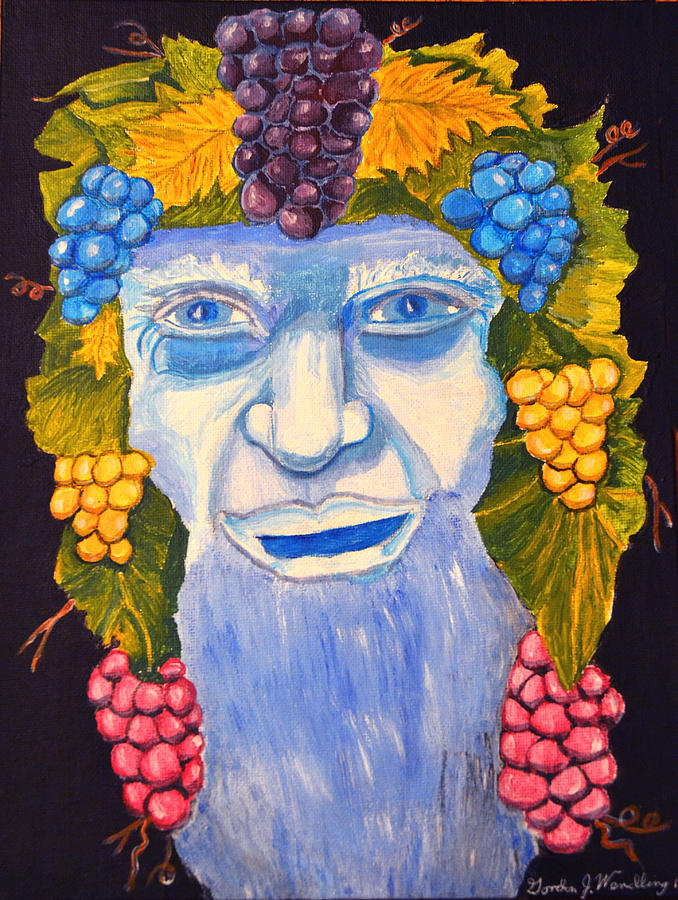
dionysus-greek-god-of-wine-gordon-wendling

Dionysus – The Greek God of Wine

1. Presenter, Participants and Birthdays of the Month of June

Wines presenter: Macello Averbug

Participants:

Marcello Averburg, Hugo Benito, Cecilio Berndsen, Alfonso Caycedo, , Clara Estrada,   Emilio Labrada, Alvaro Lopez, Orlando Mason, Ítalo Mirkow,  Alfonso Sánchez,, Ricardo Zavaleta, German Zincke.

Birthday of the Month: Alfonso Sánchez

2. Wines Information Abstract

Although Greece is one of the world’s most ancient wine producing regions, it has remained relatively under the radar…until now! In the 1990s the Greek wine was in high swing, trying to catch up with the modern wine world. Greece boasts tons of world-class wines with bright and diverse personalities.  Greece greatest asset, but also perhaps a reason why the wines are hard to sell, is its palette of indigenous varieties, many noble, and most far more ancient than the likes of Cabernet.

Nemea has been regarded as a great winemaking region since the time of the ancient Greeks. Recent archeological excavations have revealed winemaking being done here over 3500 years ago.

The most important grape variety in here is Aghiorghitiko, also known as St. George, derived from the name of the town where the grape variety is thought to have come from “Agios Georgios” or Saint George.  These are the wines for this tasting:

1) Sigalas, 2010. Blanco Assyrtiko 75% y Athiri 25%. Santorini 

2) Saint George, 2010 Rojo QAghiorghitiko Domain Skouras. Nemea, Peloponnese 

3) Gaia, 2007. Rojo Agiorgitiko. Pelopnnese.

3. Menu

  1. Calamares fritos
  2. Corvina en salsa de la casa
  3. Berenjena parmesana
  4. Cordero estofado con espinacas
  5. Postre o café


4. Wines Information

Sigalas Assyrtiko Athiri 2011 – White Wine

Cigalas AsyrticoThe colour is straw blonde, bright, with a nose of ripe citrus fruit followed by a refreshing acidity and a delightful after-taste. Blend of 75% Assyrtiko and 25% Athiri. Medium gold colour with aromas of honey, almonds, moussasaka and gallaktaburiko (Greek custard pastry).  Superb balance of sweetness and a touch of bitterness leading to a powerful conclusion. Acidity is completely under control despite the Assyrtiko’s reputation as a grape with high acidity. A long damp peach finish that grows withs intensity and fades so very slowly. Greek personality personified! This is no tourist wine to be quickly consumed with the setting summer sun. Fermented in stainless steel and oak. The alcohol content of 14.2% sure doesn’t show in the glass in a flashy way. It is extremely well integrated.

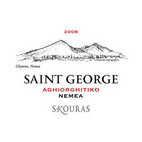
Skouras Saint George 2010 – Red Wine

Saint George USA 2011Founded by George Skouras, a Dijon qualified oenologist, in 1986, this domaine is amongst the country’s finest and has gained international fame along with distribution in 16 countries. Skouras makes a range of 15 wines from both indigenous grapes and from international varieties, and he achieved notoriety in the 90’s when he was the first winemaker to blend Cabernet and Aghioghitiko, with spectacular results.

Made with organically grown grapes, from 20 + year old vines, the 2010 Saint George is an entry level Aghiorghitiko. It is planted in clay soils at 650-meters above sea level. Fermented and macerated in stainless steel vats, it undergoes maloactic fermentation and is then aged in French barriques for 12-months and another six in bottle. It exhibits fine grained tannins, intense raspberry fruit and sweet spices.  The colour is bright, deep crimson. The nose reveals aromas of blackberries, raspberries and ripe strawberries with just a touch of anise and spices such as clove and cinnamon. It is a medium bodied wine with graceful silky texture, balanced acidity and very ripe elegant tannins. The finish is moderately long, full of red fruits with a touch of sweet vanilla and black pepper.

Gaia Estate 2007 – Red Wine

Gaia stateGaia Wines was founded in 1994, north of the Peloponnese, in the  area of Koutsi, Nemea (2100 feet elevation), regarded by many as the premier site for growing Agiorgitiko grapes in Greece. This excellent example of modern Greek winemaking is an outstanding new world wine from old world grapes!

Gaia Winery own two modern wineries that are located in two of the most interesting and promising areas of Greece, Nemea in Peloponnese and Santorini.

In 1999, their most prestigious wine, «Gaia Estate vintage 1997», were born. It would be true to say Gaia Estate was the wine that changed the perception of the Nemea wines and brought a more sophisticated dimension to Agiorgitiko grape, that of deeply aged wines. Now, Gaia Estate is the flagship red wine from this winery.

www.gaia-wines.gr/en/gaia/gaia-distinctions

Sweet, serious, velvety and dark rubi in the glass. Great depth and complexity with loads of black and red fruits with powerful yet smooth tannins. In the mouth, flavors of redcurrants, mulberries and cherry mix with a crushed stone minerality and very velvety. Excellent acidity makes for a refreshing, juicy package that possesses and airy, floral finish. This dry red wine is both bold and supple at the same time, and will benefit with some age. It is a wine with great potential of ageing. Complex and dynamic, a perfect example of why Aghiorghitiko is such a fantastic grape. A top red not just from Gaia Estate, but in the whole of the Mediterranean.

The Grapes

The Athiri Grape

Athiri is an ancient white grape variety of the Aegean Sea, used for centuries to make excellent dry white wines. Ever since its qualities were recognized by vine growers across Greece, it has been an  elegant expression of the style of white wines produced on the Cyclades and Dodecanese islands.

 Perfectly suited to arid and warm Aegean conditions, this vines is able to perform in a large variety of soils. It makes wines with moderate intensity of flavors, mainly focusing on white and yellow fruits, with moderate alcohol levels, soft acidity and a medium body, displaying freshness and vivacity.

 Athiri is grown all over the Aegean Islands and is important even in Crete. Nevertheless, numerous vineyards have been planted in the mainland, most notably in Macedonia, particularly in Halkidiki (PDO Côtes de Meliton). Nevertheless, the top results are achieved in PDO Santorini—when it is coupled with Assyrtiko and Aidani—and in the high vineyards of PDO Rhodes.

 The lean, not heavy structure and the lack of obvious flavors make Athiri wines suitable for a large range of difficult-to-match dishes. However, Greeks enjoy it as an aperitif, especially on warm summer lunches. This is a grape variety to be consumed young, within two to three years from vintage, although some five-year-old examples have been found to be delicate but complex.

The Aghiorghitiko Grape

 Aghiorghitiko is a red Greek winegrape variety that, as of 2012, was the most widely planted red grape variety in the country. The grape has traditionally been grown in the Nemea region of the Peloponnesebut can be found throughout the country, including Attica and Macedonia.

 According to Master of Wine Jancis Robinson, some of the “most serious examples” of Aghiorghitiko come from the higher altitude vineyards (up to 900 metres / 3,000 ft) of the Asprokampos plateau around Nemea and in the hills (between 500 metres / 1,600 ft to 600 metres / 2,000 ft) around Koutsi in Corinthia.

 One of the more commercially important indigenous Greek varieties, it can exhibit a wide range of characteristics, from soft to very tannic, depending on factors in the growing and winemaking processes. The red wine produced from the grape is characteristically spicy with notes of plum. It has low acidity but good fruitiness and coloring.

Aghiorghitiko is a very versatile grape variety that can be made in a wide range of styles from light rosés to soft, fruity reds made by carbonic maceration in a style similar to the French wines of Beaujolais, to very tannic wines with spicy, red fruit aromas and the potential to age.

At its most extreme, Aghiorghitiko wines have the potential to be very low in acidity, high alcohol and high in phenolics with both issues requiring the winemaker to make decisions on how to handle these components in order to make a balanced wine.

According to the Wine & Spirit Education Trust (WSET), the best examples of Aghiorghitiko tend to have moderate to low acidity, with a deep, ruby color, red fruit aromas and a sweet spicy note. These examples tend to come from vineyards planted in the middle range of the hillside slopes around Nemea with grapes harvested near the top of the 900 metres (3,000 ft) hills.

 In Nemea, the wine made from Aghiorghitiko is nicknamed the “Blood of Hercules” because of the legend that after the Greek hero slayed the Nemean lion, it was the local Nemean wine made from Agihorghitiko that he consumed. (Some versions of the story has Hercules consuming the wine before slaying the lion.) Another legend states that the wine was a palace favorite of king Agamemnon who led the Greek forces during the Trojan War.

4.a. Club del Vino Members Tasting Notes:

prepared by the the Club Secretary Ricardo Zavaleta. 

Criterio para calificar:

Excepcional: 96-100 puntos; Excelente: 90-95 puntos; Muy Bueno: 86-89 puntos; Bueno: 81-85 puntos; Aceptable: 75-80 puntos.

Tipo de Degustación:  Abierta

Resumen:

El primer vino (blanco) fue calificado como Muy Bueno con promedio de 88 puntos; el primer tinto, como Muy Bueno  con una Media de 87 puntos y el segundo (tinto) ultimo vino, también  como Muy Bueno  con una calificación media de 88 puntos.  En resumen todos se consideraron como Muy Buenos.

Vinos degustados:

  1. 2010 Sigalas, Blanco. Domain Sigalas. Region de Santorini.

Calificacion Media: 88

Desviacion Estandar: 3.6

Mediana: 88

Moda: 88

Impresion General: Un excelente Blend (Assyrtico y Athiri) agradable sabor y con un fresco aroma. Resulta un vino muy sabroso y balanceado.

  1. 2010 Saint George, Rojo. Aghiorghiko Domain Skouras. Region Nemea, Peloponnese.

Calificacion Media: 87

Desviacion Estandar: 3.1

Mediana: 87

Moda: 87

Impresión General: Color granate brillante, con aromas a diferentes frutas y especies dulces. Gran elegancia en su acidez como un vino de medio cuerpo, con un final moderadamente largo.

3. 2007 Gaia, Rojo. Agiorgitiko. Gaya State, Peloponnese.

Calificacion Media: 88

Desviacion Estandar: 2.9

Mediana: 89

Moda:  90

Impresión General: Se considera un ejemplo de vinos modernos, entendiéndose que es un vino mundialista elaborado con viejas cepas. Color rubi, gran profundidad, sabor agradable y refrescante.


Posted in Meeting Abstract | Tagged , , | Leave a comment

Mágica do Vinho

Mágica do Vinho

VinhoMataSaudades


Sugerido por R. Costa

Posted in Humor, Wine - Vino - Vinho | Tagged , , | Leave a comment

Tasting #155 – May 27, 2014 – Wines from Uruguay – Capri Restaurant

VinoLogo1Tasting #155 – May 27, 2014 – Wines from Uruguay – Capri Restaurant, McLean VA


1. Participants, Presenters, Birthday of the month.

Alfonso Caycedo, Cecilio-Augusto Berndsen, Clara Estrada, Eduardo Velez, Italo Mircow, Jairo Sanchez, Jorge Garcia-Garcia, Marcello Avergug, Mario Aguilar, Omar Rodriguez, Orlando Mason, Ricardo Zavaleta, Rolando Castaneda, Raul Sanguinetti, Ruth Connolly

Regrets: Alfonso Sanchez, Pedro Turina, Jaime Estupinan.

Presenters: Clara Estrada, Omar Rodrigues and Raul Sanguinetti.

Birthday of the Month: Leonor Barreto


2. Wine Information Abstract, all wines from Uruguay

  • Wine  #1:   2013 Sauvignon Blanc “Sur Lie” Bodegas Carrau. Cerro Chapeu, Las Violetas, Uruguay.  APV: 13%, no oak. $ 13
  • Wine #2:      2011  Tannat Reserva  Bodegas Carrau. Cerro Chapeau, Las Violetas, Uruguay. $15  Rodmans.
  • Wine #3:     Preludio Barrel Select Lote 89 Bodegas Deicas. Canelones, Uruguay.

3. Menu

1er. plato: Ensalada de Frutos de Mar
Con Vino No. 1 Sauvignon Blanc “Sur Lie” 2013 Bodegas Carrau
http://www.bodegascarrau.com/
2o. Plato: Agnolotti de espinaca con salsa Rosa
Con Vino No. 2 Tannat Reserva 2011 Bodegas Carrau

2011 Bodegas Carrau – Tannat Reserva
3er. Plato: Bife a Caballo con Fritas (Estilo Rioplatense)
Con Vino No. 3 Preludio Barrel Select Lote 89 Bodegas Deicas

4.  Detailed Wine Description

Wine #1:  2013 Sauvignon Blanc “Sur Lie” Bodegas Carrau. Cerro Chapeu, Las Violetas, Uruguay.  APV: 13%, no oak. $ 13

http://www.bodegascarrau.com/

Savignon Blanc Sur Lie CarrauThis delicious Sauvignon Blanc is from the cool coastal regions of Uruguay where the weather and soil resemble the best white wine production areas of Bordeaux and New Zealand.  Grown and made by a 10th generation family winemaker, the wine is picked and fermented at cool temperatures in stainless steel tanks and then given six months of “sur lie” (on the lees) contact to preserve fruit and add depth and complexity.

Expert Acclaim:   Richard Jennings  9/12/2013, (link)   91 points    Very light yellow color; apealing, lemon grass, lime, lychee nut nose; tasty, fresh, juicy, lemon grass, lime, lychee nut palate with good acidity; medium-plus finish.


Wine #2:     2011  Tannat Reserva  Bodegas Carrau. Cerro Chapeu, Las Violetas, Uruguay. $15  Rodmans

Tannat de Juan Carrau

Acclaim: Shannon from Wine Occasions says”:  Aroma: Red fruit and spice.  Taste: Vanilla and caramel.     My thoughts: I haven’t tried many wines from Uruguay but this one is fantastic. I’ve also tried a few bad Tannat wines so it was a pleasure to taste this one. Tannat is originally a southern France variety and makes a very tannic wine. Made in Uruguay, it is lighter in body but full of flavor. The Carrau family wine business started in Spain in 1752 and added Uruguay in the 1930s. Nice red wine for when it’s slightly cooler, say low 80s. I’d like to try some more of their wines too.

Another note: from Marisa D’Vari, on WineStory:   Tannat Reserva 2010
Attractive garnet with a fresh nose of ripe rich red fruit scented with vanilla.  On the palate, more ripe fruit, with many layers of flavor. A chewy wine that can pair well with meat.


Wine #3:     Preludio Barrel Select Lote 89 Bodegas Deicas. Canelones, Uruguay. 

From the Winemaker  Juanico.com:

Preludio - Familia DeicasPreludio was traditionally made with five grape varieties, Tannat, Cabernet Sauvignon, Cabernet Franc, Merlot and Petit Verdot. The 2002 vintage we included, with barely 2%, a sixth variety: Marselan.

* Following time honoured traditional methods, the wine is bottled without filtering in dark glass bottles with natural corks. The wines are then returned to the same cellars for a few more months and stored on their side in special racks for each vintage allowing them to further develop in the bottle.

*This is a wine for laying down, as it will continue to develop in the bottle, reaching its optimum maturity in 5 to 15 years depending on the vintage.  Appearance: Bright purple with violet tones. High concentration shown by the elegant and persistent legs.   Nose: Great variety of complex aromas with notes of dried figs, ripe red fruits and vanilla.      Palate: Good acidity and well rounded tannins, hints of ripe fruits of the forest and a touch of ink.

Serving temperature 18° to 20° C. (64° to 68° F.) It is recommended that the wine is decanted 30 minutes before serving.

4.a. Club del Vino Members Tasting Notes:

prepared by the the Club Secretary Ricardo Zavaleta. 

INFORME ANALITICO

DEGUSTACION # 155,  URUGUAY  – VINOS DE CORTE (BLEND)

Criterio para calificar:

Excepcional: 96-100 puntos; Excelente: 90-95 puntos; Muy Bueno: 86-89 puntos; Bueno: 81-85 puntos; Aceptable: 75-80 puntos.

Tipo de Degustacion:  Abierta

Resumen:

El primer vino (blanco) fue calificado como Muy Bueno con un average de 87 puntos; el primer tinto, como Muy Bueno  con una Media de 89 puntos y el segundo (tinto)  ultimo vino, como Excelente con una calificacio media de 90 puntos.

Vinos degustados:

  1. 2011  Sauvignon Blanc,  Bodegas Carrau

Calificacion Media: 87                     Desviacion Estandar: 4.3

Mediana: 88                                    Moda: 89

Impresion General: Buen sabor, muy agradable y con un fresco aroma.

  1.  2011 Tannat, Reserva 2011.

Calificacion Media: 89 puntos         Desviacion Estandar: 2.0

Mediana: 89                                      Moda: 90

Impresion General: Presenta un profundo color rojo, con aroma a hierbas y frutas negras, agradable sabor y un buen cuerpo.

3. 2007 Preludio Barrel, Seleccion Especial 2007.

Calificacion Media: 90                      Desviacion Estandar: 3.1

Mediana: 89                                       Moda:  89

Impresion General: Gran vino de color purpura brillante, gran concentracion persistente y complejo aroma. Muy buen sabor  y agradable frescura.  Considerado un excelente vino entre los mejores.


5. Region of Production

Uruguayan Wine

From: Wine Searcher
Uruguay is the fourth-largest wine-producing country in South America. Wine grapes have been grown here for over 250 years, although commercial viniculture did not begin until the second half of the 19th century, two centuries or so after Chile and Argentina. In the past few decades Uruguayan wine has emerged quietly and steadily onto the world wine market, not as dramatically as that of its larger neighbors, but with promising poise and confidence.

No summary of Uruguayan wine is complete without mention of Tannat, the robust, tannic red that has played such a pivotal role in the country’s rising wine status. Just as Chile has its Carmenere and Argentina its Malbec, so Tannat has risen to become Uruguay’s ‘icon’ grape. The first Tannat vines to arrive here were shipped across the Atlantic by 19th-century settlers from the Basque country (the autonomous communities between southern France and northern Spain). Don Pascual Harriague is the man typically given credit for Tannat’s dissemination around Uruguay; for a long time the name Harriague was used as a synonym for the variety.

Flag Uruguay animated gif 240x180 The family line of those original Tannat vines has remained largely unaltered, a genetic snapshot of rustic southern French wine from that era. Modern Tannat clones brought in from present-day French vineyards have proved quite distinct, offering more powerful (if more structurally simple) wines with higher alcohol and lower acidity. It is ironic that this New World style should emerge from a decidedly Old World wine country, and that one of the world’s ‘newest’ wine countries should produce such Old World-style wines.

Tannat in all forms has proved well suited to the South American climate – demonstrably better, in fact, than that at the heart of south-west France, the Madiran vineyards of which might be viewed as the variety’s spiritual home. As viticultural and winemaking techniques continue to progress in Uruguay, the ability to capitalize on this synergy will only increase, likely confirming Uruguay’s status as a reliable source of world-class red wine.

Mapa UruguayThe Vitis vinifera vine species is not native to the Americas, and those species that are native (Vitis labrusca, Vitis rotundifolia, Vitis aestivalis, Vitis berlandieri, Vitis rupestris and Vitis riparia) proved less suitable for winemaking than their European Vitis vinifera cousins. It is no surprise, then, that the wine grape varieties used in newly developing wine nations (of which Uruguay is a prime example) are those well-known Vitis vinifera vines that have proved commercially successful around the world. Thus Bordeaux varieties Cabernet Sauvignon, Merlot and Cabernet Franc head up the ‘dry red wines other than Tannat’ category, while their light-skinned equivalents Chardonnay and Sauvignon Blanc are behind most of Uruguay’s modern-style dry whites. Aromatic Viognier is also increasingly popular among Uruguayan vignerons, as it is in Chile, Argentina and many other parts of the world, notably California, eastern Australia and New Zealand.

Underpinning the development of Uruguay’s quality wine production is a significant quantity of bulk rose wine, made mostly from Black Muscat (Muscat Hamburg). Behemoth Brazil, immediately to the north, has traditionally been a key export focus for Uruguayan wines, although as the quality improves, doors are opening all over the world market.

The majority of Uruguayan wine is made from vineyards in the south of the country, in the Canelones, Montevideo and San Jose departments. There are small patches of viticultural activity all around the western periphery, along the border with the Entre Rios province of eastern Argentina. There is even one notable outcrop in the northern Riviera department, at Cerro Chapeau, just across the Paraguay-Brazil border from Brazil’s Campanha wine region. The distance north to the next Brazilian wine region beyond Campanha (Serra Gaucha) is some 275 miles (445km), roughly equivalent to Uruguay’s entire width; the differences in scale between Brazil and Uruguay are hard to overstate.

Additional information recommended by the Technical Director of the Club Mr. Jairo Sanchez:

Amigos,

Adjunto dos interesantes y bien informados articulos sobre los vinos de
Uruguay, escritos por un experto Ingles. Este y otros articulos seguramente
seran de interes de los miembros para la degustacion del proximo martes 27.

http://www.wine-pages.com/guests/wink/uruguay-wine.htm

http://www.wine-pages.com/guests/wink/uruguay-wine-2.htm

6. Next meeting

Tasting #156    June 30 –  Wines from Greece:  Aghiorghitiko and Xinomavro or other.

Presenter:  Marcello Averbug.

_____________________________________________

.o0o.o0o.o0o.

Posted in General, Meeting Abstract, Wine - Vino - Vinho, Wine Regions | Tagged , , , , , | Leave a comment