Roman emperors and winemaking

Roman ruins reveal how emperors used winemaking in a lavish power play

The Villa of the Quintilii is only the second site in the world known to use wine in this way

By Charlotte Lytton, Washington Post,   July 23, 2023 at 6:00 a.m. EDT

ROME — Fights involving exotic cats, chariot races, gladiatorial battles: At the banquets of ancient Rome, there was no skimping on dinnertime entertainment. And, according to a recent study, sport for elite guests included something rarer, too: winemaking as a form of theater.

The findings, published in the journal Antiquity, describe how the Villa of the Quintilii used alcohol production for show in what is now believed to be the among the most lavish wineries in the ancient world. This makes the 2nd-century villa only the second known to have used wine in this way, said lead study author Emlyn Dodd, a lecturer in classical studies at the University of London.

The villa has “this amazing level of decoration and luxurious appointments in it that we never see in ancient wineries,” Dodd said.

The discovery highlights the use of wine as a form of power for the privileged in one of the ancient world’s bloodiest empires.

“The lives of the bad emperors are full of what had always seemed completely unrealistic” behaviors, said Nicholas Purcell, Camden Professor of Ancient History at the University of Oxford, who was not involved in the study. “And then something like [the winery at the Quintilii] turns up, and it actually turns out that it’s all true; that they really were doing this kind of thing, and building special places in order to do it.”

Winemaking as theater

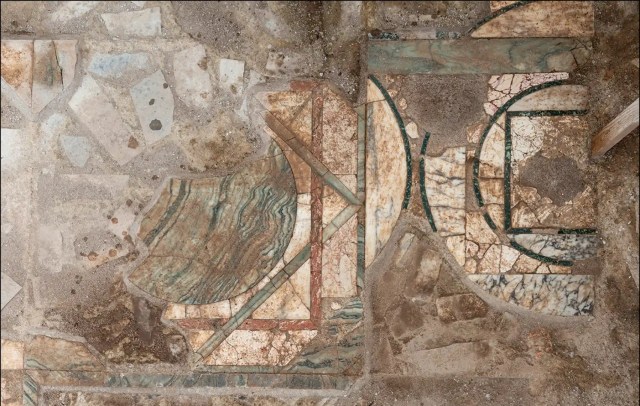
This decorative inlaid marble pavement is in one of the dining rooms overlooking the winery. (S. Castellani, after Dodd et al. 2023)

A pair of wealthy brothers built the Villa of the Quintilii in the 2nd century A.D. on land that sits about eight miles from Rome’s modern-day city center.

The site was so desirable that around 182 A.D., then-Emperor Commodus killed its owners to claim it for himself, kicking off a long period of imperial ownership. Many emperors used the villa over the years, with some making renovations and adding to its opulence. The name Gordianus is stamped into the lead pipes at the facility, which suggests that Emperor Gordian III, who ruled from 238 to 244 A.D., built the winery or at least renovated it.

Formal excavations of the villa ruins have been going on since the late 18th century, but the first evidence of the winery did not emerge until 2017. Archaeologists were originally looking for the entrance to the roughly 60-acre site when they found an “unexpected surprise,” said Dodd, who wrote the paper while working at the British School at Rome.

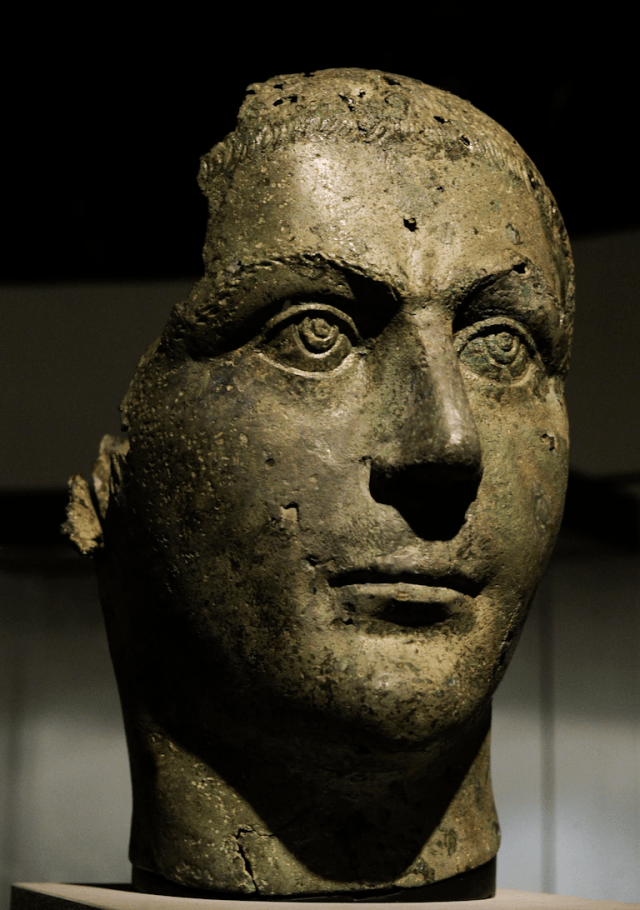
A bronze bust of Roman Emperor Gordian III. (Universal History Archive/ Universal Images Group/Getty Images)

Unlike the other winemaking facilities that would have been common in the empire, the Quintilii winery was extravagantly decorated with some of the finest materials. The floors were not waterproof concrete but were made of imported red marble. Juice from pressed grapes would have spurted from channels in a marble-lined façade, creating a purely entertaining fountain effect. And the winery is surrounded by dining rooms, once richly appointed, that seem to have nothing to do with the production process.

On the basis of these clues, archaeologists think the Quintilii served as a kind of “imperial toy,” said Alice Poletto, a Rome fellow at the British School at Rome who was not involved in the research.

The experts think enslaved people would have pounded grapes in the winery’s treading area, most likely slipping about on the luxurious red marble while doing so, to the gruesome delight of sloshed guests. Attendees from the era’s highest social circles would look on as the roughage of crushed grapes, or must, made its way down to mechanical presses, which would send juice gushing through fountains set in the courtyard wall and pouring from open channels into dolia, or ceramic storage jars, in the ground to collect the spoils.

By Poletto’s estimations, the dining complex could seat 25 to 27 guests, with the winemaking spectacle taking place perhaps twice a year as “a unique opportunity and an absolutely high honor that served not only as a reward to the invitees, but also, in my opinion, a way for the emperor to highlight [and] reinforce his power.”

Playing at agriculture

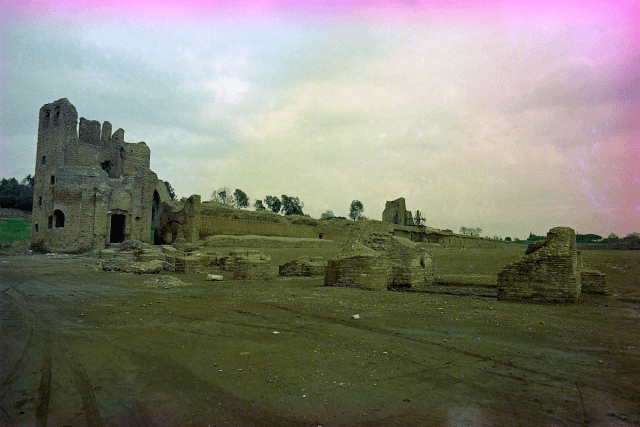
The lavish Villa of the Quintilii sprawled across almost 60 acres of land. (AP)

Banquets at the Quintilii might have been organized ahead of political elections, Poletto thinks; a way to manipulate results behind the most regal of doors. For many emperors, extending invitations to such events was “a privilege and a warning,” she said, a way for them to communicate that “your life is in my own hands … be aware that if I decided that you’re going to die tomorrow, you are going to die tomorrow.”

Such was the state of play in ancient Rome, where death could be employed to expand the empire and for post-feast japes alike. Poletto says that Rome’s latter Imperial period included “banquets of the dead,” where actors would dress as demons or afterworld deities and pretend to murder guests for the grim entertainment of others.

In addition, “drinking wine was a very important symbol of status and prestige” for the ancient Romans, said Paulina Komar, an assistant professor at the Institute of Archaeology at the University of Warsaw who has written extensively on wine’s role in ancient empires.

Oxford University’s Purcell said that “the gathering of grapes and the making of wine [was] of course the centerpiece of Greek and Roman upper class,” and that he would be “quite surprised” if the more humdrum olive or grain harvests attracted similar attention.

Still, history is replete with examples of the wealthy toying with the idea of a bucolic lifestyle for sport, Purcell added. In the late 18th century, Marie Antoinette installed a dairy at her castle in Rambouillet that has stunningly ornate décor, designed for its form rather than function. The winery at the Quintilii is a similar example of “the super-rich play[ing] with the fantasy that they might be participating in the romantic life of agricultural production,” he said.

A view from what once was the west dining room shows the winery’s cellar area leading up to the production levels. (Emlyn Dodd)

It is possible that more examples of winemaking as sport will emerge from Roman ruins. The discovery at the Quintilii follows that in 2016 of a similar facility at Villa Magna, a site in central Italy dated to about 100 years earlier. These “thick and fast” findings, as Purcell describes them, offer hope about what might be unearthed next.

“It does make you wonder about other periods of the Roman Empire, perhaps even earlier in the republic,” Dodd said. “Was it a common phenomenon, or are we just seeing a handful of incredibly rare examples that particular emperors or super-elite people built?”

Purcell’s money is on Hadrian’s Villa in Tivoli, 20 miles from Rome, as the spot next likely to reveal such riches. “It wouldn’t astonish me at all,” he said, to find “sumptuous public rooms … [at] the biggest and best Roman Imperial villa that was ever built.”

And back at the Quintilii, there are more discoveries to be made. One dining area has been excavated, but two spots around the wine cellar have yet to be unearthed, as well as a number of spaces attached to the presses and production areas. Finding what lies beneath these is the next step, Dodd said, “to tease apart chronologies and purposes and see where it takes us.”

.o0o.

Posted in Magazines and Books wine related, Wine History | 1 Comment

Tasting No 254 – June 27, 2023 – Valle de Uco, Argentina

Club del Vino

Tasting No 254 – June 27, 2023 – Valle de Uco, Argentina


Capri Ristorante, McLean VA


  1. Tasting Overview

 Valle de Uco is a viticultural region southwest of Mendoza, in Argentina. Situated along the Tunuyán River, the Uco Valley is widely considered one of the top wine regions in Mendoza, and all of Argentina. The main objective of the tasting is to present four of the most significant types of wine produced in Valle de Uco.

Type of tasting: Open

Presenters: Jairo Sanchez and Jorge Requena

Participants: To be announced

These are the wines: 

  1. Catena Zapata, Catena Alta, Chardonnay, 2018
  2. Domaine Nico, La Savante, Pinot Noir, 2020
  3. Salentein Numina Gran Corte, Bordeaux Red Blend, 2019
  4. Zuccardi, Jose Zuccardi, Malbec, 2018     

The Valle de Uco Region

Argentina is one of the most important wine-producing countries in the New World, and vies with Chile for the position of largest producer of wine in South America. The high altitude deserts of the eastern Andes mountains have given rise to a high quality wine industry.

Mendoza is Argentina’s largest and best-known wine regions, often producing great wines to critical acclaim. Here, desert landscapes and high altitudes combine to make a very stable climate and a terroir that gives rise to aromatic, intensely flavored reds. Three-quarters of Argentinian wine production takes place in Mendoza. Furthermore, Mendoza Malbec accounts for 85 percent of the Malbec made in the country. There is more Malbec planted in Mendoza than anywhere in the world.

Valle de Uco is located 88 km to the south of the City of Mendoza, in the foothills of the Andes, the Uco Valley spans the departments of Tunuyán, Tupungato and San Carlos. The wines from there are often labelled with one of these three place names.

Whereas in 2005 the valley had 16,800ha under vine, today it contains 28,600ha, representing 19% of all the vineyards in Mendoza. Almost one in five bottles produced in Mendoza, comes from the valley.

Because the region is so large, in recent years producers have been carrying out detailed analysis to identify smaller Geographic Indications (GIs). Paraje Altamira, Los Chacayes and San Pablo are some of the most famous, together with Gualtallary, and all contain vineyards set at altitudes of between 900m and 1,500m. Irrigation water comes from the glaciers above, mainly channelled by the Tunuyán and Las Tunas rivers.

The climate is continental: dry with plenty of sun, low rainfall, cold winters and warm summers with a large thermal range. The point of difference is the altitude, which defines the temperature (on average, it drops 1༠C every 150m higher up you go) and the cool climate has lured many producers away from warmer areas further down. All these different factors result in expressive, tense reds and vibrant whites.

The proximity and exposure to the Andes make for alluvial, rocky soils with widely varying mixtures of sand, limestone and clay in unique combinations that produce memorable wines.

Within the 50km (30 miles) Valle de Uco region there are smaller wine regions with slightly different wine styles:

Tupungato is well-known among collectors because of an unofficial growing area called Gualtallary with calcareous soils. You’ll find fresher styles of Malbec, Chardonnay, and Cabernet Franc because vineyards are as high as 5,250 feet (1600 meters).

Tunuyán contains the Vista Flores appellation. The area has sandy soils which produce elegant and aromatic styles of Malbec with minty notes. You’ll also find some Cabernet Franc and even Pinot Noir here.

San Carlos has alluvial soils with more loamy-clay which creates a lush, chocolately palate. The region also sits a bit lower at around 3770 feet (1150 m) which softens the acidity. Expect to find lush, rich styles of Malbec and Cabernet Franc. 

Wine selection. The selected wines – Malbec, Red Blend, Chardonnay and Pinot Noir – are representative (about 75%) of the wines produced in the Uco Valley.

  1. Information about the wines

Wine #1. Catena Zapata ‘Catena Alta’ 2018, Chardonnay, Mendoza, Argentina

Producer: Catena Zapata is one of the foremost wine estates in Mendoza, Argentina. Founded in 1902 and still in family hands, it is particularly known for its rich, full-bodied red wines produced from Malbec. The estate is made up of six vineyards in the Luján de CuyoTupungato and San Carlos sub-regions of Mendoza, at altitudes ranging from 3000 to 4750 feet (920 to 1450 meters) above sea level.

The Wine:     Vintage: 2018              Varietal: 100% Chardonnay

Regions: Gualtallary District, Tupungato Region, Uco Valley, 1,450m average elevation

Vinification: Hand-harvested. Whole clusters are pressed, and then 100% fermented in 500 L French oak barrels with natural yeasts at low temperatures. Wild yeasts. Aged for 14 months in French oak. 30% does not undergo malolactic fermentation. First, second and third use barrels used.

Alcohol: 13.8%       Total Acidity: 7.05 grams/liter       pH: 3.25

Tasting notes: This chardonnay’s clonal material often gives way to rot from botrytis (the fungus that produces sweet wines), which is here manifested in that sweetness, although without compromising the wine’s tension and freshness. It also adds tremendous complexity, candied aromas in the midst of ripe fruits, and all accompanied by a very-Gualtallary acidity. Very much a mountain wine. (Patricio Tapia 94)

Rich but fresh aromas of lemon zest, orange and rose blossom. Also smoke and caramel. Rich, viscous and well structured on the palate. Lots of citrus. Elegant spice and a juicy, supporting acidity (Vinum Wine Magazine 17/20).

Wine # 2. Domaine Nico La Savante Pinot Noir 2020

Producer:   Domaine Nico lleva el nombre de la hija de Laura Catena, Nicola, que a su vez rinde homenaje a su bisabuelo, Nicola Catena, fundador de la bodega Catena Zapata en el año 1902

The wine:      Vintage: 2020     Varietal: 100% Pinot Noir

Vineyard Location:    Gualtallary, Tupungato Elevation: 1450 m.s.n.m. (4757 feet) Planted: In 1994,  Dijon clones: 115 and 777

Vinification:    The fermentation was in roll-fermentor and small stainless-steel tanks. Clone 115 was fermented with 40% whole cluster and clone 777 with 30% whole cluster. Max. Fermentation temperature: 24° C, 7 days maceration. Aged 15 months 30% new barrels, 30% second-use and 40% third-use. All french oak

Alcohol: 13.5%     pH: 3.46

Tasting Notes:       Red fruit with presence of herbs such as thyme, spices, and clove. Medium-high acidity, low alcohol, slight minerality alongside integrated oak and grainy tannins.

Wild smoky raspberries, brambleberries and oyster shells on the nose. Medium-bodied with vibrant acidity and taut, mineral character. Tense and elegant with a fine frame of tannins. Tightly wound. Drink after 2024. (James Suckling 95)

2020 was a warmer year, and the wine shows it when you taste it next to the 2021, which is cooler. This is a little rounder, with 13.5% alcohol and mellow acidity, with more cherry than flowers, tasty and juicy. It finishes dry and chalky. Best after 2022. (Robert parker 95).


Wine # 3. Salentein Numina Gran Corte 2019

The producer: The Bodega Salentien is located at an elevation of 1.200 meters (4.000 feet), right in the vineyard’s center. More than 49 hectares (121 acres), of native desert habitat were preserved and are a part of the bodega’s everyday landscape. The western horizon is dominated by the close snowy Andes.

The wine:        Vintage: 2019

Varietal Composition: 65% Malbec, 14% Cabernet Sauvignon, 8% Petit Verdot, 8% Merlot and 5% Cabernet franc.

Region: Tunuyán, Valle de Uco, Mendoza

Vinification: Hand harvested, fermentation in 7,000-liter oak casks. The varieties of this blended were made separately and after 6 months aged in barrels, the barrels were emptied and the blend was made, which came back to the oak barrel to finish the ageing process. The total ageing time was 16 months.

Alcohol: 14.5%         pH: 3.79

Tasting notes: It displays a bright, intense and deep purplish color. Is aroma is complex and elegant with notes of tobacco, cassis, blueberries, spices as well as notes vanilla and caramel. In the mouth, it is a wide and intense wine with full body and tannic structure and a long finish

Salentein Numina Gran Corte displays a bright, intense and deep purplish red color. Its aroma is complex and elegant with notes of tobacco, cassis, blueberries, spices as well as notes of vanilla and caramel. In the mouth, it is a wide and intense wine with full body and tannic structure as well as a long and lingering finish (Winemaker Notes)

Purple in the glass. The complex nose offers clearly defined notes of cigar box, vanilla, fresh plum, blackcurrant and bay leaf with hints of ash. Lean and juicy in the mouth with refined tannins, the flavors are driven by the oak (Vinous 94).

Wine # 4. Zuccardi Jose Zuccardi Malbec 2018

The producer:  Familia Zuccardi is a family-run winery based out of the Bodega Santa Julia in the Mendoza region. The company has numerous brands, each with a wide range of wines, covering classic Argentinian varieties as well as numerous styles including sweet and sparkling wines.

The wine:         Vintage: 2018

Varietal Composition: 95% Malbec, 5% Cabernet Sauvignon

Vineyard Location: Malbec from IG Paraje Altamira (San Carlos), Cabernet Sauvignon from IG Gualtallary (Tupungato)


Vinification: Cluster selection, fermentation with native yeasts in concrete tanks. Aging for 24 months in large casks (2500 liters) and barrels (500 liters)

Alcohol: 14.5%           pH: 5.69 g/l

Tasting notes:  Blackberries, graphite, bla

ck pepper and crushed berries on the nose. Full-bodied, very tight and focused with bolted-down tannins that give it fantastic potential for aging. A little cabernet sauvignon here, too. Try after 2023 (James Suckling 96).

Balances muscle with grace, showing notes of molasses, ripe black cherry and black plum that offer nice richness, while a thread of plumeria picks up the trail midpalate. Reveals stony tannins, peppery elements and notes of espresso and orange peel on the lengthy finish. Drink now (Wine Spectator 94).

The 2018 José Zuccardi mixes Malbec from different regions in the Valle de Uco (today, Altamira and Gualtallary) all with limestone soils. It always has a touch of Cabernet Sauvignon (only 5% to 10%), which is not mentioned on the label, and is now matured in foudre for two years. I tasted this next to the 2019, where there are no differences other than the nuances from the year, with similar alcohol and acidity, but the sensation is of a little wider and powerful in the 2018. The wine feels very stable and harmonious after the long élevage, but there are no traces of oak (Robert Parker’s Wine Advocate 94).


  1. Menu (and wine pairing)

  • Seafood salad (Chardonnay)
  • Chicken grilled meat with vegetables (Chardonnay, Pinot Noir)
  • Grilled sirloin strip steak with cooked potatoes (Malbec, Malbec Blend)
  • Dessert, coffee, tea


  1. CV Members Rating : 

References:

https://daily.sevenfifty.com/exploring-argentinas-high-elevation-uco-valley/

https://timatkin.com/cork-talk/uco-valley/

https://www.winemag.com/2018/10/05/uco-valley-wine/

https://aroundtheworldin80harvests.com/2016/11/15/uco-valley-guide-terroir-wines-winemakers-wine-region/

https://www.tangol.com/blog/eng/the-19-most-outstanding-wineries-in-valle-de-uco_post_164

https://www.decanter.com/wine-reviews-tastings/uco-valley-wines-12-essential-ones-to-try-446346/

https://catenazapata.com/catena-alta-chardonnay.php

https://domainenico.com/english/la-savante-eng.html

http://www.bodegasalentein.com/en/bodega/lineas.html

https://zuccardiwines.com/en/vinos-de-viticultor/#jose-zuccardi

.o0o.


Qual a Quantidade Certa de Vinho na Taça?

What is the right amount of wine to pour in the glass?

.o0o.

Posted in Wine - Vino - Vinho | Leave a comment

Tasting No 253 – May 30, 2023 – Beyond Malbec: other wines with deep-rooted Argentinian identity

Tasting No 253 – May 30/2023 – Beyond Malbec: other wines with deep-rooted Argentinian identity

           Capri Ristorante, McLean VA

Torrontes vineyard, Salta

Bonarda vineyard, Mendonza


  1. Tasting Overview

In Argentina, while all the usual suspects are well known (Malbec, Cabernet Sauvignon, Merlot, Chardonnay, Sauvignon Blanc etc.), there are a few lesser-known varieties that have taken on a uniquely Argentinian identity. The main objective of this tasting therefore is to explore wines made with these special grapes: the white Torrontés and the red Bonarda.

Type of tasting: Open

Presenters: Claudia and Agilson Perazza

Participants: R. Arroio; M. Averbug; J. Brakarz; R. Connolly; M. Fryer; J. García; N. Marzella; A. and C. Perazza; L and J. Redwood; J. Requena; J. Sanchez; C. Santelices; R. Santiago; E. Silva; G. Smart; G. Vega; G. Zincke; and S. Ardila (guest).

These are the wines:

  • Susana Balbo, ‘Torrontés Crios’, Salta, 2019
  • Altos Las Hormigas ‘Colonia Las Liebres’ Bonarda, Mendoza, 2020
  • Familia Zuccardi ‘Emma Zuccardi Bonarda’, Mendoza, 2019
  • Bodega Aleanna ‘El Enemigo Bonarda’, Mendoza, 2018

The Menu

  • Seafood salad
  • Agnolotti di ricotta with tomato sauce
  • Lamb with rosemary and potatoes
  • Dessert, coffee, tea


  1. The grape varietals and the regions that produce them

 TORRONTÉS

“Malbec may be more popular, but Torrontés is Argentina’s special grape” (M. Puckette@Wine Folly)

Torrontés is an aromatic white wine that originated in Argentina. The only native grape variety in South America to really woo its drinkers, Torrontés is the Queen of Argentina.

Torrontés involves a group of three distinct varieties – Torrontés Riojano, Torrontés Sanjuanino and Torrontés Mendocino – all native to South America. They are a natural cross between the mission grape País (a red grape) and the sweet Muscat of Alexandria grape (also known as Zibbibo), and first appeared in the north of Argentina. Of the three varieties, the most popular (and most delicious) is the Torrontés Riojano, which grows dominantly in northern Salta. Other regions such as Mendoza and La Rioja produce a lot of Torrontés wines using the other two varieties of Torrontés, but these tend to be much simpler in aroma and taste and often made in a sweet style. The wine smells sweet but is usually made in a dry style. Albariño and dry styles of Riesling and Muscat Blanc (dry “Moscatel” from Portugal) are similar in aroma and taste to Torrontés.

The Torrontés thrive in Argentina’s high-altitude vineyards, particularly in the Cafayate region of Salta, where T. Riojano is grown. This region, on the edge of the Andes, boasts some of the highest vineyards in the world, reaching up to around 10,000 feet (3,000m) above sea level. Here, dry, desert-like conditions and a significant diurnal temperature shift help bring out the best qualities of Torrontés. The soils in Cafayate consist mostly of free-draining chalky loam and in some areas can be quite rocky. The dry soil causes stress in the vines which causes them to produce less vegetation and not as many grapes. As there are fewer grapes, it means the concentration of flavors within the grapes rises. New plantations in the higher parts of the Uco Valley in Mendoza are promising too.

Tasting notes: Color: pale straw color with silver and green highlights. Primary flavors: Meyer lemon; peach; rose petal; geranium; and citrus zest. “A perfume bomb in the nose, Torrontés is locally known as “the liar”, as its floral, fruity, and tropical notes trick you into thinking you might have a sweet wine, but the mouth is, to the contrary, bone dry and occasionally a little bitter. If you want a sweeter finish, try one of the late harvests (sweet wine) versions. When made well, it’s like the vinous equivalent of a gin and tonic!” (A. Barnes, Wine Folly).

Food pairing notes: Torrontés is an excellent match with fish and shellfish, as well as with the regional cuisine of the northwestern Argentina, especially the empanadas and the typical Locro argentino. Even though Torrontés smells sweet, it’s usually quite dry, making it a great match with savory dishes that feature exotic spices, fruit, and aromatic herbs. With its light aromatic style and cool serving temperature, it is an ideal wine to match with Asian and Indian cuisine due to its sweet floral aromas of rose petals and flavors of white peach and lemon zest.

BONARDA aka Charbono, Corbeau, Douce Noir…

Emblematic variety of Argentina

Bonarda is a stealthy red wine option from Argentina that many experts think is going to make a big splash in the coming years. If País was the most-planted red variety in Chile, Argentina’s equivalent would be Bonarda. Bonarda was the most widely planted red grape before the Malbec boom and suffered a similar historical treatment as País: downgraded to table wine and abandoned as it lost out on the fashion stakes.

About the grape: Bonarda, as it is called in Argentina, is not supposed to be called Bonarda: the actual true Bonarda grapes are a group of at least six distinct Italian grape varieties, the most well-known of them being Bonarda Piemontese.

Instead, the Argentinian grape, when was DNA-profiled, was found to be identical to a rare grape from the alpine vineyards of Savoie in eastern France, known as Douce Noir or Corbeau de Savoie, which is also found in old vineyards in Napa, under the name Charbono.

The Bonarda/Charbono grape is believed to have originated in the Savoie region in the 18th century, when the Savoie was in fact under Italian rule, rather than being part of France as it is today. The grape became a much-maligned variety during the 20th century and almost disappeared in France. In 1958 it was prohibited in France, and all 500 hectares of the Bonarda vines were pulled out, while it was being planted widely in Argentina.

Bonarda is very important viticulturally in Argentina, where it is second only to Malbec in terms of acreage. In all, Bonarda accounts for over 18,000 hectares (45,000 acres) in the country, representing nearly 10 percent of all grapes grown there. Bonarda has been used to make fruity, medium-bodied bulk wines with low tannins. However, more recently some producers began looking more seriously at Bonarda, discovering its great potential as a varietal, especially for its adaptability to warmer areas, and using site selection and winemaking techniques to make more interesting and premium wines. Of the total cultivated in Argentina, 60% is found in Eastern Mendoza, a warm area located at about 700-800 meters above sea level, where it does best, because of its long hang time required to reach phenolic maturation.

How does Bonarda differ from Malbec? Often considered Malbec’s little brother, while Bonarda displays ample color in the glass, just like Malbec, it delivers lower tannins and slightly higher, more juicy-tasting acidity. Most Bonarda wines are made with little to no oak, and rarely carries alcohol above 13.5% ABV.

Tasting notes: Color: deep ruby to deep purple. On the nose: very fruity on the nose at first; notes of black cherry compote, fresh blueberry, and plum. Then, its complexity evolves, giving off nuanced aromas of violets, 5-spice, allspice, and peonies. If the wine was oaked (though most are not), may have slight smoky notes of cigar box, sweet figs, and chocolate. On the palate: initial burst of fruitiness, medium-body, juicy acidity, and smooth, low-tannin finish. The Bonarda wines fall within three styles:

Traditional Bonarda: Historically pipped as Malbec’s little brother, they are vinified in the same way. More traditional Bonarda wines are fruit-forward coming from warmer regions. Key regions are San Juan, La Rioja, and sub-regions San Rafael and Rivadavia in Mendoza.

Fresh, flirty Bonarda: Treated with shorter maceration periods and some whole cluster carbonic maceration, this new clan of Bonarda are lighter, fruitier, and perfect to enjoy chilled over lunch. Key areas are Luján de Cuyo (sub-regions of Vistalba and Ugarteche) and Tupungato, in the Mendoza region.

Serious Bonarda:  In recent years, you will find a few new Bonarda plantations popping up on prime vine-estate in the highlands of the Uco Valley in Argentina, which proves just how seriously winemakers are once again taking the variety. Delving into the potential quality of Bonarda, these wines do not come cheap, but they do not taste cheap either. Most producers skip the oak and age wines in cement eggs, resulting in more linear, dark fruit and floral Bonarda with finesse. Key region is Uco Valley, Mendoza.

Pairing notes: Bonarda is a remarkably diverse food pairing wine because of its lower tannin and higher acidity. It will go well with chicken, beef, pork, and even a more steak-like fish (e.g., grilled salmon steaks with hoisin BBQ). Because of its subtle brown spice flavors, it will also pair well with flavors from the South Pacific (think pineapple, mango, teriyaki etc.). Locally inspired fares include mole sauces, curried potatoes, empanadas, and tacos al pastor.

  1. Information on the Wines

Wine #1 – Susana Balbo, ‘Torrontés Crios’, Salta, 2019

– The Producer: Dominio del Plata is an Argentinian wine company founded and owned by leading winemaker Susana Balbo since 1999. The winery is located in Luján de Cuyo, Mendoza, with vineyard plots in several subregions of the Uco Valley. The Crios label features a wide range of monovarietal and blended wines for everyday consumption, including a Malbec rosé. The winery mainly ferments the wine in stainless steel tanks, though concrete eggs have been introduced for premium wines. The Torrontés grapes are sourced from Cafayate, Salta, and the highest vineyards in Valle de Uco, Mendoza.

– The wine: this wine is crisp, refreshing and aromatic, with a bouquet of citrus fruits, passion fruit, lychee, and white flowers. Lively acidity, a hint of creaminess and a long mineral finish add depth and balance to the palate.

  • Vintage: 2019
  • Varietal: 100% Torrontés
  • Regions: Cafayate (Salta) and Uco Valley (Mendoza); 1700m average elevation
  • Hand-harvested
  • Vinification: fermentation in stainless steel tanks at 13oC max. with selected yeasts; conservation over lees for 3 months to improve wine structure.
  • Alcohol: 13%
  • Ratings: 90 pts. (Patricio Tapia Descorchados; Tim Atkin); 88 pts. (Cellar Tracker)

Tasting notes: “This wine blends grapes from two origins: Altamira in the Uco Valley (Mendoza), and Cafayate (Salta). According to Susana Balbo, the Altamira vineyard contributes with the herbs and citrusy side, while Cafayate’s adds the ripe white fruit aromas. The result is a tremendously fresh wine (something you often don’t find in this variety) that hasn’t lost its varietal character. The texture is smooth and round. An aperitif wine” (Patricio Tapia @ Descorchados).

Classic Bonarda: Bonarda wine to get to grips with the grape.

Wine #2 – Altos Las Hormigas ‘Colonia Las Liebres’ Bonarda, 2021


The producer: The sister brand of Altos Las Hormigas winery, Colonia Las Liebres was established in Luján de Cuyo, Mendoza to focus solely on the cultivation of Bonarda grapes and was one of the original makers of export-quality single-varietal Bonarda. It makes fresh, juicy and great value Bonarda reds, as well as an excellent traditional method rosé bubbly, and even a sparkling red (named Brusca, in ode to its Italian inspiration).

The Wine. The winery defines their approachable and very affordable red Colonia Las Liebres Bonarda Clásica as a bistro or trattoria wine. The ‘house style’ is to keep moderate alcohol and good freshness. It is a good example of the fresher, fruitier Bonarda produced in the region.  Ideal to pair with pasta Pomodoro dishes, pizza and light meats.

  • Vintage: 2021
  • Varietal: 100% Bonarda
  • Region: Mendoza; 90% organic grapes from Luján de Cuyo and 10% grapes from their new property Jardín de Altamira in the Uco Valley, where the limestone soils and higher altitude add tension to the wine even in a warmer year.
  • Fermented for 10 days in 3,000-liter stainless steel vats with indigenous yeasts, with daily rack-and-return for gentle extraction.
  • Matured in concrete tanks with no oak treatment.
  • Alcohol: 13.1%.
  • Ratings: 90 pts (Robert Parker’s Wine Advocate); 91 pts (Patricio Tapia – Descorchados); 90 pts. (Tim Atkin).

Tasting notes: “This is a classic in the Altos Las Hormigas catalog and has been made since the early 2000s. The grapes come from old vines in Luján de Cuyo and some grapes from estate-owned vineyards in Paraje Altamira in southern Uco Valley. It’s a juicy Bonarda with firm and friendly tannins and tones of black fruit in jam (as is usual in the variety) but accompanied by refreshing acidity that invites you to keep on drinking.” (Patricio Tapia).


Bonarda with Bite: Serious Bonarda wines for a different expression

Wine #3. Bodega Aleanna ‘El Enemigo Bonarda’, 2018

The Producer. El Enemigo is a cult wine producer based in Mendoza. The estate is a joint venture by Adrianna Catena and Alejandro Vigil, the chief winemaker at Bodega Catena Zapata since 2002. The pair created El Enemigo and the “Bodega Aleanna” in 2007. The estate focuses on traditional winemaking techniques and produces two wine ranges: Gran Enemigo and El Enemigo. The El Enemigo range is devoted to varietal wines made from Malbec, Cabernet Franc, Bonarda and Chardonnay, while the Gran Enemigo range includes Bordeaux blends, and a number of single vineyard Cabernet Franc wines.

The Wine: This Bonarda is a tribute to old Bonarda wines of the Eastern Mendoza, a wine made in a traditional Mendoza style. This wine shows a deep violet color with bluish reflections. The nose is intense and complex. Intense aromas of ripe black fruit, blackberries, raspberries, black cherries, chocolate and liquor, with some spicy notes of fresh herbs provided by the Cabernet Franc. The taste has a sweet impact with silky tannins and aromas of ripe black and red fruits with notes of licorice and vanilla. Its natural acidity is refreshing. Because of its concentration and complexity, the finish is long and persistent.

  • Vintage: 2018
  • Composition: 85% Charbono (Bonarda; 15% Cabernet Franc.
  • Region/vineyards: El Mirador, Rivadavia (Bonarda); Gualtallary, Tupungato (C. Franc).
  • Vinification: 15 days-fermentation with wild yeast, max. temp. 28oC for 15 days, with 25 days maceration in French oak barrels 2nd and 3rd
  • Aged 15 months in 100-year-old foudres.
  • Alcohol: 13.5%
  • Ratings: 92 pts. (Wine Spectator); 91 pts. (Tim Atkin); 92 pts. (Jésica Vargas @Wine Enthusiast); 88 pts. (Decanter World Wine Awards).

Tasting notes: An intense and spiky Bonarda. Super aromatic and a more challenging, but fun, mouth feel that is blended with a dash of Cabernet Franc. “The bouquet of this well-crafted wine is loaded with flowers, rosemary, strawberry and cherry aromas. Medium in weight, it delivers plenty of red fruit flavors with a touch of spice and toasted oak. Silky tannins and nice acidity make the wine very enjoyable. It’s a good and delicious example of what Bonarda wines can offer”. (Jésica Vargas @ Wine Enthusiast).


Wine #4 – Familia Zuccardi, ‘Emma Zuccardi Bonarda’, Mendoza, 2019

The Producer: Familia Zuccardi is a family-run winery based out of the Bodega Santa Julia, built in 1968, in Mendoza by Alberto Zuccardi. The Familia Zuccardi bodega was established in 2013 in the Valle de Uco, by Alberto’s grandson, Sebastián. Today he leads a young team of agricultural engineers and enologists charged with producing the highest quality wines in the Uco Valley.

The wine: Emma Zuccardi is part of the bodega’s ‘winegrowers’ line of wines. Emma Zuccardi, Sebastián’s grandmother, is a charming and sophisticated woman. She is creative and has her own style. This wine is a tribute to her personality. “The 2019 Emma Zuccardi Bonarda was produced with grapes from the zones where they believe the variety behaves better, in this case in the Valle de Uco, more specifically San Pablo and Altamira, in approximately the same proportion. Fermented and matured in concrete and bottled unoaked, like many wines at Zuccardi, to preserve the varietal purity. It’s juicy and has citrus freshness, something 2019 might have in common with 2018, with very good finesse” (Robert Parker’s Wine Advocate).

  • Vintage: 2019
  • Variety: 100% Bonarda
  • Region: IG Paraje Altamira, Uco Valley; 1100 m ASL and IG San Pablo, Uco Valley, 1400 m ASL
  • Manual harvest
  • Vinification: spontaneous fermentation with native yeasts, maceration for 20-25 days followed by Malolactic fermentation.
  • Fermentation and aging in concrete vats.
  • Alcohol: 12.9 %
  • Ratings: 93 pts. (Robert Parker’s Wine Advocate); 95 pts. (Patricio Tapia, Descorchados); 94 pts. (Tim Atkin).

Winemaker notes: Red with black intense purplish tints. Very fresh, red and black fruit aromas reminiscent of strawberries, cherries, blueberries and raspberries. Silky, smooth and juicy entrance, with a lively acidity and elegant tannins that give a great structure.

Club del Vino  Members Rating 

The tasting took place before the wines’ prices were revealed. The participants rated them according to relative preference, and the Familia Zuccardi ‘Emma Zuccardi Bonarda’, 2019 was rated the as the Best Wine and the Altos Las Hormigas ‘Colonia las Liebres Bonarda’ 2019 as the Best Buy.


References

https://www.wine-searcher.com/

https://winefolly.com/; https://www.winesofargentina.org/en/provinces/salta;

https://winefolly.com/tips/5-south-american-wine-varieties-you-need-to-know/

https://winefolly.com/grapes/bonarda/

https://southamericawineguide.com/a-guide-to-bonarda-wine-grape-variety-argentina/.

https://www.decanter.com/argentina-2014-coverage/bonarda-a-unique-varietal-of-argentina-with-great-potential-30561/

https://www.susanabalbowines.com.ar/

https://zuccardiwines.com/vinos-de-viticultor/#emma-zuccardi

https://www.susanabalbowines.com.ar/vino/crios-torrontes.

https://www.enemigowines.com/about-us

.o0o.

Posted in Wine - Vino - Vinho | Leave a comment

Tasting No 252 – April 25, 2023 Aconcagua, Chile

Club del Vino

Tasting No 252 – April 25, 2023, 12:30 PM

Wines from Aconcagua Region, Chile

           Capri Ristorante, McLean VA

 1. Tasting Overview

The wines of the Aconcagua region, Chile, have a long history and tradition of more than 150 years and are awarded worldwide recognition for their quality. The main objective of the present tasting is to discover the new wines of this region produced by the historic winery Errázuriz. The three red wines presented are from a special edition 2020 vintage, aged in first and second-generation barrels that mitigate the wood influence in smell and taste from older barrels. The fourth red is one of the new ultra-premium wines in Chile created by the winery Seña, located in Ococa, at the center of the Aconcagua Valley. The wines to be tasted come from the coastal Valley and the Andes Mountain, selecting the varietals that most shine in these areas.

Type of tasting: Open

Presenters: Jorge Claro and Cristian Santelices

Participants: M. Averbug; L. Boccalandro; J. Brakarz; J. Claro; C. Estrada; J. García; A. and C. Perazza; L. Redwood; C. Santelices; R. Santiago; E. Silva; P. Turina and J. Entwistle (invited).

These are the wines:

  1. Viña Errázuriz, ‘Aconcagua Costa’ Pinot Noir, Aconcagua Valley, 2020
  2. Viña Errázuriz, ‘Aconcagua Alto’ Cabernet Sauvignon, Aconcagua Valley, 2020
  3. Viña Errázuriz, ‘Aconcagua Alto’ Carmenere, Aconcagua Valley, 2020
  4. Viña Seña, Seña– 25 años, Aconcagua Valley, 2019


  1. The Aconcagua Region

The Aconcagua Valley is a wine-producing region of Chile located 100 kilometers (60 miles) north of the capital, Santiago, and is one of Chile’s four main producing regions. It takes its name from the eponymous river flowing through it, named after the 6,960 meter-high (22,835 ft) Mt. Aconcagua at its eastern end. This is the highest mountain in the Americas and directly contributes to the terroirs in the Valley below. This Valley is part of the Valparaiso Region, which produced 15% of the 2022 national wine production.

The Aconcagua Valley was chosen for this tasting because of its unique viticultural climate. The Mediterranean climate in this valley ensures the warm, dry summers, the bright sunny days, and the cold, rainy winters that the vines love. In addition, the cooling effects of the Pacific Ocean’s Humboldt current and the down-drift winds of the Andes Mountains create unique climate conditions with cooling midday breezes, cold nights, and a broad daily temperature oscillation that also extends the ripening period so that the grapes develop intense fruit flavors, ripe tannins, deep color, and crisp acidity.

Measuring around 100 km (60 miles) in length, the Valley runs between the slopes of the Andes in the east and the Pacific Ocean in the west. Many wine-growing areas are closely linked to the Aconcagua river and follow its course as it brings fresh meltwater (and mineral-laden silt) down from the Andean peaks and provides vineyard irrigation. Vineyard altitude in Aconcagua varies from 1,000 meters (3,300 ft) above sea level in the east to 50 m (160 ft) in the lower-lying regions in the west.

While alluvial soils predominate in the Aconcagua Valley along its river throughout, its east-west flow creates drastically different conditions on each end. Its western seaside vineyards, with clay and stony soils upon gently rolling hills, produce cool-climate varieties such as Sauvignon Blanc, Chardonnay, and Pinot Noir. Its inner region is one of Chile’s hottest and has some of its best red wines. Panquehue in the inner Aconcagua is the site of Chile’s first Syrah vines, planted in 1993.

Red grape varieties dominate the production in the highest part of Aconcagua Valley. Cabernet Sauvignon, Merlot, and Cabernet Franc have a long tradition in the interior of the Valley. However, Chardonnay, Sauvignon Blanc, and Pinot Noir, as cooler climate varieties, are well suited to the coastal zone of the Valley.


  1. Information about the Wineries

Errázuriz Winery and Vineyard

The winery was founded by Maximiano Errázuriz (February 21, 1832 – November 17, 1890), a Chilean politician, industrialist, and winemaker of Basque descent. He chose the Aconcagua Valley to found Viña Errázuriz in 1870, when no one imagined its natural benefits as a terroir.

With 150 years to its name, you might be forgiven for thinking Errázuriz is a historical winery – it is, but it is also one of the most innovative and forward-thinking producers in Chile. The wine portfolio is almost endless, and their treasures include the ‘Aconcagua Costa’ range, from the cooler parts of Aconcagua Valley, and the ‘Las Pizzaras’ Chardonnay and Pinot Noir on slate soils. Their most famous wine is ‘Don Maximiano’, a rich Cabernet-based blend from the warmer Aconcagua Andes.

In 1873, Viña Errázuriz launched its first wine. At this time, Viña Errázuriz had 300 hectares, irrigation canals, and vines imported from France. Together with the winery, Don Maximiano built a villa, baptized as Villa Errázuriz, which had a church, a school, and houses for the worker. Since its foundation, Viña Errázuriz has been dedicated to a philosophy of excellence and innovation. Don Maximiano sent for the finest clones from France and, with tenacity and perseverance, transformed this barren land into a world-class vineyard.

In 1890, Rafael Errázuriz, the son of Don Maximiano, took over the administration of the winery. During this period, the total area of planted vineyards increased to 1,300 hectares, making it the largest vineyard in the world in the hands of a single owner.

On August 16, 1906, the Valparaíso earthquake happened, with an intensity of 7.9° on the Richter scale, which damaged part of the winery’s cellars, including the underground warehouses. During the following decade, intense repair work was carried out, which also meant renovating the bottling room.

Inspired by ‘The Judgement of Paris’ in 1976, Viña Errázuriz decided to carry out a blind tasting, one of the most professional and impartial ways of presenting and qualifying wines. The tasting took place in 2004 in Berlin, with the wine legend Steven Spurrier. Europe’s most respected judges tasted historic vintages of First Growths Super Tuscans from Italy and Grand Crus from Bordeaux, France. The result was surprising. Two wines from the same group won first and second place, and Don Maximiano was listed as one of the ten best wines in the world. The Berlin tasting became a milestone for Viña Errázuriz and the entire Chilean industry, empirically verifying that Chilean wines were up to the standards of prestigious fine wines worldwide, and raising Chile’s image as a world-class producer.

This critical milestone was followed by ten years of blind tastings around the world, with the support of Steven Spurrier. It included 22 events in 18 markets around the world, with more than 1,400 experts from the wine industry. Chile was among the first three places in 20 of the 22 events, reaching an impressive 90% of the preferences, demonstrating enormous consistency.

Viña Errázuriz promoted the new Aconcagua Costa Appellation, and was the first winery to plant vines and develop the coastal area of the Aconcagua Valley. Established into a new Chilean wine appellation, Aconcagua Costa was recognized by Chilean Wine Legislation in 2012. Aconcagua Costa’s new DO appellation is an area with a cool climate, maritime influence, and slate soils.

Errázuriz is recognized as, perhaps, the single top-quality producer of Chilean wines in recent years. As a result of these efforts, a Chilean wine obtained 98 points: Las Pizarras Chardonnay 2017 was awarded best Chilean wine, a milestone for the country’s wine industry. The same year, Robert Parker’s Wine Advocate Extraordinary Winery Awards recognized Viña Errázuriz as the Best Winery in Chile. In addition, Eduardo Chadwick, the current owner, the fifth generation of his family to be involved in the wine business, was named Decanter Man of the Year 2018.

Today, this family tradition continues, exploring new appellations in the Aconcagua Valley and constantly improving its winemaking techniques to keep Chile a world-class wine producer. As an estate winery, Errázuriz strives to produce the finest wines by controlling every stage of the winemaking process with the most natural techniques. An emphasis is placed on the delicate handling of the wines to produce wines of elegance and complexity. This dynamism and passion for wine have made Errázuriz an internationally respected quality wine producer.

Seña Winery and Vineyard

Seña is a stunning, ground-breaking estate located in Ocoa in the Aconcagua Valley. It was created in 1995, as a joint venture between Errázuriz President and owner, Eduardo Chadwick, and the well-known wine businessman Robert Mondavi. Their shared passion for excellence and innovation led to the creation of the first world-class Chilean wine with provenance and a distinct personality. Modeled on a Bordeaux style, it has a Chilean soul given by its Carmenère variety, grown under biodynamic farming principles in the Aconcagua Valley. Their dream was to create a wine that would be welcomed, in time, among the world’s First Growths.

Seña wine is one of Chile’s top Cabernet Sauvignon blends coming from Aconcagua Valley in Chile. Seña 2019, its 25th Anniversary vintage, showcases that full potential in a wine of balance, depth, and elegance. Each year, one Seña wine is made and blends Cabernet Sauvignon, Carmenère, Cabernet Franc, Malbec, Merlot, and Petit Verdot. It champions Chile’s Carmenère grape and showcases the grape, the region, and the nation.


 4. Information on the Wines

Wine #1. ErrazurizAconcagua Costa’, Pinot Noir, Aconcagua Valley, 2020

Producer: Errázuriz Winery

The wine:
Vintage: 2020

  • Composition: 100% Pinot Noir
  • Viticulture: the grapes were sourced from the Aconcagua Costa vineyard, 12 kilometers from the Pacific Ocean. Planted by Viña Errázuriz in 2005 and 2009, the soil is composed of a thin layer of loamy texture and placed on clay and metamorphic rock (slate/schist), providing the mineral notes present in the wines that are grown in these vineyards.
  • Winemaking process: Grapes were handpicked between February 26 and February 28, double sorted, 85% destemmed and crushed, then placed in open-top stainless-steel tanks (15% whole clusters). Before fermentation, the grapes underwent a 3 to 5 days cold soak at 8°C.
  • Fermentation: was carried out with native yeasts only, by which the wine develops complex and distinctive aromas and flavors. Total skin contact, including post-fermentation maceration, was 12 to 20 days.
  • Aging: The final blend is aged for 11 months in French oak barrels, 15% new.
  • Alcohol: 13,5 %
  • Critical Acclaim, awards: 93 pts (Tim Atking); 92 pts (Robert Parker’s Wine Advocate).
  • Important facts about the wine: the wine has limpid ruby-red color with beautiful violet flashes. On the nose, this Pinot Noir is intense, showing red fruits as raspberries, accompanied by floral notes that remind of rosehip, framed by spices and a smoky note. It also has notes of fresh red fruit with smooth balsamic touches, pleasant tension, fresh with polished, round tannins, and elegance. Fresh red fruits and floral notes with soft balsamic hints dominate the palate. It has excellent structure, tension, and freshness, with polished and rounded tannins that make it a very attractive wine and easy to drink.
  • Suggested Pairing: Pairing with risotto, pizza/pasta, mild creamy cheeses, and oriental food.


Wine #2. Errazuriz, ‘Aconcagua Alto’ Carmenère, Aconcagua Valley, 2020

Producer: Errázuriz Winery

– Information about the wine:

  • Year– Vintage: 2020
  • Composition: 100% Carmenère
  • Viticulture: The Aconcagua Alto Carmenère primary grapes come from various vineyard blocks in the Aconcagua Valley. Located in the valley’s interior, the vineyard soils have a predominantly silty texture and are of colluvial origin. The unique conditions of nutrition and drainage of the diverse soils help control plant vigor, producing balanced fruit loads with small bunches and berries.
  • Winemaking process: Grapes were handpicked, double-sorted, and then crushed. Next, the must was deposited into stainless steel tanks for fermentation. Then, the wine was moved directly to French oak barrels, 35% of which new, where it underwent malolactic fermentation and was aged for 14 months.
  • Alcohol: 13,5 %
  • Critical Acclaim, awards: 92 pts. (James Suckling) and 92 pts. (Robert Parker’s Wine Advocate).
  • Important facts about the wine: The 2020 vintage of Aconcagua Alto Carmenère displays a beautiful cherry red color with violet hues. The nose delivers black cherries, cigar box, black olives, roasted red pepper, and a soft hint of ripe blackberries. With an elegant entrance, the palate offers red and black fruits accompanied by delicate notes of tobacco, cloves, and some bitter chocolate. Silky tannins deliver a great sensation of freshness and sound Volume with a long and pleasant finish.
  • Suggested Pairing: Pair this with grilled and roasted red meat, casseroles/stews, and mature strong cheeses.


 Wine #3 Errazuriz, ‘Aconcagua Alto’ Cabernet Sauvignon, 2020

Producer: Errázuriz Winery

The wine:
Vintage: 2020

  • Composition: Cabernet sauvignon 88 %, Petit verdot 7 %, Cabernet franc 5 %
  • Viticulture: The Aconcagua Alto Cabernet Sauvignon grapes are sourced primarily from our Max vineyards in the Aconcagua Valley. Located in the valley’s interior, the vineyard soils have a predominantly silty texture and are of colluvial origin. The unique conditions of nutrition and drainage of the diverse soils help control plant vigor, producing balanced fruit loads with small bunches and berries.
  • Winemaking process: The grapes were handpicked early in the morning, inspected on a double selection table, crushed, and deposited into stainless steel tanks for fermentation. Total maceration ranged from 8 to 28 days. The wine was aged for 14 months in French oak barrels, 35% of which new.
  • Alcohol:0 %
  • Critical Acclaim, awards (optional): 92 pts. (James Suckling); 91 pts. (Robert Parker’s Wine Advocate).
  • Important facts about the wine: The 2020 vintage of Aconcagua Alto Cabernet Sauvignon displays a medium-intensity, bright, ruby-red color. The nose shows ripe red and black fruit aromas framed by clove and a soft coffee note. The palate offers a dominant note of cassis, cherry, fresh blueberries, and a hint of cherry tart. It has a medium structure with fine-grained tannins provide excellent support, finishing with great persistence.
  • Suggested Pairing: grilled and roasted red meat, casseroles/stews, mild creamy cheeses, and portobello mushrooms with garlic butter.

 Wine #4.  Seña, ‘25 Años’, Aconcagua Valley, 2019

Producer: Seña Winery

The wine:
Vintage: 2019

  • Composition: 60% Cabernet Sauvignon, 21% Malbec, 15% Carmenere and 4% Petit Verdot
  • Viticulture: The Don Maximiano vineyards are located in the Aconcagua Valley, and the oldest among them are Max I, Max II, and Max V blocks. Cabernet Sauvignon and Carmenère vines were planted in 1978 and 1993, respectively, while the Petit Verdot was planted in 1999. The three vineyard blocks contributing grapes are planted on north or northeast-facing hillsides with 5°–25° of a slope. Soils are volcanic, colluvia l, and piedmont (Max I and II) or alluvial (Max V), with good drainage conferring low to moderate vigor. The colluvial and volcanic rocky soils of Max I show a high presence of mica with a clay-silt texture. Max II has deep colluvial grounds of volcanic origin, with loam to sandy-loam texture, and both have 30–40% stone content. Max V has deep gravelly alluvial soils with 50% stone content and excellent drainage.
  • Winemaking process: After a mild winter and a shortfall of rain, warm temperatures encouraged a fast spring start with a healthy bud break and perfect flowering and fruit set as October to December were warmer than usual. Although 2019 is considered a warm vintage in Chile, the Seña vineyard enjoyed a cooler-than-average summer, resulting in a total heat summation of 1,478 DD, very much in line with our historical records. Being situated close to the sea and with the benefit of coastal winds generated temperatures, fortunately, cooled during January, March, and April, allowing for a long hanging period. This led to a slower accumulation of the sugars needed to balance the gradual softening of tannins and the development of fruit-driven flavors: so the wines’ fruit intensity and bright acidity were preserved. The 2019 harvest started on March 15th, delivering a small crop with complex aromas and ‑flavors. The young wines had a seamless texture, good structure, silky tannins, and great length, elegance, and finesse that shone through them. This is a great vintage of Seña. The wine was aged 22 months, 90% in French oak barrels (80% new) and 10% in foundres.
  • Alcohol: 13.5 %
  • Critical Acclaim, awards (optional): 98 pts Robert Parker, 98 James Suckling, and 97 pts Decanter
  • Important facts about the wine: A deep, bright, ruby red color with purple hues, Seña 2019 shows complexity on the nose with red and black fruit aromas and a distinctive freshness. Several layers of aromatics deliver suggestions of pepper, dill, and rosemary alongside coffee beans, pastries, and vanilla. On the palate, Seña shows notes of blueberry pie and cassis cream whilst brimming with fresh-picked red and black fruits. Seña 2019 is an exquisite wine with great structure, complexity, and depth – with notable freshness and polished tannins.
  • Suggested Pairing: grilled and roasted red meats, pizza/pasta, casseroles/stews, mild creamy cheeses, and mature strong cheeses.

The following link provides further information about the History of wine making in Chile, and about the founder of Viña Errázuriz, Maximiliano Errázuriz.


  1. Menu

  • Crab soup

  • Mushroom risotto

  • Grilled tenderloin with potatoes and green beans

  • Desert


  1. CV Members Rating : 

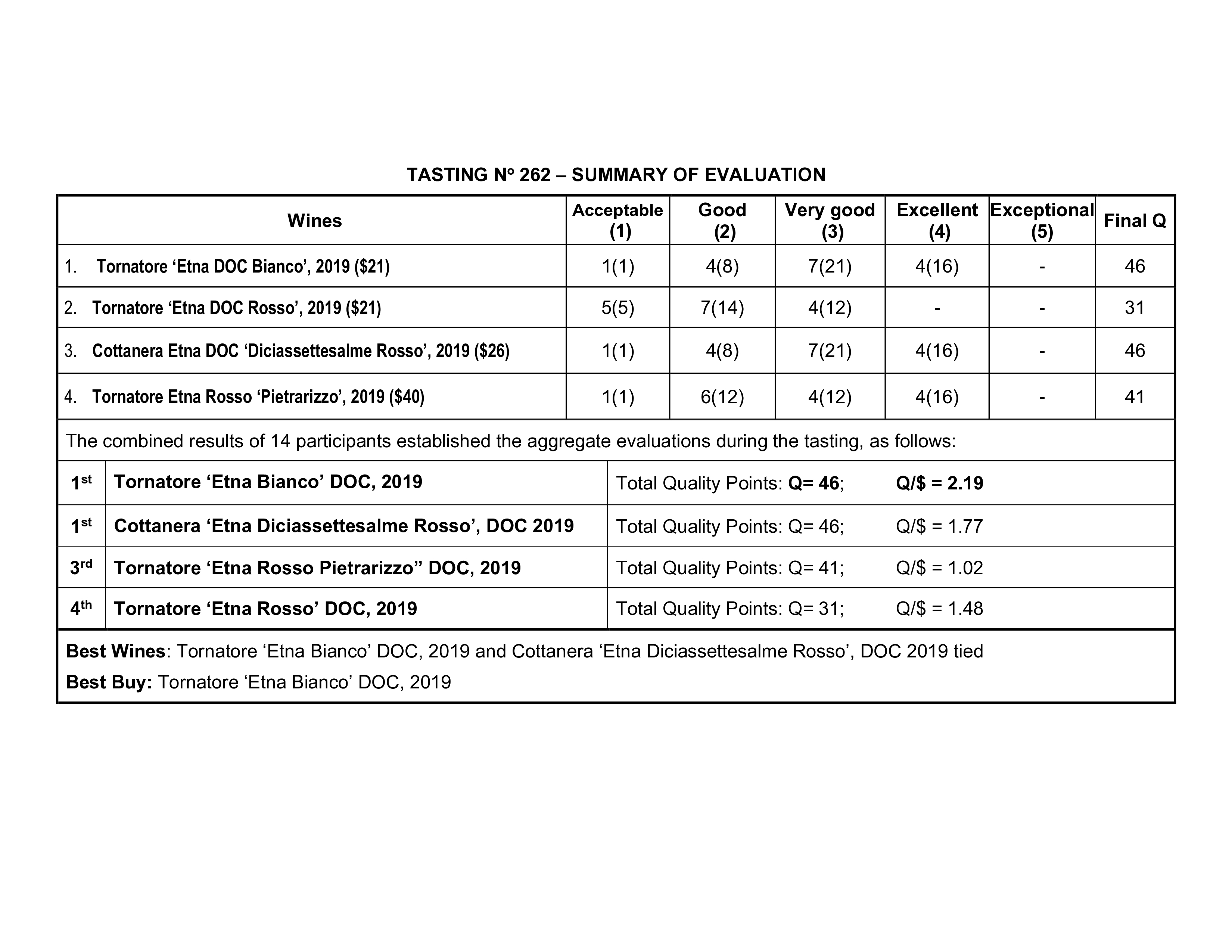
The tasting took place before knowing the wines’ prices, and 15 participants rated them from acceptable to exceptional. The combined results established the preference order during the tasting, as follows:

1st – Seña, Aconcagua Valley, 2019

2nd– Viña Errázuriz ‘Aconcagua Alto’ Carménère, 2020

3rd – Viña Errázuriz ‘Aconcagua Alto’ Cabernet Sauvignon, 2020

4th – Viña Errázuriz ‘Aconcagua Costa’ Pinot Noir, 2020

Seña, 2019  was rated as Best Wine and ‘Aconcagua Alto’ Carménère, 2020 as Best Buy. The following Table presents the details of individual ratings and combined results.
  1. References

  1. https://www.sag.gob.cl/sites/default/files/Informe%20Final%20Cosecha%202022.pdf
  2. https://errazuriz.com/en/terroir
  3. https://www.wine-searcher.com/regions-aconcagua%20valley
  4. https://sites.google.com/a/merceblanco.com/errazuriz/personajes/maximiano-errazuriz-valdivieso
  5. https://aseuniv.com/errazuriz.html
  6. https://www.wine-searcher.com/regions-aconcagua%20valley
  7. https://www.abcfws.com/errazuriz-don-maximiano-founders-reserve/106255
  8. https://southamericawineguide.com/winery/winery-filters/wineries/chile-wineries-winery-filters/aconcagua-chile-wineries-winery-filters/vina-errazuriz-winery/
  9. https://www.sena.cl/
  10. https://es.wikipedia.org/wiki/Regi%C3%B3n_vit%C3%ADcola_de_Aconcagua
  11. https://www.sag.gob.cl/sites/default/files/Informe%20Final%20Cosecha%202022.pdf
  12. https://errazuriz.com/en/winery/history
  13. https://www.scielo.cl/pdf/historia/v39n1/art02.pdf
  14. http://www.historiadelpozo.uqam.ca/pdf/vino.pdf
  15. http://gauchosfilms.com/proyectos/vina-errazuriz/
  16. https://www.hatchmansfield.com/our-winemakers/Errázuriz/wine/aconcagua-costa-pinot-noir-2020/
  17. https://Errázuriz.com/en/wines/aconcagua-costa/aconcagua-costa-pinot-noir/2020
  18. https://www.hatchmansfield.com/our-winemakers/Errázuriz/wine/aconcagua-alto-carmenere-2020/
  19. https://Errázuriz.com/en/wines/aconcagua-alto/aconcagua-alto-carmenere/2019
  20. https://www.hatchmansfield.com/our-winemakers/Errázuriz/wine/aconcagua-alto-cabernet-sauvignon-2020/
  21. https://www.hatchmansfield.com/our-winemakers/sena/wines/sena/
  22. https://www.sena.cl/Wines/sena/2019
  23. https://www.klwines.com/p/2019-sena-red-blend-valle-de-aconcagua/1562447?searchId=067edb99-983e-42d8-a0fd-13d048a6e5a9&searchServiceName=klwines-prod-productsearch&searchRank=2

.o0o.


Is this a joke?  It doesn’t sound like.


.o0o.

Posted in Meeting Abstract, Wine - Vino - Vinho | Tagged , , , , , | Leave a comment

How bold is your favorite red wine?

How bold is your favorite red wine?

Jose Brakarz sent this chart. Club Members will find this certainly interesting.

Dear Members: I found this graph about the scale of red wines and thought about sharing with you.

I first sent it to our foremost expert in the group, Ricardo, to hear his opinion.

Ricardo Santiago’s comments: “Wine Folly is a serious and trustworthy publication. The Graphic is great but is
really a generalization. For instance: Pinot Noir is a light body, but it can also be medium body. You can
have a specific Mencia classified as medium body, but with less body than a specific Pinot Noir from
Oregon. In the same way the Gamay light body can be medium body.”


Next April 25th is the monthly Club de Vino tasting. Cristian Santelices and Jorge Claro will present a selection of Chilean wines from Aconcagua Region. Details will be posted as soon they are available.

Please, as soon as possible,  let Claudia Perazza and or Clara Estrada know that your plan to attend. Keep tasting!

.o0o.

Not so serious matter:

Every morning having a glass of water with some lemon drops will make you lose a lot of weight. The only requisite is that the lemon tree must be 10 Km from your place.

Posted in Wine - Vino - Vinho | 1 Comment

Tasting No 251 – March 28, 2023 The Diversity of Wine in Chile

Club del Vino, Washington DC

Tasting No 251 – March 28, 2023, 12:30 pm

The Diversity of Wine in Chile 

Heritage wines, underrated grapes and iconic wines

Capri Ristorante, McLean VA


  1. Tasting Objective and Overview

The main objective of this tasting is to taste different wines that highlight the diversity of wines produced in Chile.
The tasting will have one orange wine and three red wines. The grapes are Semillon, Carignan, Cinsault, and Cabernet Sauvignon (Bordeaux blend).
Small producers with traditional techniques in Itata and a major winery in Aconcagua

Tasting_Chilean Wines_Heritage_Iconic Here a complete Power Point presentation of the wine history, productive process and interesting details of this Chilean region. The pdf format document is enriched with relevant ilustrations.

Type of tasting: Open

Presenter: Ricardo Santiago

Participants: J. Brakarz; R. Connolly; C. Estrada; J. Garcia; N. Marzella; O. Mason; C. Perazza; L. Redwood; J. Sanchez; R. Santiago and G. Vega (guest).

These are the wines:

– Roberto Henriquez, Molino Del Ciego, Semillon, Valle del Itata, 2021

– Pedro Parra, Trane, Cinsault, Itata Valley, 2019

– Rogue Vine, El Insolente, Carignan, Itata Valley, 2016

– Seña, Aconcagua Valley, 2019.

  1. Wine Regions

             Itata Valley

Situated 500 km South of Santiago, the first vineyards were planted in the 16th century.

Topography: Coastal Mountain range with river terraces inland.

Soil: Granitic soils in the coastal mountain range and mainly alluvial river terraces further inland.

Climate: Semi-arid, continental climate.

Bush vines, no irrigation.

Itata Valley lost its fame in the 1800’s to more central regions in Chile (high production and new varieties). It was left behind and has the constant threat of planting pine and eucalyptus trees.

The region still has one of the lowest average vineyard sizes in all South America, at less than two hectares. These small vineyards and wine families are a complete contrast to the manicured vineyard rows, industrialized estates, and big wineries further north.

The majority of Itata’s grapes are still sold cheaply for bulk wine production. However, there is also growing appreciation for the old vines in the region, and wineries of all sizes are now participating in Itata’s revival. Most planted varieties are Moscatel de Alejandria, País, Cinsault, Cabernet Sauvignon, Corinto.

              Aconcagua  

Stretches from the coast to the Andes. Vineyards planted in all three geographical designations (Costa, Entre Cordilleras, and Andes).

Topography: Ranging from the Andean foothills to the banks of the River Aconcagua and the Coastal hills.

Climate: Mediterranean climate with some mountain influence. Most of the vineyards are in the warm inland areas of the valley floor in what is one of Chile’s hottest and driest wine regions.

Since the 1990’s, Aconcagua’s wine region has also expanded further west towards the coast in search of cooler climate terroirs where they can make fresher wine styles. Stable climate makes it one of Chile`s most reliable regions.

Directly downhill from Aconcagua, on the Argentine side, lie Mendoza and San Juan where over 90% of Argentina’s wine industry is concentrated.

It is a region that produces powerful red wines and a handful of producers in the region specializes in Bordeaux – or Mediterranean-style blends and varieties.

Most planted varieties are: Cabernet Sauvignon, Carmenere, Syrah, Chardonnay, Pinot Noir, Sauvignon Blanc, Merlot, Petit Verdot.

  1. The grape varietals

      Semillon

First arrived in Chile in the 19th century. It was the most planted white variety by the 1960’s with some 35,000 ha. It has been in decline ever since. Often found in mixed old-vine plantings with Riesling and Corinto (Chasselas) and other white varieties.

It is produced with some skin contact and occasionally produced as an orange wine, vinified in tinajas, concrete eggs or old foudres, or even with some biological ageing under a veil of flor.

These wines can be very textured, structured, and waxy.

        Carignan

Believed to be native to Aragon, Spain. Main synonyms are Mazuelo and Carineña. It is a vigorous and productive (abundant crop), and the grape needs a long, hot growing season.

It delivers high acid deeply pigmented tannic wines. Carignan’s color, acidity, and structure could be blended into pale País wines. Tannic management is key to avoid coarse and rustic wines.

One of the rising stars of Chilean wines helped build the modern reputation of Maule denomination in the Central Valley. Tamed tannins, refreshing acidity, and red fruit aromas prioritizing elegance over power.

Planted in Chile in the early 20th century. After the 1939 earthquake, the Government supported the wine industry in Itata and Maule by giving them Carignan plants. But due to its susceptibility to powdery mildew, it was largely abandoned within a decade of being planted.

          Cinsault  

Native to southern France, it was first planted in Chile in the 1930’s. It is a vigorous variety that produces an abundant crop. Requires high temperatures to ripen.

Known locally as cargadora (heavy-load bearer). Young vines produce ‘rather uninteresting’ grapes. On the other hand, as old vines yield drops, concentration increases and the wines produced are more interesting. Old Cinsault vines are mainly in Itata and Bio Bio, some well over 60 and some close to 90 years old.

Old-vine and traditional winemaking renaissance and adoption of traditional techniques using native rauli vats, ageing in clay tinajas and working on a very small scale using artisanal methods.

The wine has moderate to low pigment, low acidity, light tannins, and expressive red fruit aromas.

    Cabernet Sauvignon  

Cabernet Sauvignon was brought to Chile with many other grapes (mainly Bordeaux varieties) in the mid-19th century. Chile has some of the world’s oldest Cabernet Sauvignon vines and pre-phylloxera genetic material. However, most of the Cabernet vines are relatively new, planted from the 1990’s onward.

Between 1997 and 2002, Cabernet plantings more than doubled, shooting up from some 15,000 to 39,000 hectares. Chile ranks second in the world, with 12% of all the Cabernet Sauvignon vines.

An extraordinary amount of everyday bulk wine is still produced, while there are world-class examples at the top end of the scale. The best examples of Chilean Cabernet rank among the best in the world.

It is very common to find Cabernet blended with the other major Bordeaux varieties, particularly Merlot and Carmenere.

  1. The Wines

Wine #1. Roberto Henriquez, Molino Del Ciego, Semillon, Valle del Itata, 2021

The Producer: Roberto Henriques, a leading winemaker in Bio Bio and Itata, has a small winery focusing on making natural wine on an artisanal scale. It produces distinctive natural wines from old vines and often helps resuscitate abandoned vineyards.

The wine

–  Wines are produced in the pipeño tradition: an old technique where grapes (white or red) are destemmed but left on their skins for fermentation before ageing in a rauli barrel.

– Grape: Semillon with Corinto (Chasselas) and Moscatel in the field blend.

– Vineyards: 90 years-old vines planted on granite soils very close to the Pacific Ocean in the Itata Valley. Dry-farmed with sustainable viticulture.

– Fermentation: Fermented with its skins (“con orujos”) for three weeks.

– Ageing: Old barricas and concrete vessels for five months to one year.

– Unfined and unfiltered.

– Alcohol: 12.5%

– “A Paradigmatic wine for semillon in South America” (P. Tapias).

Wine #2. Pedro Parra, Trane, Cinsault, Itata Valley, 2019

The Producer: Pedro Parra y Family is the boutique, family winery of renowned terroir expert Pedro Parra, focusing on an artisanal production of natural wines made from old vines of Pais and Cinsault in Itata and Bio Bio. Pedro Parra produces a series of Cinsault wines to show his interpretation of the granitic soils of Itata.

The Wine:

– Grape: Cinsault 100%.

– Appellation: D. O. Secano Interior, Itata.

– Vineyard: 70-year-old at 300 m altitude, on shallow granite soil with silt and stones.

– Fermentation: 30% whole bunches in concrete tanks utilizing native yeast and with low intervention.

– Ageing: 11 months in 1,500 liters oak vats.

– Alcohol: 13%.

Wine #3. Rogue Vine, El Insolente, Carignan, Itata Valley, 2016

The Producer: Two people – Leonardo Erazo and Justin Decker – started Rogue Vine in 2011, in a one-car garage in Concepción with a project to make natural wines from ‘the forgotten old bush vines almost falling out of steep granitic hills in Itata.’

The Wine:

– Grape: Carignan 100%.

– Single Vineyard granite soil at 270 m. in Nipas, Itata Valley.

– Old Bush vines of more than 60 years old. Dry and organic farmed and hand harvested.

– Winemaking: Whole berry fermentation with native yeast and little to no sulfur added prior to bottling.

– Ageing: cement globes and used oak barrels.

– Unfiltered and Unfined.

– Alcohol: 14.0%.

Wine #4. Seña, Aconcagua Valley, 2019

The Producer: Viña Seña: Single-estate, single-wine operation joint venture in the Aconcagua Valley founded by Robert Mondavi and Eduardo Chadwick of Errazuriz in 1995. Their aim was to make a wine that would demonstrate the full potential of Chile and that would be welcomed among the world’s First Growth.

The Wine:

– Composition /grape: Bordeaux blend: Cabernet Sauvignon (60%), Malbec (21%), Carmenere (15%), and Petit Verdot (4%).

– Vineyard: Close to the sea with the benefit of coastal winds and long hanging period.

– Farming: Biodynamic and hand harvested.

– Ageing: 22 months in 90% French oak barrels (80% new) and 10% foudres.

– Alcohol: 13.5%.

  1. Menu

  • Calamari Fritti
  • Spaghetti con polpette
  • Vitello alla Parmigiana
  • Dessert, coffee.
  1. References

Barnes, A. The South America Wine Guide. 2nd ed. England: The South America Wine Guide, 2022.

International Organization of Vine and Wine (Home | OIV)

Pedro Parra y Familia, Skurnik Wines & Spirits  (Pedro Parra y Familia – Skurnik Wines & Spirits)

Roberto Henriquez revives Chile’s pipeño tradition | The Morning Claret

Robinson, J et al. Wine Grapes. New York: HarperCollins Publishers, 2012.

Rogue Vine (Rogue Vine Winery (rogue-vine.com))

Seña Wines (Seña Wines (sena.cl))

Vinos de Chile (Vinos de Chile – (winesofchile.org))

“What`s Hot in Chile?”, Decanter: Wines of the Word, 2nded., 2022.

Woolf, S. J. Amber Revolution. Northampton, MA: Interlink Books, 2018.


  1. CV Members Rating 


Note: Numbers in the chart indicate the number of participants that rated the wine with the corresponding quality level. In parentheses are equivalent numerical values conversion used to calculate the numerical indexes: one Mediocre= 0, one Acceptable= 1, one Good= 2, one Very Good= 3, Very Good= 3, one Excellent=4 and, one exceptional= 5 

.o0o.

Posted in Wine - Vino - Vinho, Wine Regions | Tagged , , , , , , , | Leave a comment

Tasting No 250 – February 28, 2023 – Wines from Mendoza, Argentina

Tasting No 250 – February 28, 2023 – 12:30pm  Wines from Mendoza, Argentina


Capri Ristorante, McLean VA

..

  1. Tasting Overview

Objective:

The main objective of this tasting is to compare three red wines of the same varietal – MALBEC, from the same Bodega – Catena Zapata. In addition, one white wine from the same winery will be tasted.

Type of tasting: semi- blind; the names of the wines are provided.

Presenters:

Clara Estrada and Jorge García-García

Participants:  

R. Arroio; M. Averbug; J. Brakarz; J. Claro; C. Estrada; J. Estupiñan; J. García; N. Marzella; O. Mason; A. and Claudia Perazza; John and Lucia Redwood; J. Sanchez; R. Santiago; G. Zincke.

These are the wines:

  1. Catena Zapata ‘Appellation White Clay’, Semillon-Chenin, 2020
  2. Catena Zapata ’Catena Alta’, Malbec, 2018
  3. Catena Zapata, ‘Catena Appellation La Consulta’ Malbec, 2019
  4. Catena Zapata ‘Catena Appellation Paraje Altamira’ Malbec, 2019The Men
  • Menu

    • Mussels in a light white wine sauce
    • Homemade Agnolotti with fresh spinach in tomato sauce
    • Beef medallions
    • Coffee, tea and dessert


    1. Information about the Catena Zapata Winery

      a .General Information

    The winery was founded in 1902 by Italian immigrant Nicola Catena and was passed to his son Domingo. Domingo’s son, Nicolás Catena Zapata (A.K.A. Nicolás Catena), was a pioneer to introduce European winemaking techniques to Argentina, including the introduction of Malbec and vine growing in high altitudes. Nicolás is recognized as the vintner who revolutionized wine quality in Argentina.

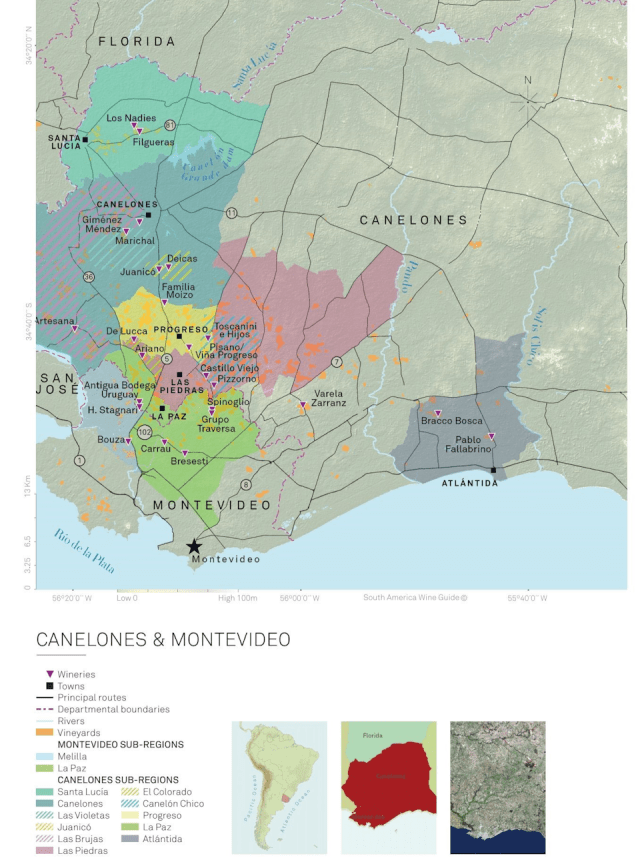
    All wines are produced at high altitude in the winery located in Luján de Cuyo from grapes produced in different vineyards in the Mendoza Region, Argentina (see map above). The Catena Zapata wines are a blend of single varietal lots from the Catena family’s vineyards. Over the years, Nicolás Catena discovered the influence altitude has on fruit quality. As one climbs the altitudes of the Andes the average temperature decreases and the amplitude between day and night temperatures increases. This environment provides the ideal climate for grape maturation. Each of the Catena Zapata family vineyards is divided into parcels according to their soil composition. Each vineyard is divided into lots that are harvested separately, and especially prepared to be part of the final blend of each Catena wine: Cabernet Sauvignon, Malbec and Chardonnay. (See https://catenazapata.com/adrianna-vineyard.php for more information about the different vineyards).

    B. Vinification

    Vineyard lots are harvested at different times to ensure optimal natural acidity and moderate alcohol levels. Whole berries are hand loaded into small format fermentation bins and 225-500 L barrels; lots from each vineyard are treated individually; fermentation and maceration last for 28-30 days; cold maceration. Wild yeasts. Alcoholic and malolactic fermentation in barrel; wine undergoes active battonage to protect it and drastically reduce the amount of SO2 needed. Aged for 18 months in French oak.

    C. Historic Rows

    Catena Alta is an assemblage of historic rows within the Catena family Estate vineyards. The blend of these historic rows, like the marriage of sounds that create a symphony, yields a highly aromatic and elegant wine that speaks for the earth and the vines that have been tended by the Catena’s for four generations. The Catena Alta wines can usually be drunk starting three years after harvest and into the following one to two decades.

    Sources: https://catenazapata.com/catena-alta-wines.php

    https://catenazapata.com/index.php.


    1. Information on the Wines

    Wine #1.  Catena – Appellation White Clay, 2020

    • Year – 2020
    • Varietal: White blend Semillon 60%; Chenin Blanc 40% from Luján de Cuyo
    • Eight months in French
    • Total Acidity: 6.4 grams/liter in tartaric acid; pH: 3.2
    • 13% APV
    • 92 pts (Vinous); 90pts. (Wine Advocate)

    Tasting notes: Deeply aromatic with expressive citrus and peach with a rich and mineral finish. Pairs well with vegetables, pasta and grilled white meat (Catena).

    “Yellow with a golden sheen. The nose is dominated by white flowers, honey and the aging process. In the mouth, this is voluminous with mild freshness and a creamy, compact, terse feel followed by a long, oaky finish.” (Vinous);

    “The grapes were harvested quite early and then fermented in stainless steel, managing to keep the alcohol to 13.5% in this warm and dry year. It’s balsamic and medicinal, with notes of yellow fruit and some spicy smokiness, as 35% of the wine matured in new barrels for seven to eight months. It’s soft and creamy without excess, combining volume and tasty flavors and a bitter twist in the finish” (Wine Advocate).

    Wine #2. Catena Alta, Malbec, 2018

    • Year – 2018
    • Varietal: 100% Malbec
    • Vineyards: Angelica; La Pirámide; Nicasia; Adrianna; Angelica Sur.
    • Vineyard lots harvested at different times to ensure optimal natural acidity and moderate alcohol levels.
    • Alcoholic and malolactic fermentation in barrel; active battonage
    • Aged 18 months in French oak.
    • Total Acidity: 6.2 grams/liter; pH: 3.55
    • Unclarified and unfiltered
    • 8% APV
    • 93 pts. (Wine Advocate)

    Winemaker notes: after many years of research and experimentation, Nicolas and his daughter identified their best vineyard rows of Cabernet Sauvignon, Chardonnay and Malbec and made the first vintages of the Catena Alta wines in very small quantities. Catena Alta continues to be a limited production of single varietal wines made from the selected few rows in the Catena family’s vineyards. These special barrels undergo a rigorous second selection at the winery. The Catena Alta wines can usually be enjoyed starting three years after harvest and into the following one to two decades.

    Tasting notes: “The 2018 Catena Alta Malbec shows more evolution and ripeness than the 2019. It’s varietal and floral with a mixture of red and black fruit, sweet spices and aromatic herbs. It has moderate ripeness—in fact, it’s a little lower in alcohol than the 2019—a medium body and fine-grained tannins, with good grip”. (Wine Advocate).


    Wine #3.  Catena, Appellation La Consulta, 2019

    • Year – 2019
    • Varietal: 100% Malbec
    • La Consulta vineyard; cold maceration; fermentation 16 days + post maceration 10 days.
    • Aged 12 months in French oak.
    • Total Acidity: 5.85 grams/liter; pH: 3.65
    • 5 APV
    • 92 pts (Wine Advocate)

    Winemaker notes:  In the 1950s, Don Domingo Catena began sourcing Malbec from the Vineyards of La Consulta. The combination of intense sunlight and cool nights yielded a wine that Domingo prized for its deep purple color, black fruit aromatics and rich velvety tannins.  https://catenazapata.com/index.php

    Tasting notes: The Catena Malbec Appellation La Consulta shows a dark violet color with deep purple tones. The nose offers aromas like red fruit and ripe, concentrated dark berries with fresh herbs and floral notes like lavender and violets, some traces of vanilla and tobacco. The mouthfeel is rich, with raspberries and blueberries, spices notes and a touch of mocha. The finish presents soft and well-structured tannins with bright, crisp acidity that gives the wine exceptional length.(Winemaker notes, taken from Wine.com??).

    The 2019 Appellation La Consulta Malbec feels primary and fruit-driven, quite faithful to the varietal and vintage, with good freshness and moderate alcohol. It was juicy, with some of the chalky texture of the stony soils. 90,000 bottles produced. (Wine Advocate).


    Wine #4. Catena – Appellation Paraje Altamira, 2019

    • Year – 2019
    • Varietal: 100% Malbec
    • Altamira vineyard; cold maceration; fermentation 16 days + post maceration 10 days.
    • Aged 12 months in French oak.
    • Total Acidity: 5.95 grams/liter; pH: 3.6
    • 5% APV
    • 93 pts. (Wine Advocate); 93 pts. (Robert Parker)

    Winemaker notes. In the 1950s, Don Domingo Catena began sourcing Malbec from the Vineyards of Paraje Altamira in the Uco Valley. The combination of intense sunlight and cool nights yielded an elegant, mineral, slightly spicy Malbec with a deep texture and flavors. tannins. It is an elegant, mineral, slightly spicy Malbec with a deep texture and flavors born of the combination of intense sunlight and cool nights. Perfect paired with meat, fish, fowl and vegetarian dishes.

    “Following the path of the 2018, the 2019 Appellation Paraje Altamira Malbec is phenomenal. It shows freshness, elegance, balance, complexity and nuance as well. It’s seamless, precise and ethereal with lots of inner energy and light. As the 2018 was, it’s expressive and floral, varietal and with the full chalky texture that is a distinct characteristic of Altamira. It’s tasty, the tannins are polished and there is an almost salty sensation in the finish” (Wine Advocate).

    For more information about the harvests for the vintages selected see: https://catenazapata.com/harvest-2019.php.


    CV Members Ratings  prepared by the C. Directiva


.o0o.

An Insider’s Guide to the Wines & Wine Country of Argentina | Laura Catena | Talks at Google

Contribution of Juan Luis Colaiacovo


.o0o.


Posted in Wine - Vino - Vinho | Leave a comment

Pablo Neruda: Ode to Conger Chowder and Ode to Wine

Pablo Neruda: Ode to Conger Chowder and Ode to Wine


Ode To Conger Chowder

 by Pablo Neruda

Pome suggested by Ginger Smart special for Club del Vino participants

Bellow Oda al Vino in Spanish and English.

In the storm-tossed
Chilean
sea
lives the rosy conger,
giant eel
of snowy flesh.
And in Chilean
stewpots,
along the coast,
was born the chowder,
thick and succulent,
a boon to man.
You bring the conger, skinned,
to the kitchen
(its mottled skin slips off
like a glove,
leaving the
grape of the sea
exposed to the world),
naked,
the tender eel
glistens,
prepared
to serve our appetites.
Now
you take
garlic,
first, caress
that precious
ivory,
smell
its irate fragrance,
then
blend the minced garlic
with onion
and tomato
until the onion
is the color of gold.
Meanwhile steam
our regal
ocean prawns,
and when
they are
tender,
when the savor is
set in a sauce
combining the liquors
of the ocean
and the clear water
released from the light of the onion,
then
you add the eel
that it may be immersed in glory,
that it may steep in the oils
of the pot,
shrink and be saturated.
Now all that remains is to
drop a dollop of cream
into the concoction,
a heavy rose,
then slowly
deliver
the treasure to the flame,
until in the chowder
are warmed
the essences of Chile,
and to the table
come, newly wed,
the savors
of land and sea,
that in this dish
you may know heaven.


English version 

Ode to wine

Pablo Neruda

Wine the color of day,
wine the color of night,
wine with purple feet
or topaz blood,
wine,
starlit son
of the earth,
wine, sleek
like a golden sword,
smooth
like a mussy velvet,
wine spiraled
and suspended,
loving,
mariner,
you have never fit in a glass,
in a song, in a man,
coral, gregarious you are,
and at least, reciprical.
Sometimes
you feed on deadly
memories,
on your wave
we go from grave to grave,
stonecutter of a frozen grave,
and we cry
momentary tears,
but
your beautiful
spring gown
is different,
your heart rises to the limbs,
the wind moves the day,
nothing remains
inside your motionless soul.
Wine
moves springtime,
it grows like a joyous plant,
walls tumble,
boulders,
the abysses close,
a song is born.
Oh you, pitcher of wine, in the desert
with the savory taste that I love,
said the old poet.
The pitcherful of wine
joins your kiss to the kiss of love.
My love, suddenly
your hip
is the full curve
of the wineglass,
your bosom is the bouquet,
the light is the alcohol of your hair,
the grapes your nipples,
your navel a pure seal
stamped on your vessel of a belly,
and your love the cascade
of insatiable wine,
the clarity that falls on my senses,
the earthly splendor of life.
But not only love,
a burning kiss
or a burnt heart
are you, wine of life,
but
friendship of beings, transparency,
a chorus of discipline,
an abundance of flowers.
On a table I love,
as one is conversing,
the light from a bottle
of intelligent wine.
May they drink it,
may they remember in each
golden drop
or glass of topaz
or purple spoon,
that autumn worked
until the vessels of wine were filled
and may the sinister man learn,
in the ceremonial of his business,
to remember the earth and its obligations,
to propogate the song of the fruit.

___________________________________

Oda al vino 

Oda al vino

Vino color de día,
vino color de noche,
vino con pies de púrpura
o sangre de topacio,
vino,
estrellado hijo
de la tierra,
vino, liso
como una espada de oro,
suave
como un desordenado terciopelo,
vino encaracolado
y suspendido,
amoroso,
marino,
nunca has cabido en una copa,
en un canto, en un hombre,
coral, gregario eres,
y cuando menos, mutuo.
A veces
te nutres de recuerdos
mortales,
en tu ola
vamos de tumba en tumba,
picapedrero de sepulcro helado,
y lloramos
lágrimas transitorias,
pero
tu hermoso
traje de primavera
es diferente,
el corazón sube a las ramas,
el viento mueve el día,
nada queda
dentro de tu alma inmóvil.
El vino
mueve la primavera,
crece como una planta la alegría,
caen muros,
peñascos,
se cierran los abismos,
nace el canto.
Oh tú, jarra de vino, en el desierto
con la sabrosa que amo,
dijo el viejo poeta.
Que el cántaro de vino
al beso del amor sume su beso.
Amor mio, de pronto
tu cadera
es la curva colmada
de la copa,
tu pecho es el racimo,
la luz del alcohol tu cabellera,
las uvas tus pezones,
tu ombligo sello puro
estampado en tu vientre de vasija,
y tu amor la cascada
de vino inextinguible,
la claridad que cae en mis sentidos,
el esplendor terrestre de la vida.
Pero no sólo amor,
beso quemante
o corazón quemado
eres, vino de vida,
sino
amistad de los seres, transparencia,
coro de disciplina,67
abundancia de flores.
Amo sobre una mesa,
cuando se habla,
la luz de una botella
de inteligente vino.
Que lo beban,
que recuerden en cada
gota de oro
o copa de topacio
o cuchara de púrpura
que trabajó el otoño
hasta llenar de vino las vasijas
y aprenda el hombre oscuro,
en el ceremonial de su negocio,
a recordar la tierra y sus deberes,
a propagar el cántico del fruto.

.o0o.

Posted in Wine - Vino - Vinho | Tagged , , , , | 2 Comments

Tasting #249 January 31, 2023 12:30 pm Wines from Southern Chile

Tasting #249
January 31, 2023 12:30 pm
Wines from Southern Chile

 Capri Ristorante, McLean VA

Tasting Overview

The main objective of this tasting is to explore wine grapes and styles characteristic of the Southern Region of Chile.

Wines

1.    Koupin, Carignan, 2019. Vinos Gustavo Martinez. Valle de Itata, 2019  13.5% Alchool

2.    Chardonnay, Sol de Sol. Vina Aquitanie, S.A. Valle de Malleco. Traiguen, Chile. 13.3% Alchool (93 points)

3. Mission Grapes (Pais),   Santa Cruz de Coya, Roberto Henriquez, 2016, 12%  Alchool

4.   Brisas de Guarilihue Cinsault, 2019, Wildmakers, Guarilihue Alto- Valle del Itata. 2019, 11% Alchool

Presenters:

Ruth Connoly,  Ginger Smart and Michele Fryer as collaborator

Participants:

R. Arroio, M. Averbug, L. Bocalandro,  C. Estrada, J. Garcia, N. Marzella, Lucia and John Redwood, R. Santiago, E. Silva.

Menu:

Given the regions’ three centuries of history making wines of/ the people,  in choosing the menu,  emphasis was placed on dishes that reflect as far as possible food that the people of the area would eat with the wines selected. This has resulted in some unusual combinations and the presenters thank the Capri staff for their collaboration in designing the menu with us.

1.   Brochetta with corn, tomatoes and onions

2.  Calamares with seaweed

3.   Cazuela (soup) with pork, potatoes and squash

4.  Grilled trout with potatoes and cabbage

5. Coffe and Dessert


The Southern Wine Region in Chile

Wine arrived he southern valleys of Chile in the 1550’s. Brought by Spanish priests primarily for use in the liturgical ceremonies of the Roman Catholic Church, the vineyards also produced table and family wines to complement local foods.

Over the next three centuries, the South served as Chile’s major production region. Few if any
attempts were made to modify or upgrade the vines, vineyards or wine making technology. It was not until the 1850’s that wealthy Chilean travelers began to bring more sophisticated varietals from Europe, although these came to be cultivated in the more central and northern regions of Chile. Essentially, the wines produced in the south were “wines for the people.”

In the 1990’s and particularly in the southern valleys we will discuss today, a diverse group of native
and international experts and entrepreneurs, and the Chilean government began to focus on the regions’ possibilities. One expert experimented with Chardonnay, and others liaised with long time growers to develop new organizational and technological structures to benefit the regions’ wine industry. It seems that the Chardonnay grape was so successful that this southern area has become the benchmark for the Chilean Chardonnay.

The Wine Producing Valleys

Itata, Bio Bio and Malleco are among the southernmost wine producing wine producing valleys of Chile and are vastly different from the rest of Chile’s wine regions. Origin studies on these wines of valleys are currently underway.

Itata Valley: This wine region is situated in the southern end of Chile's long, thin wine producing  zone. It rains up to 50 inches a year. In addition to this weather advantage, the region’s soils are mostly volcanic in origin, unlike those of the other wine valleys in Chile. The valley presents a lot of cloud cover, also a classic cool climate growing advantage.

This historical, cool-climate region is dominated by plantings of Carignan, Muscat of Alexandria and País (AKA Mission), aimed more at domestic consumption), although producers are beginning to plant more modern grape varieties like Cabernet Sauvignon, Cabernet Franc, Pinot Noir and Chardonnay.

Plantings of old vine Cinsault, “País” (Mission grape) and Muscat are most common. Wines produced is basically red with Carignan, Muscat of Alexandria, “País”, Pinot Noir, and Cabernet Sauvignon grapes.
Old traditions and a lack of large-scale viticulture and winemaking sets Itata apart.  Look for red blends,
Cabernet Franc.

Bio Bio Valley: At 36 South latitude, the more windy, rainy climate of the Bio Bio Valley is somewhat more extreme than in most of the country’s other wine regions, which favor the production of crisp wines. Its excellent Riesling and Viognier white wines are of note. Another interesting white is the
Muscat de Alexandria. Pinot noir is also produced. Bio Bio is characterized by fewer vineyards, fewer wineries, and amazingly interesting soils.

Malleco Valley: Located 340 miles south of the Chilean capital of Santiago, at latitude 38 South, the Malleco Valley is becoming a growth area for Chilean wine. Malleco has well-drained soils, consisting principally of red clay and sand. However, due to its rigorous climate and short growing season, the
development of the wine industry is particularly challenging. The current production of its fresh Sauvignon Blanc, Chardonnay and Pinot Noir enjoys a racy acidity.

Wines

1.Koupin, Carignan, 2019. Vinos Gustavo Martinez. Valle de Itata, 13.5% Alcohol

 Variety: 100% Carignan
 13.5 % APV
 Viticulture: grapes obtained from the Ninhue commune in the Itata valley. The vineyard is more than 50 years old, which
is unique in the Itata area, since most of the Carignans of that age have been uprooted and replaced by País grapes that are much more rustic and resistant to diseases. The vineyard is managed on a low trellis (80cm) simple, unlike all the others that are managed on the head. The grass is cut once or twice a season with a triangular horse-drawn harrow and only sulfur is used to control powdery mildew and other diseases. The grape producers apply red guano and green manure as a fertilization base.

 Viniculture: 50% of grapes are vinified as carbonic maceration for approximately 3 weeks, and the other 50% is destemmed in a sieve and fermented like other red wines, then barreled until spring. The wine is aged for around 10 months before it is bottled.

 About the winery: Gustavo Martínez Winery began as a personal dream around 2012 when, after working for 5 years in Portezuelo, Gustavo decided to take advantage of everything he had learned with the vintners in the area, on how to value everything related to Pipeño wine, the ancestral
vineyards and what this means in cultural, landscape, and historical terms of the Itata Valley.

 Tasting notes: Deep garnet with a vibrant ruby edge, velvety soft on the palate with bright cherry to plum flavors. This wine is weighty and full of fresh ripe berries with rich, dark accents of cocoa nib.

 Intriguing and delicious. Aromas of dark chocolate, plum, black cherry, cedar and tarragon jump
from the glass.

-=-=-=-=-=

From the winemaker: Es un vino que se obtiene de la comuna de Ninhue en el valle del Itata. Es un viñedo de mas de 50 años, el cual es único en la zona de Itata, ya que la mayoría de los carignan de esa edad se han arrancado y reemplazado por uva país que es mucho más rustica y resistente a las enfermedades. Este viñedo se maneja en espaldera baja (80cm) simple a diferencia de todos los demás que se manejan en cabeza.

2. Chardonnay, Sol de Sol. Vina Aquitanie, S.A. Valle de Malleco. Traiguen, Chile. 13.3% Alchool (93 points)

Notes from Producer: De color amarillo brillante. Muy intenso en la nariz, sus aromas recuerdan frutas como manzanas verdes, melón verde (tuna), algo de espárrago, olivas y avellanas tostadas, con notas minerales. En boca presenta fresca acidez, gran volumen y concentración. Su persistencia al final de la degustación es frutal y mineral, complementado con el sabor de la encina francesa. Gran equilibrio entre el alcohol y la acidez natural que le da frescor, persistencia y potencial de envejecimiento, algo difícil de obtener en un vino blanco chileno.

3. Mission Grapes (Pais),   Santa Cruz de Coya, Roberto Henriquez, 2016, 12%  Alcohol

From vinatis.co.uk

Sol de Sol has really changed the reputation of Chilean Chardonnay and is recognized for such!

The quality of the grapes from this terroir is so impressive that it was created with the Chilean Ministry of Agriculture. Complex and elegant wines are produced here, allowing the minerality of the volcanic soil and the freshness of the coldest climate in the Valle del Malleco to express themselves. Sol de Sol delights us from the moment it opens with its intense golden colour, but also with its enchanting aromas of apples and fresh figs. Notes of olives and roasted hazelnuts accompany the desire to taste it. On the palate, it is a freshness and a long fruity and mineral finish, integrating woody flavours, which enchant us. An excellent balance of characteristics that can make up a wine. Sol de Sol has a rare ageing capacity for Chilean white wines. An exception to be discovered and shared, a journey to the heart of unique flavours.

This wine is made from 100% pure País grapes obtained from a 200-year-old vineyard located in Nacimiento, in which soils are granitic intrusive (solidified magma). The vines were managed traditionally without the addition of chemical fertilizers or herbicides. Santa Cruz de Coya is the name of the nearby village established in 1595 that was a key site of the 1598-1599 uprising that ended the Era of the Conquista. The Mapuches finally won the battle against the Spanish conquistadors.

10/13/2021 – DIGGYDAN WROTE:93 Points

Beautifully elegant and light weight. Aromatic red berry. Palate a nice mix of upfront red fruit and background herbaceousness.

4.   Brisas de Guarilihue Cinsault, 2019, Wildmakers, Guarilihue Alto- Valle del Itata. 11% Alchool

Notes from producer

General description: Los viñedos utilizado para la elaboración de nuestros Brisas Cinsault se encuentran ubicados en Guarilihue Alto, sector El Huaro a unos 30 km del mar. Son viñedos de más de 40 años, manejados a la usanza tradicional de la zona. Es decir, manejo del suelo a caballo, sin aplicación de pesticidas. Nos enfocamos en realizar una vinificación enfocada a preservar toda la fruta y las características varietales que nos aporta la variedad Cinsault, sin crianza en madera.

Tasting Notes:

En nariz, Brisas Cinsault, presenta mucha fruta roja y energía, recuerda a freses, ciruelas fresca y cerezas combinada con suaves toques de especias herbales. Es un vino fresco y peligrosamente fácil de tomar y de jugoso final.

Color: Rojo rubí, limpio y brillante,  Varietal: 100% Cinsault,  From:  Guarilihue Alto- Valle del Itata.

Wine Regions

ltata, Bio Bio and Malleco are among the southernmost wine producing valleys of Chile and are drastically different from the rest of Chile’s wine regions.

ltata Valley

It actually rains here, up to 50 inches a year. In addition to this wine weather advantage, the regions soils are mostly volcanic in origin and unlike those of the other wine valleys in Chile. There is also a lot of cloud cover in this area, a classic cool climate growing advantage.

Plantings of old vine cinsault, ^pais” (mission grape) and muscat are most common. Wine produced is basically red with Carignan, muscat (musket) of Alexandria, “Pais” (Mission Grapes or Criolla Chica in Argentina), Pinot Noirs and Cabernet Sauvignon grapes.

Old traditions of wine making and a lack of large-scale viticulture and winemaking sets ltata apart. Look for: red blends, Cabernet Franc.

BioBio

At 36 degrees south, the more windy, rainy climate of the Bio Bio valley, is somewhat more extreme than the country’s other wine producing regions and favors the production of crisp wines. Of particular note are its excellent Riesling and Viognier white wines. There is also another interesting white called Muscat de Alexandria. Bio Bio is characterized by few vineyards, fewer wineries and amazingly interesting soils. Pinot Noir is also produced.

Malleco

Located 340 miles South of the Chilean capital of Santiago at 38 degrees South latitude, the Malleco Valley is becoming a growth area for Chilean wine. Malleco has well-drained soils, consisting principally of red clay and sand. However, although its marginal climate and short growing season makes the development of a wine industry particularly challenging, its current fresh sauvignon Blanc, Chardonnay and Pinot Noir production enjoys a racy acidity.

Currently, Vine Aquitania, S.A. from the Chilean Central Valley is exploring additional growth possibilities both in Malleco and further South.

Wines Evaluation on the opinion of Club del Vino  Members

CV Members Rating
The tasting took place before the wines’ prices were revealed and 11 participants rated them from
mediocre to excellent. The combined results established the preference order during the tasting, as
follows:
1 st – Vina Aquitanie, Chardonnay Sol de Sol, 2019
2 nd – Wildmakers, Brisas de Guarilihue Cinsault, 2019
3 rd – Vinos Gustavo Martinez, Carignan, Koupin, 2019-
4 th – Roberto Henriquez, País (Mission grapes), Santa Cruz de Coya, 2016.
Chardonnay Sol de Sol, 2019 was rated as Best Wine and Brisas de Guarilihue Cinsault, 2019 as Best Buy. The table bellow represents the details of individual rates and combined results:

Note: Numbers in the chart indicate the number of participants that rated the wine with the corresponding quality level. In parentheses are equivalent numerical values conversion used to calculate the numerical indexes: one Mediocre= 0, one Acceptable= 1, one Good= 2, one Very Good= 3, Very Good= 3, one Excellent=4 and, one exceptional= 5 


Next Meeting:

Wines from Mendoza by Clara Estrada and Jorge Garcia

CALENDARIO DE DEGUSTACIONES – 2023

No.

FECHA

TEMA

PRESENTADORES

250

feb 28

Región Mendoza, Argentina

Clara Estrada and Jorge Garcia

251

mar 28

“Off the Beaten Track Chilean Wines”:

Pipeño wines and Carignan, Cinsault, and Pais

Ricardo Santiago

252

abr 25

Región de Aconcagua, Chile

Cristian Santelices y Jorge Claro

253

may 30

TBD

Claudia y Agilson Perazza

254

jun 27

Valle de Uco, Argentina

  Jairo Sánchez y Jorge Requena

255

jul 25

Blancos de la Región Sur

Erico Silva y Nick Marzella

256

ago 29

Región del Valle Central, Chile

 José Brakarz

257

sep 26

Región de Casanova, Chile

 Marcello Averbug

258

oct 31

Región Sur, Argentina

Jaime Estupiñan

259

nov 14

 TBA

Michelle Fryer

260

dic 12

The best wines of 2023

John and Lucia Redwood

.o0o.


.o0o.

Posted in Meeting Abstract, Wine - Vino - Vinho | Tagged , , , , , , , , | Leave a comment

Mario Aguilar is not with us anymore

Mario Aguilar is not with us anymore

Mario Aguilar passed away January 1st. 2023

Mario Aguilar distinguished and appreciated member of the Club del Vino  has left us at the dawn of the new year of 2023.

His activity at the Club del Vino with his deep expertise on the matter was a great contribution to our meetings. A good friend will be missed indeed.

Juan Colaiacovo, former Club del Vino President, wrote a few word that will help us remember Mario:

-Una gran pérdida por todas las razones indicadas.> Mario fue una presencia importante para el CV.

 -Ingreso al Club alrededor de 2010 traído por Alfonso Sánchez que ya tenía en el Club algunos meses. Alfonso vino invitado por el amigo Ítalo Mirkow cuando el Club se abrió a miembros de fuera de la OEA.

-Mario fue miembro de la CD y tuvo importante participación en la creación de dos clubes que funcionaron en paralelos al CV hasta el indicio de la pandemia.

-Algunos tuvimos el privilegio de disfrutar de la generosidad de Mario al compartir vinos de su valiosa colección.

– El COVID lo afectó mucho y después un cáncer.

 -Mario y Alfonso dos grandes contribuciones del Banco Mundial al CV.

Siempre lo recordaremos con afecto.

Juan Luiz Colaiacovo

Mario Aquilar 2012

.o0o.

Posted in Photos and Videos - Club del Vino | Tagged , , | Leave a comment