 Tasting No 289 – May 26, 2026
A Survey of Israeli Wines
Tasting Overview
The main objective of this tasting is to explore wines from Israel. We will taste wines from different regions of the country. This is an open tasting.
Presenters: Yacsire Cutler, Orlando Mason and Rene Gutierrez
Participants: R. Arroio; M. Averbug; J. Brakarz; R. Connolly; Y. Cutler; C. Estrada; M. Fryer; G. García; R. Gutierrez; O. Mason; A. and C. Perazza; J. and L. Redwood; C. Santelices; G. Smart; and L. Uechi.
These are the wines
- Golan Heights, ‘Yarden’ Chardonnay, Galilee, 2024
- 1848, ‘Second Generation’ Cabernet Sauvignon – Merlot, Galilee, 2024
- Carmel, ‘Appelation’ Cabernet-Shiraz, Galilee, 2020
- Recanati, ‘David Vineyard Reserve’, Cabernet Sauvignon, Galilee, 2023
The Menu
- Mussels in white wine
- Mushroom ravioli
- Lamb shops with roasted potatoes and vegetables
- Cheese platter, Coffee, Tea

-
Brief History of wine growing in Israel
Wine has a long and deep history in what is now Israel—going back to biblical times. Its significance links religion, agriculture and trade.
Archaeological evidence shows winemaking in the region as early as 3000–4000 BCE. Grapes thrived in the Mediterranean climate, and wine became a staple of daily life and ritual. By the time of the kingdoms of Israel and Judah (around 1000 BCE), viticulture was widespread, with wine presses carved into rock and large storage jars used for distribution. Under successive empires, especially the Roman Empire, the region became a significant wine exporter. “Gaza wine” from the southern coast was famous across the Mediterranean. During the Byzantine period (4th–7th centuries CE), production expanded further, driven partly by Christian demand for sacramental wine. After the Muslim conquest, wine production declined significantly. Viticulture didn’t disappear entirely—grapes were still grown for food (raisins, juice), and some wine was produced for minority communities (Jewish and Christian).
Modern Israeli winemaking began in the late 1800s, largely thanks to Baron Edmond de Rothschild. He funded vineyards and wineries, most notably the establishment of Carmel Winery in 1882. His efforts introduced European grape varieties and modern techniques, laying the foundation for a commercial wine industry. Still in operation today, Carmel is the largest producer of Israeli wine and has been at the forefront of many technical and historical advances in both winemaking and Israeli history.
In the early 20th Century the wine industry remained relatively small and focused mostly on sweet sacramental wines for religious use. A major shift began in the 1980s, when wineries adopted modern technology and global winemaking practices. The founding of Golan Heights Winery in 1983 was a turning point, emphasizing quality, terroir, and international grape varieties like Cabernet Sauvignon and Merlot.
The wine industry of Israel is still building out its own regulations and regional identities. Therefore, the official wine regions (like an AVA or AOC) are still being adjusted and developed. There are now more than 300 wineries across different regions, producing a combined 40 million bottles a year. The U.S. is the recipient of a majority of the country’s wine exports (55%). Israeli wines now compete internationally and have won major awards, reflecting a blend of ancient tradition and modern innovation.
Kosher Wine. The demand for kosher wines throughout the world, particularly in the US, has underpinned the development of the Israeli wine industry over the past few decades, bringing some very New World styles and techniques to this definitively Old World country. Not all wine made in Israel is kosher, however. Modern Orthodox Jews believe that to be considered truly kosher, various products (wine and dairy among them) should be prepared only by Jews. Some Jews consider non-Jewish wine (known as “yayin nasekh”) to be kosher if it has been heated, the reason being that heated wine was not used as a religious libation in Biblical times, and its consumption is therefore not sacrilegious.
-
Regions of production
Many parts of the country are too hot and dry to reliably produce wine of high quality. But various areas have more suitable microclimates, and are either well established or showing promise. The major winemaking zones based on key differences in soils, topography and climate are:
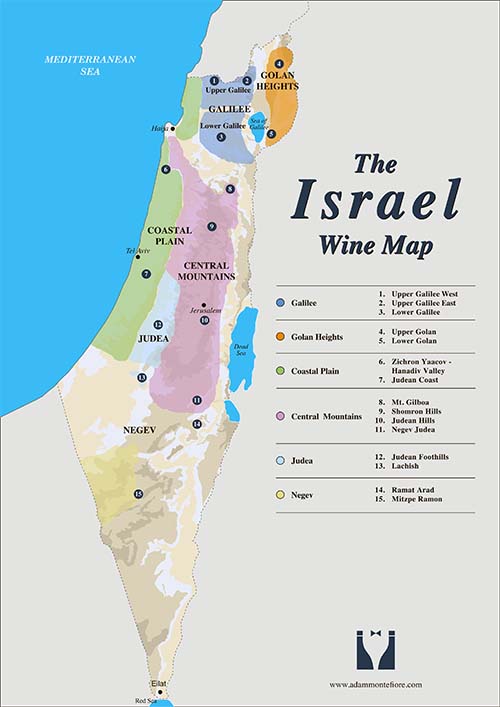 Galilee (HaGalil) – In the north, is considered the region most suited for viticulture. The Galilee benefits from higher elevations, cooler temperatures, marked day and night temperatures and volcanic soils. The cooler climate helps grapes ripen slowly, preserving acidity and complexity. Noted for elegant, structured reds (Cabernet Sauvignon, Merlot Syrah), and fresh whites (Sauvignon Blanc, Chardonnay.) Galilee wines tend to show cool-climate balance, acidity, and layered fruit, thanks to elevation and volcanic/limestone soils.
It includes the Golan Heights, in the northeast corner, sits at some of the highest vineyard elevations in Israel. Volcanic basalt soils and snowy winters (rare in Israel) give wines a more “Old World” feel. Noted for high-end reds, crisp whites, and even sparkling wines. The cool climate and basalt soils contribute to wines with deep minerality and slow, even ripening.
Judean Hills – Located between Jerusalem and Tel Aviv, this region terrain is characterized by rocky hills, limestone soils, high elevations. Vineyards are planted on terra rossa over limestome. The climate features warm days and cool nights, ideal for red-Bordeaux style blends. Noted for balanced, terroir-driven wines; both reds and whites. It is home to many boutique wineries pushing quality forward. This region accounts for about 27% of the country’s wine production.
Samson (Shomron) Region – Stretching along the coastal plain and inland foothills, the Samson region is one of the country’s largest production zones. The climate is warmer and more humid than hill regions. Noted for fruit-forward, approachable wines. It’s a major contributor to volume production rather than premium boutique wines.
Negev Desert – The Negev showcases modern irrigation and ancient ingenuity. Drip irrigation has made wine growing pssible combined with the revival of ancient desert viticulture techniques. Hot days and very cool nights. Noted for surprisingly fresh wines with good acidity.
Carmel Mountain Range – Near the Mediterranean coast, the Mount Carmel area has historic importance in Israeli winemaking, being one of the earliest modern vineyard areas (19th century revival) . This region blends history with Mediterranean style, often producing approachable wines and rediscovering older grape varieties. Noted for both everyday and higher-end wines.
Coastal Plain – Running along the Mediterranean, the Coastal Plain includes lower-lying vineyards. The climate is hot and humid. Modern vineyards are often located in cooler microclimates. Noted for simpler wines, often used for blends or mass production. It account ts for about 15% of the country’s wine.
-
Climate and grape varieties grown
Israel has a distinctly Mediterranean climate. There are two primary seasons – a hot, humid summer season running from April to October with very little precipitation and a cold, rainy winter season from late October to March. With a dry growing season, drip irrigation is needed. Vineyard managers utilize pruning and canopy management techniques to maximize shade production from the sunlight. Harvest often takes place during the cooler temperatures of night time. The dryness of the growing seasons serves a protective barrier to many grape diseases that thrive in damp weather and allows vineyard managers to control vigor and yields with by irrigation.
Israel grows a mix of imported grapes and a small but growing set of indigenous varieties that are being rediscovered. The combination is part of what makes Israeli wine distinctive, together with the climate diversity, high UV plus dry conditions and the use of many grape varieties
Imported grapes dominate most vineyards. Red grapes: Cabernet Sauvignon, Merlot, Syrah, Petit Verdot, Cabernet Franc, Grenache. White grapes: Chardonnay, Sauvignon Blanc, Gewürztraminer, Riesling, Viognier. The following Mediterranean varieties are gaining popularity because they suit Israel’s heat: Carignan, Mourvèdre, Marselan (modern cross- Cabernet x Grenache), and Argaman (Israeli-developed red grape-Carignan × Souzao.) There is also a movement reviving the use of indigenous/ancient red and white grapes with roots going back centuries, such as Baladi Asmar, Bittuni, Dabouki, Hamdani/Marawi, and Jandali.
A primary concern in Israeli wine production is maintaining acid levels to balance the naturally high sugars that the warm climate of the region produces. Vineyards at higher elevations, as opposed to the lower coastal plains, have more consistently produced wines with the necessary acid balance. Cabernet Sauvignon has shown the greatest aging potential thus far. The smooth texture and ripe tannins of Israeli Merlot has increased that wine’s popularity in the market. Chardonnay grown in Israel has shown itself to be highly reflective of terroir and of the particular characteristics of vineyard soils. It is also the primary grape used in Israeli sparkling wine production made according to the “methode champenoise.”
-
Information on the Wines
–Wine # 1. Golan Heights, ‘Yarden’ Chardonnay, Galilee, 2024
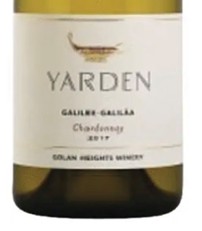 The Producer: The Golan Heigths Winery was established in 1983 and produces four labels with a range of varieties and styles: Yarden, Gamla, Hermon and Golan. The Winery maintains about 630 hectares of grape-yielding vineyards. It has planted some 20 varieties of grapes in 28 vineyards divided into roughly 450 blocks, at elevations ranging from 400 to almost 1,200 meters. Each vineyard block is mapped and cataloged, with constant monitoring of its various parameters including soil conductivity, growth, water condition in the vine, and more. The blocks are harvested separately, and their wines are stored separately in stainless steel tanks in order to maintain their identity and uniqueness until final blending. From this large selection of small blocks, winemakers can choose the most appropriate blocks for the relevant wine. Single-vineyard wines are produced only in vintages in which grape quality is exceptional and the vineyard’s terroir is clearly expressed in the wine.
Golan Heights Winery and its subsidiary Galil Mountain Winery both received the first international certification for sustainable vineyards under the LODI RULES program, which is considered meticulous and comprehensive.
The Wine: A well-balanced, complex Chardonnay with ripe pear, apple, pineapple and citrus fruit notes layered with oak and vanilla characters; rich and buttery with a long finish.
Vintage: 2024
Region: Galilee / Golan Heights, known for volcanic terroir; elevation 3,900 feet.
Grape: 100% Chardonay
Winemaking: Barrel fermented and aged for seven months with partial malolactic fermentation.
ABV: 14.5%
Tasting notes: Fresh lemon, ripe pear, green apple, and tropical fruits. Finish is rounded out by notes of apricot, cream, and French oak.
Pairings: Complements grilled chicken, seafood dishes, and creamy dishes.
–Wine # 2. 1848, ‘Second Generation’, Cabernet-Merlot, Galilee, 2024
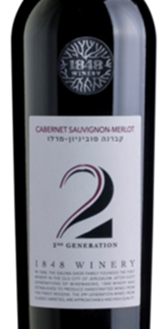 The Producer: 1848 Winery is named to honor the beginning of modern winemaking in Israel by its parent Zion Winery in 1848. 1848 Winery celebrates the generations of the Galina-Shor family. It took eight generations to have a first quality wine that is well known in the region as well as the world. From the first generation that purchased grapes from the local market and made wine that were sold in small barrels. Nearly all the wines were sweet. The first evidence of the new family profession was shown in the census commissioned by Moses Montefiore in 1849. The eighth Generation under Yossi Shor founded the 1848 Winery in 2006, which became recognized for high quality in international markets. He invested in quality vineyards in the finest wine growing regions, in particular the Galilee and Judean Hills. They began aiming for quality at all costs, updated winery equipment to state of the art levels, and employed a French born, Bordeaux trained winemaker. The quality wines won awards and recognition on the international stage. The 1848 wines have gained the respect of wine lovers and connoisseurs alike, both in Israel and around the world.
The Wine:
Vintage: 2024
Region: Galilee, grapes from the Galil and the Jerusalem Hills.
Grape composition. Cabernet Sauvignon 60% and Merlot 40%
Vinification: The grapes come to the winery in the early morning and transferred from the crusher into refrigerated stainless steel tanks. After a short maceration keeping the grape juice on its lees, the fresh grape juice was separated and fermented in stainless steel tanks at a temperature of 23 degrees Celsius, in order to preserve the fresh fruit flavors.
Aging: Aged in European oak barrels for 10 months. After this period the final blend was made, emphasizing the velvetiness of the Merlot.
Alcohol: 14%
Tasting notes: Nose – blackcurrant and plum red fruit, green pepper, blackberries and vanilla and tobacco in the background; Mouth – full fruit flavor and long finish; Color – Deep red crimson color with bright purple hues. The wine has freshness and balance, medium body and a long, complex finish.
Pairing: Pasta Bolognese, sausages, blue cheese.
–Wine # 3. Carmel, ‘Appellation’ Cabernet Sauvignon-Shiraz, Galilee, 2020
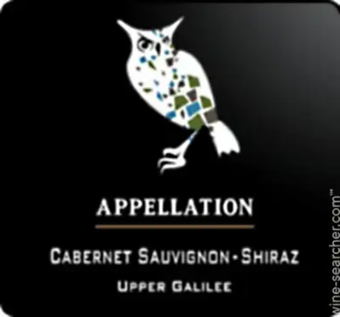 The Producer: Carmel Winery is a historic wine producer that was founded in 1882 by Baron Edmond James de Rothchild. Carmel Winery manufactures mainly wine, brandy and grape juice and it is the prime producer of wine in Israel, with nearly half of the Israeli wine market share, and one of the largest wine producers in the Eastern Mediterranean. It is also the first and oldest exporter of wine, brandy and grape juice in the country, and the largest producer of kosher wine in the world. The company holds the two largest wineries in Israel (Rishon Le Zion and Zichron Ya’acov), as well as two new smaller ones: Yatir Winery (50% ownership) and the Kayoumi Winery. In addition, the company owns 1,400 hectares (3,472 acres) of vineyards in Israel. Carmel’s production reaches 15 million bottles per year and its profit from export is US$5 million from 40 countries.
The Wine: Part of the ‘Appellation’ Regional Series representing the best vineyard regions of Israel. Wines of this series are produced from classic grape varieties harvested in vineyards from selected wine regions. This wine is a dry red blend, primarily produced from grapes grown in the Upper Galilee region and aged for 12 months in French oak barrels. It is known for a full-bodied, deep purple profile featuring blackberry, dark plum, spice, and chocolate notes.
Vintage: 2020
Region: Upper Galilee, Israel
Grape composition: Cabernet Sauvignon and Shiraz
Aging: 12 months in French oak barrels
Alcohol: 14%–15% ABV
Flavor Profile: Full-bodied, featuring blackberry, black pepper, spice, and oaky notes
Pairing: Pairs well with grilled meats, hearty stews, and roasted vegetables
–Wine # 4. Recanati, ‘David Vineyard Reserve’, Cabernet Sauvignon, Galilee, 2023
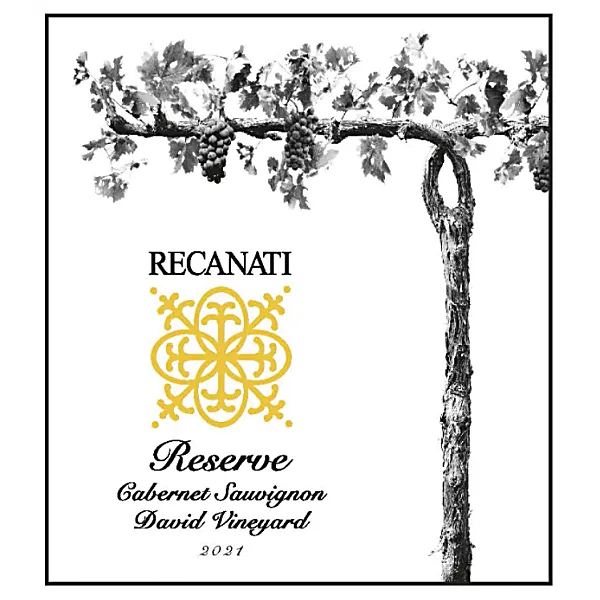 Producer: Recanati Winery was founded in 2000 and it produces young red and white blends under its ‘Yasmin’ label, single varietals under its ‘Recanati’ and ‘Reserve’ labels, and a ‘Special Reserve’. All grapes are hand-harvested, two-thirds originating in Recanati’s high-altitude Manara vineyards in the Upper Galilee and the remainder from vineyards planted in the clay-rich soil of the Jezreel Valley. The newly built Recanati winery, opened in 2022, obtains its grapes from some of the area’s high-altitude vineyards, which enjoy a climate similar to that of California’s Napa Valley. Warm days and contrastingly cool nights, together with chalky-gravelly soil conditions and limited rainfall, create an ideal environment for this variety.
The Wine: Summary: Red wine from Israel’s Upper Galilee region. It is a 100% Cabernet Sauvignon known for a full-bodied profile with notes of plum, raspberry, black cherry, and spices.
Vintage: 2023
Region: David’s Vineyard, Upper Galilee, Israel
Variety: 100% Cabernet Sauvignon
Vinification: Grapes are harvested by hand from late September through mid-October. Immediately following the crush, the must is chilled to 60ºF in route to fermentation vats.
Aging: 15 months in French oak
Alcohol: 14% ABV
Tasting Notes: Color is vibrant violet; aromas of ripe black cherry.
Pairing: Pairs well with grilled meats, roasts, and hard cheeses.
The wine is considered to have a good aging potential, capable of lasting a decade or more.
CV Members Rating (TBA after the tasting)
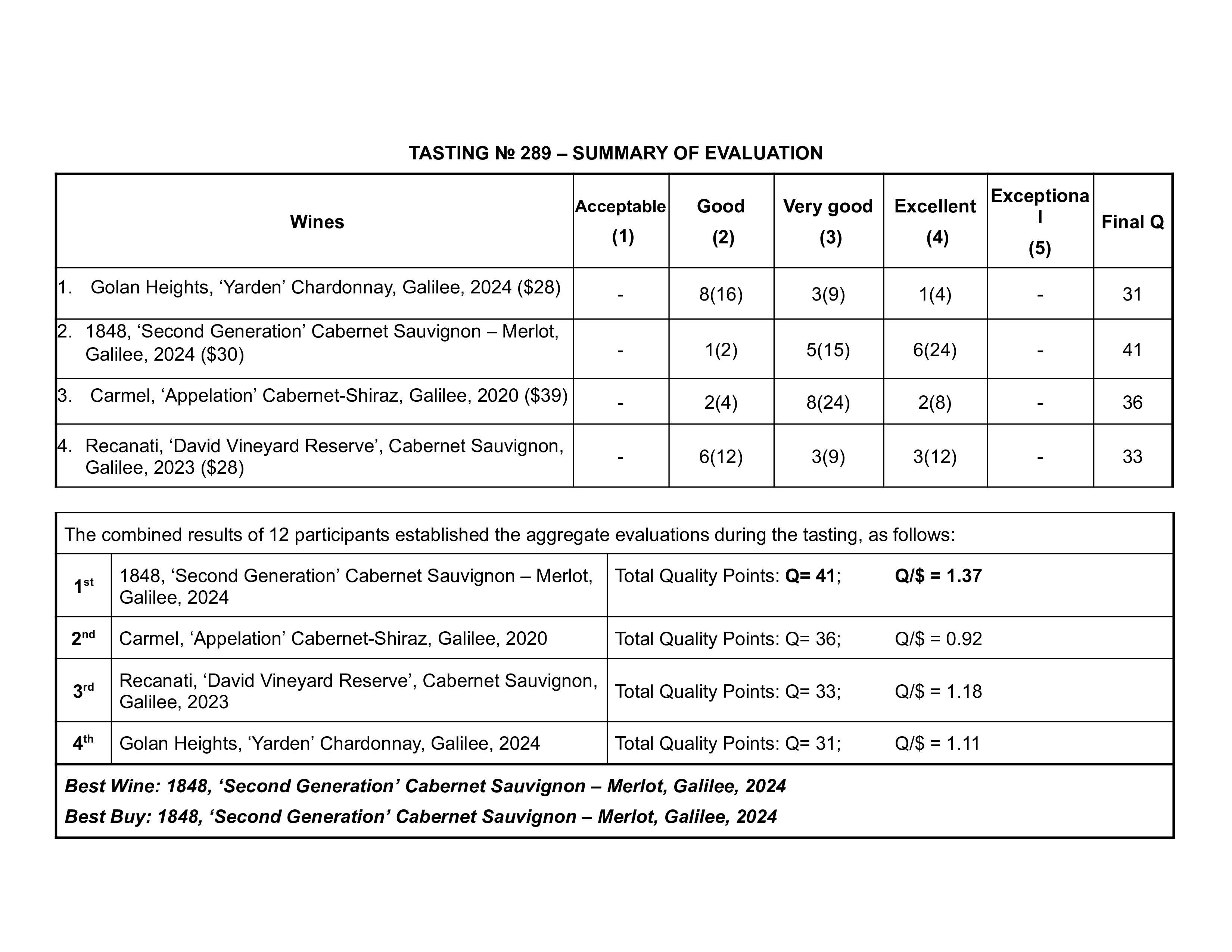
The wine tasting was conducted blind, with prices revealed only after all evaluations were completed. Twelve participants rated each wine individually on a scale from Good to Excellent. The combined scores determined the final ranking shown in the table below.
In the overall results, 1848 ‘Second Generation’ Cabernet Sauvignon–Merlot, Galilee, 2024 earned the highest score, making it both the Best Wine and the Best Buy of the tasting.
References:
https://www.carmelwines.co.il/
https://www.recanati-winery.com
https://www.wine-searcher.com/
.o0o.
.o0o.


