
 Tasting #287 – March 31, 2026 Tasting Spätburgunder
-
Tasting Overview
The objective of this tasting is to compare Spätburgunder from three different regions of Germany. Spätburgunder is the name of Pinot Noir in Germany.
Type of tasting: Open
Presenters: Erico Silva, Nick Marzella and Ricardo Santiago
Participants: to be listed
These are the wines:
- Rebholz – Spatburgunder R 2021
- Meyer Näkel Spätburgunder 2022
- Meyer Näkel Spätburgunder Blue Slate 2022
- Thörle Spätburgunder 2022.
-
Menu
- Insalata di Caprese
- Gnocchi “au-Gratin” in a Ragu sauce topped with mozzarella and Parmesan cheese
- Salmone alla Griglia with olive oil and lemon sauce
- Dessert, coffee and tea
-
Wine Industry in Germany
Overview
Germany cultivates a focused set of grapes varieties in comparison with France, Italy, and Spain.
Historically, Germany is at the limits of ‘Vitis vinifera’s viability in the northern hemisphere. Few varieties could be cultivated due to its temperature, frost, and topography.
More than 130 wine grape varieties are officially allowed for cultivation. However, only about two dozen varieties are commercially or culturally significant.
Nowadays, about 103,390 hectares are under vine, being 68% white grape varieties and 32% black grape varieties.
German Wine Classification
Germany’s national classification system was recently reformed to improve clarity and transparency. Those reforms have full effect this year (2026).
The 1971 Wine Law — “Ripeness Rules”
For most of the 20th century, in a marginal region like Germany, the essential question was: How ripe can grapes become each short, cool vintage? German wine classification was set up to reward growers who achieved peak ripeness.
German legislators enshrined this paradigm in the 1971 German Wine Law. It pointedly pinned quality to sweetness or potential alcohol but brushed aside terroir and the elements of viticulture and vinification — historic sites, yields, additions, élevage — which contribute to the precise expression of terroir.
The 1971 law set up classifications for Germany’s basic wines, Qualitätsweine, or “quality wines,” and Prädikat: wines with “specific attributes” that were required to meet increasingly selective criteria, mostly ascending ripeness levels.
The VDP and Terroir–Based Classification[1]
The VDP — Verband Deutscher Prädikatsweingüter a private association of roughly 200 German growers recognized that the national classification system failed to address changes in taste and climate. Both had begun to favor the production of dry wines. Moreover, the national system had all but erased the identity of Germany’s most acclaimed vineyards.
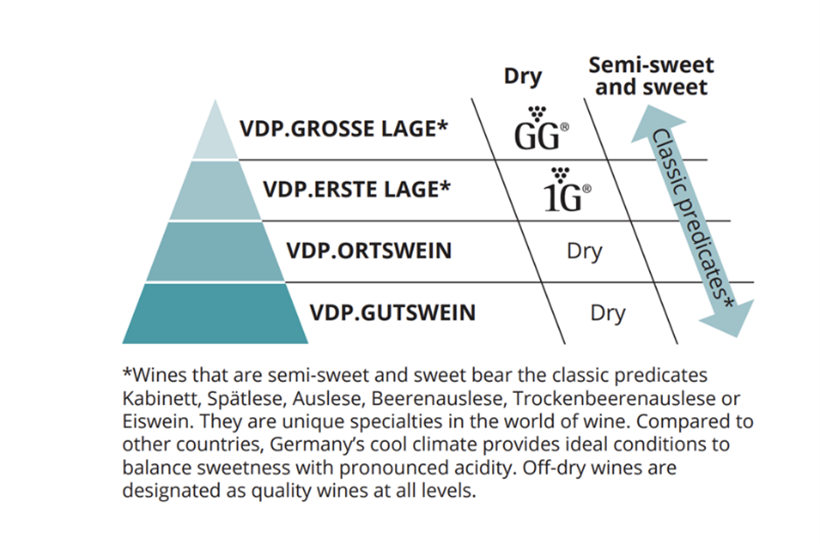
So, in 2002, with one eye on Burgundy, the other on restoring the prestige and marketability of top German wines, the VDP rolled out its own terroir-based classification system. The VDP’s prominence meant that its quality hierarchy gained widespread acceptance as a second, parallel system of classification — albeit only usable by its members. Today, its four-tier classification structure looks like this:
All four tiers are for dry wines. Specifications include:
VDP.GUTSWEIN (estate level) from estate-grown grapes, with maximum yields of 4.5 tons/ac or 75 hl/ha
VDP.ORTSWEIN (village level) from top sites from a single village, with the same yield limits as for VDP.GUTSWEIN
VDP.ERSTES GEWÄCHS (“premier cru”) sourced from recognized Erste Lage (“premier cru”) sites; maximum yields are 3.6 tons/ac or 60 hl/ha
VDP.GROSSE GEWÄCHS (“grand cru”) sourced from recognized Grosse Lage sites; maximum yields are 3 tons/ac or 50 hl/ha.
 The VDP also has a separate classification for Sekt, or traditional-method sparkling wine:
VDP.Sekt (minimum 15 months on lees, 24 months in bottle)
VDP.Sekt Prestige (36 months on lees, 36 months in bottle).
The 2021 German Wine Law — Origins Matter After All
It turns out that having two parallel, complex systems was not the way to win over converts to German wine, so in 2021 Germany got a new wine law — and, with it, a new classification system. Under the motto “The smaller the origin, the higher the quality,” German wines are now largely classified by terroir, not ripeness.
The new law and classification do not have full effect until this year (2026). Up to and including vintage 2025, German wines may still be labeled under the old rules and kept on the market.
The 2021 classification does not change the existing Prädikate. The additional indication of Prädikate is still allowed by the 2021 wine law for all categories of Qualitätswein (except Erstes Gewächs and Grosses Gewächs).
What does change is that quality is now assessed by narrowing geographic specificity. The three main tiers are: Deutscher Wein (German wine); Landwein (Country wine); Qualitätswein (Quality wine).
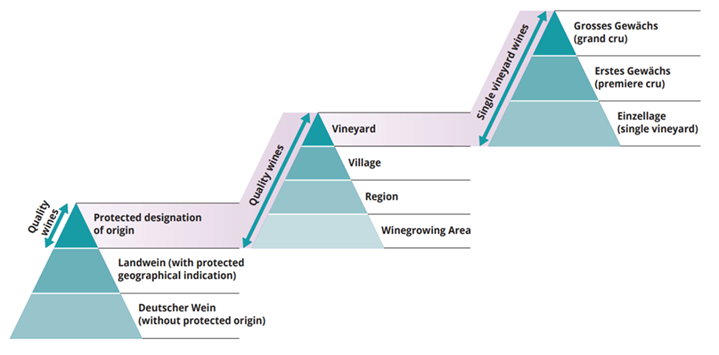
Deutscher Wein is the most basic wine category, with more laxed requirements and no PGI or PDO designation.
Landwein requires at least 85% of the grapes originate in a given wine region. Landwein is typically Trocken (dry) or Halbtrocken (off-dry). This is equivalent to EU’s PGI denomination.
The vast majority (60-80%, the share depends on the vintage) of German wine is classified as Qualitätswein. These wines must originate entirely from a single German Anbaugebiet or wine region – one of 13 in Germany – and the region must be declared on the label. Wines can only be made from legally permitted grapes and must reach a minimum alcohol content as prescribed for the region. Among the notable provisions of the 2021 wine law, the term Qualitätswein can now be accompanied or replaced by the term geschützte Ursprungsbezeichnung (g.U.) or PDO, combined with the name of a winegrowing area.
Qualitätswein is now subdivided into four narrowing tiers of origin. These are: Anbaugebiet (wine region), Region or Bereich (district), Ort (village), and Lage (vineyard). Lage sits at the apex of this pyramid.
The 2021 law then goes further, splitting Lage into three rising quality levels:
Einzellage (single vineyard) wines must reach a certain ripeness level; further specifications are set regionally.
Erstes Gewächs (premier cru) are white or red wines produced from a single variety identified as traditional and characteristic of a particular region. Yields may not exceed 3.6 tons/ac or 60 hl/ha on flat land, or 4.2 tons/ac or 70 hl/ha on steep slopes. Potential alcohol must be at least 11% and come from a declared vintage and site or parcel. The wine must be vinified dry and pass a sensory evaluation by an official tasting committee. Erstes Gewächs may not be released before March 1 of the year following the vintage.
Grosses Gewächs (grand cru) are the pinnacle. Only white and red wines produced from a single variety identified as traditional and characteristic of a particular region qualify as “GG”s. Manual harvest is required. Yields are capped at 3 tons/ac or 50 hl/ha. Potential alcohol must be at least 12%. The wine must come from a declared vintage and a particular site or parcel. The wine must be vinified dry and pass a sensory evaluation by official tasting committee. Grosse Gewächse may not be released before September 1 of the year following the vintage if white and June 1 of the second year after the vintage if red. The new law goes so far as to allow parcels within a single vineyard to be stated on a wine label, provided that these Gewannen, or cadastral vineyards, are entered in an official vineyard register.
-
Spätburgunder (Pinot Noir)
It is Germany’s leading black grape variety. In Germany, the Spätburgunder (Pinot Noir) is to red wine what the Riesling is to white wine: the cream of the crop. The grape ripens with distinct acidity and moderate tannins and produces wines ranging from light to full-bodied, depending on the region of cultivation.
It is widely cultivated across nearly all German wine regions, with notable significance in Ahr, Baden, Franken, Hessische Bergstraße, Mosel, Nahe, Pfalz, Rheingau, Rheinhessen, and Württemberg.
The Ahr region holds the largest concentration of Spätburgunder vineyards in Germany.
Between 1980 and 2020, the vineyard area dedicated to Spätburgunder in Germany nearly tripled and today, Germany is the third-largest producer of Pinot Noir in the world, after France and the United States.
The traditional style of Spätburgunder is lighter in color, body and tannic acidity than its counterparts from warmer climates.
High demands on location and climate
Aroma: blackberries, cherries, strawberries, elderberries, pepper.
Cultivation and significance
Demanding in terms of soil, climate and weather conditions, Pinot Noir is the number one red grape variety in Germany.
In Germany, around 11,519 hectares (2023) of vineyards are planted with the Pinot Noir variety, which corresponds to around 11 per cent of the total vineyard area. Wine growers and consumers are increasingly favoring the variety. Since the beginning of the 1990s, the area planted with Pinot Noir has grown by more than 5,000 hectares. Most of the vines of this variety are in Baden (5,029 hectares) – with a focus on Kaiserstuhl. The Palatinate (1,739 ha), Rheinhessen (1,504 ha), Württemberg (1,302 ha), the Rheingau (403 ha) and the Ahr (342 ha) are also important areas for growing Pinot Noir.
Vinification and flavor
Pinot Noir wines taste full-bodied and velvety, with a fruity flavor and hints of almond. The typical Pinot Noir has a slightly sweetish aroma of red fruit, from strawberry to cherry and blackberry to blackcurrant. Barrique wines also have hints of vanilla and cinnamon. A distinction is made between the classic and the modern type. Traditionally, the best Pinot Noirs were made from very ripe grapes, were not very colorful, mild, low in tannins and reddish-red in color. In addition to this classic type, the modern Pinot Noir with a strong red color, more tannin, less acidity and often a short ageing period in small oak barrels is becoming increasingly important.
History
The Pinot Noir grape variety belongs to the Burgundy family. It is probably one of the earliest varieties to be selected from the wild vines in western Central Europe. Charles the Fat brought the variety to Lake Constance in 884. It was planted in the Rheingau in the 13th century. In the 16th century, it was probably also planted in the Palatinate. In the 18th century, the variety is said to have travelled from Burgundy to the Ahr. The variety experienced a boom 150 years ago with the expansion of sparkling wine production, for which pure Burgundy vineyards were planted. The terms “Pinot Noir” and, in parts of Baden, “Klevner” are used as synonyms.
-
The Wine Regions for this Tasting
The Spätburgunder in our tasting comes from three of the country’s wine regions: Ahr, Pfalz, and Rheinhessen
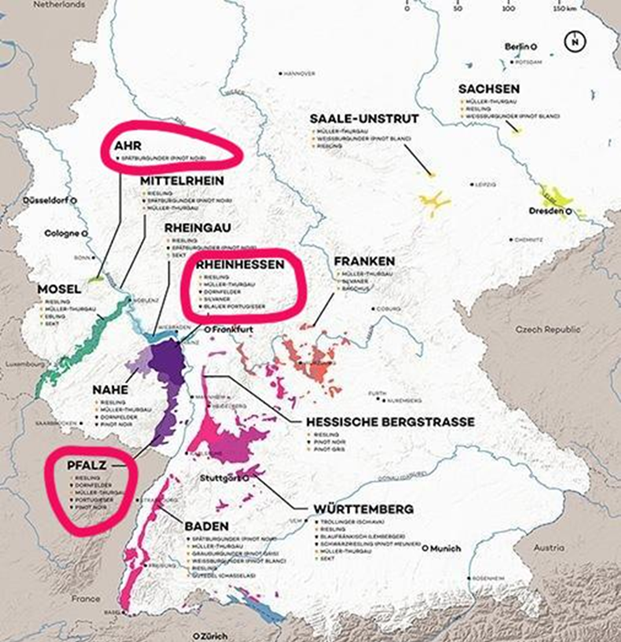
Ahr – Red Wine Paradise
The Ahr is one of Germany’s northernmost wine regions. It is also one of the smallest, with vineyards extending only 24 km along the Ahr River as it flows toward the Rhine just south of Bonn. From Altenahr, in the west, to the spa town Bad Neuenahr, the vines are perched on steep, terraced cliffs of volcanic slate. In the broad eastern end of the valley, the slopes are gentler and the soils are rich in loess. Four out of five bottles of Ahr wine are red — velvety to fiery Spätburgunder and light, charming Portugieser predominate. Lively, fresh Riesling is the most common white wine produced here. Another specialty of the region is the red variety Frühburgunder.
The Ahr Valley is on the fringe of the protective Eifel Hills. Climate is mild and favorable, greenhouse-like in some of the steeper sites. Soil types are deep, rich loess in the lower Ahr Valley (eastern portion); slate, volcanic stone and rocky soils in the middle Ahr Valley (western portion). The Ahr River meanders dreamily in tight bends through the bizarre rock landscape towards the Rhine and the vineyards nestle above on barren rocks. The mild climate provides the grapes with ideal conditions, as the warmed rocks release their stored heat to the vines at night.
Vineyard area (2022): 529 ha · 1 district · 1 collective vineyard site · 40+ individual sites.
Grape varieties (2022) include 20% white and 80% red. Spätburgunder (64.3%), Riesling (8.7%), Frühburgunder (5.9%) as well as Müller-Thurgau and Portugieser.
Today, the Ahr Valley in the north of Rhineland-Palatinate presents itself as a distinguished red wine growing region. In addition to Spätburgunder, the king of red vines, Frühburgunder is also valued and is one of the specialties of the region.
The top Ahr wines can only be produced with great effort and dedication. To work on the vines and harvest, the winegrowers often must climb through rugged crevices in extremely steep slopes, where sometimes only a few vines stand side by side. Top quality rewards this arduous work in such extreme vineyards.
Most growers are members of the five cooperatives that produce and market about 75% of the region’s wine. The State Wine Domain at the 12th century monastery Kloster Marienthal is the Ahr’s largest wine estate. Nearly all the region’s wine is consumed locally or sold to tourists.
Pfalz – Where Almond Trees Bloom
Pfalz is located between the densely forested Haardt Mountains (an extension of the Vosges) and the Rhine plain, extending from south of Worms all the way to the French border. For over 85 uninterrupted kilometers, Pfalz’s vineyards sweep across this remarkably pretty, peaceful land, linking the 130 wine towns of the region between Bockenheim and Schweigen on the border with Alsace.
The climate is influenced by many hours of sunshine, with average temperature of 11°C. In terms of soils, Loam is prevalent, often in a mixture with other soil types, such as loess, chalk, clay, colored sandstone or sand.
Vineyard area (2022): 23,698 ha · 2 districts · 25 collective vineyard sites · 300+ individual sites.
Grape varieties (2022) 61% white and 39% red. Riesling (25.2%), Dornfelder (10.7%), Grauburgunder (9%), Müller–Thurgau (6.9%), Spätburgunder (7.2%) as well as Portugieser, Weißburgunder, Kerner and Chardonnay.
Pfalz is the second largest German wine-growing region. The focus of the winegrowers is on classic grape varieties, especially Riesling. The king of white wines has become the undisputed leader in the Pfalz with nearly 6,000 hectares cultivated, and several other white verieties are on the rise. Red wines are becoming increasingly important. There is lively, fresh Weißherbst from the Portugieser grape, fruity Pinot Noir and as a special Pfalz success story, Dornfelder, which has been creating a sensation for several years. This deep-colored and quite complex red wine is mostly produced in a dry style with southern charm. About 40% of the vines between the Rhine and Haardt mountains now carry red grapes, making the Pfalz the largest red wine region in Germany.
About a third of the region’s wine is sold directly to consumers and 50% is marketed through commercial wineries and some two dozen cooperative cellars.
Rheinhessen – Land of a Thousand Hills
Germany’s largest wine region, Rheinhessen, lies in a valley of gentle rolling hills. While vines are virtually a monoculture in the Rheingau or along the Mosel, they are but one of many crops that share the fertile soils of this region’s vast farmlands. Wine has been grown here on the left bank of the Rhine since the Romans, and the oldest document about a German vineyard location – the Niersteiner Glöck – concerns a wine location in Rheinhessen.
The climate is mild as the region is surrounded by protective hills and forests: in the west, the forested, hilly countryside known as “Rheinhessen’s Switzerland”; in the north by the Taunus Hills; and in the east, the Oden Forest.
Soil types are mostly loess, limestone and loam, often mixed with sand or gravel, are the main soil types. “Rotliegendes” is a red, slaty-sandy clay soil in the steep riverfront vineyards of Nackenheim and Nierstein and near Bingen, there is an outcropping of quartzite-slate.
Vineyard area (2022): 27,312 ha · 3 districts · 24 collective vineyard sites · 400+ individual sites
Grape varieties (2022): 74% white and 26% red. Riesling (19.4%), Müller-Thurgau (14.3%), Dornfelder (11.3%), Silvaner (7.1%), Pinot Gris (8.5%), Pinot Noir (5.5%), Pinot Blanc, Portugieser and Kerner
Varied soils and the favorable climate make it possible to grow many grape varieties, old and new. In earlier times, it was a blend of whites that were popular, and some may remember Rheinhessen as the birthplace of the soft, mellow white wine Liebfraumilch. The region also boasts the world’s largest acreage planted with the ancient variety Silvaner, which is again making a name for itself. Now, a new young generation of local wine growers, appreciating the ideal working conditions on these gentle slopes, have drawn attention to themselves in recent years for their excellent wines, amongst them, high quality Rieslings.
There are a large number of part-time winegrowers in the region who sell grapes or bulk wine to commercial wineries and producer associations who produce and/or bottle and market the wine. Because of the large number of individual sites, about half the region’s wine is marketed under the name of a few collective sites (e.g. Niersteiner Gutes Domtal, and Oppenheimer Krötenbrunnen). About one third of all Rheinhessen wine is exported, not least because it is the primary supplier of the components for “Liebfrauenmilch“.
-
Information on the Wines
Wine #1. Okonomierat Rebholz, ‘R’ Spätburgunder, Pfalz, 2021
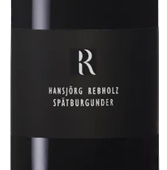 – The Producer: Weingut Rebholz family has long been defined by a steadfast commitment to producing pure, natural, and authentically dry wines. This began with Eduard Rebholz (1889–1966) who transformed the winery after World War II and rejected the growing trend toward sweetened, manipulated wines. In 1951, he articulated his principle of “natural wine”: wines made without sugar additions, artificial sweetening, or any intervention that alter their original character. For him, true quality began in the vineyard, and cellar work should preserve — not modify — the wine. His son, Hans Rebholz (1920–1978), continued this uncompromising dry style, even when it was unfashionable in Germany. Since the mid‑1990s, Hans’s son Hansjörg and wife Birgit have led the estate, expanding vineyard holdings, joining the VDP, and strengthening their commitment to sustainability through organic and later biodynamic certification. Their sons, Hans and Valentin, represent the next generation embracing these same values.
All vineyards have been organically farmed since 2006. The estate places great importance on old vines, essential for producing top‑quality wines. The Burgundy varieties grow on shell limestone and calcareous loess. Limestone soil is the best condition for all the great Burgundy /Pinot Noir wines of the World!
The “R” wines represent Hansjörg Rebholz’s cross‑generational contribution to the legacy of his father, a tradition the next generation continues with the same focus and dedication to quality. The “R” label marks wines that have always been aged in barriques. By firmly establishing barrique aging for top Burgundy varieties, Hansjörg made it a defining discipline of the Rebholz estate. These wines gain depth and finesse with every passing year.
– The Wine:
- Year – 2021
- Grape – 100% Pinot Noir
- Viticulture: Organic farming across all vineyards since 2006; focus on keeping old vine parcels healthy, young, and productive. Siebeldingen’s soils are highly diverse due to the geological formation of the Rhine Rift Valley and the uplift of the Palatinate Forest.
- Vinification: Healthy, ripe grapes are hand‑harvested and destemmed; Pinot Noir berries is added whole to the destemmed mash; the mash is cooled for cold maceration to capture varietal and site‑specific aromas; spontaneous natural fermentation begins to preserve freshness while extracting structure and complexity; pressing usually occurs after about three weeks; the must is clarified by natural sedimentation
- Aging: 19–20 months in French barriques
- 5% APV
Producer’s Tasting Notes: Dense and complex structure with lots of character. In the bouquet you will find the scent of sour cherry, black pepper and herbs. A Pinot Noir with an eerie spiciness where the oak is in the background. Unfiltered, juicy, elegant and with a long aftertaste.
Wine #2 Meyer Näkel, Spätburgunder, Ahr, 2022
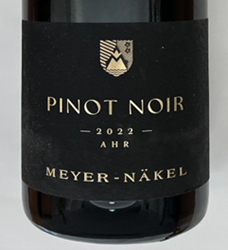 – The Producer: Weingut Meyer-Näkel is a producer in Dernau in the Ahr Region. It is best known for red wines made from the Spätburgunder wine grape variety, though the portfolio also includes whites and rosé. The name of the wine estate goes back to the marriage of grandparents Paula Meyer and Willibald Näkel in 1950. They cultivated an area of just 1.5 hectares yet were able to make a name for themselves, because Willibald’s production of dry red wines represented thoroughly pioneering work at the time. As of 2021 the vineyard holdings had grown to 15 hectares of Pinot Noir. The business was managed by Willibald’s son Werner, his wife Claudia and their daughters Meike and Dörte. The two sisters are now proceeding with making the magnificent terroir of the steep slopes by the Ahr tangible in mineral-laden and fruity wines. This requires a great deal of care in the vineyard as well as reduced yields, which are harvested by hand and carefully selected. The work in the cellar focuses exclusively on preserving this high level of quality through a gentle working method.
– The Wine:
-
- Vintage: 2023
- Grape: 100% Pinot Noir
- Category: VDP-GUTSWEIN
- Vineyard & winemaking: The vineyard is in the Ahr Region and the soil is slate and greywacke decomposition stone. The grapes are hand picked with crushed must fermentation and matured in big oak barrels.
- 0% ABV
Producer Tasting Notes: This wine is a typical traditional Ahr Pinot. In the nose you find a slightly earthy aroma of red berries like blackberry, blueberry and raspberry as well as ripe cherries, strawberries and blackberries with spicy traces of juniper and laurels. A smooth wine with elegant tannin structure and good substance.
This wine goes well with poultry, light meat, pasta and mushrooms as well as a spicy companion to grilled stronger spiced fish.
Wine #3. Meyer Näkel, Spätburgunder ‘Blauschiefer’ (Blue Slate), Ahr, 2022
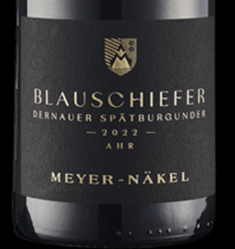 – The Wine: VDP.ORTSWEINE denotes high-quality, characterful and traditional vineyards within a town and give expression to the local terroir. Only regional varieties are used. Reduced yield yields and a long ripening period on the vine enable the typical aroma and elegant acidity and tannin structure. The slate soils of the Ahr River give Spätburgunder an unmistakable minerality that is truly unparalleled, making it something unique.
- Vintage: 2022
- Grape: 100% Pinot Noir
- Category: VDP ORTSWEIN
- Viticulture: There are three vineyards Dernauer Pfarrwingert (1.2ha), Bad Neuenahr Sonnenberg (1.4ha) and Walporzheimer Kräuterberg (0.7ha) for the cultivation of several grapes, but the majority (75%) are Pinot Noir.
- Vinification: The fully ripened grapes are hand picked (yield of 40-45hl/ha), the crushed must is fermented with natural yeasts for about 20 days.
- Aging: 11 months in French Oak barriques, for the most part in used barrels just to underline this elegant wine.
- 13% ABV.
Producer Tasting Notes: The Blue Slate (“Blauschiefer”) is a very good example of the extraordinary combination of slate and Pinot Noir. The stony soil creates a mineral wine with smoky aroma of red fruits like blackberry, blueberry, red currant and dark cherry, that is accompanied by floral and roasted aromas, with a good substance and sustainability, elegant and smooth tannins.
This wine goes well with poultry, light meat, pasta and mushrooms as well as a spicy companion to grilled stronger spiced fish.
Wine #4. Thörle, Spätburgunder, Rheinhessen, 2022
 – The Producer: The Thörle Estate dates back to the 16th century. In 1985 Rudolf Thörle took over from his father Jakob Thörle and set the estate’s focus more on the traditional varietals Riesling and Pinot Noir. In the following years, the Thörle family acquired and planted excellent parcels in Salheim’s Grand Cru and Premier Cru vineyards sites to expand the estate’s diversity of terroir. Since 2006 the state has been in the hands of the next generation, Johannes and Chrisph Thörle, who manage the winery with innovative skills.
The Thörle brothers obtain their distinctive, sappy Riesling and delicate Pinot Noir from the characteristically calcareous limestone soils of Saulheim’s Holle, Scholssberg and Probstey. They have received several prizes and awards for their individual approach and new pressing techniques. To ensure maximum extraction from the grapes, they apply mash retention and use spontaneous yeast for the fermentation process. Today, the Thörle estate ranks among the best producers in Rheinhessen.
– The Wine:
- Vintage: 2022
- Grape: 100% Pinot Noir
- Category: VDP GUTSWEINE
- Viticulture and winemaking: grown in the younger vineyards around Saulheim. The soils are characterized by limestone sediments and loess-clay deposits. Grapes harvested by hand at an optimal balance of aroma, acidity, and ripeness. The harvest time is particularly crucial for Pinot Noir. Skin-fermented, extract-rich Pinot Noir was aged for 18 months in traditional French barriques (225l). Bottled unfiltered.
- 13% ABV
Producer Tasting Notes: The nose offers wild aromas and intense dark fruit. On the palate, a hint of herbal mint, fine acidity, and a powerful minerality. Pure Pinot Noir!
Critic’s tasting notes: “Drinking window: 2024 – 2040. This 2022 Pinot Noir is from a mix of German and French genetics. Fully destemmed and fermented in open cuve, it graduated for 18 months in used barrique. A touch of smoke wraps itself around aromatic wild cherry. Cool, smooth balance is immediately apparent on the palace—coolness, in fact, is the operative term, even in this warm year. Fully ripe tannins brush like starched velvet, rounded but really fine. The wild cherry aroma is beguiling and pure, while the freshness is pristine, pure and expressive. My oh my, this is quite a number for an estate Pinot Noir. Bone-dry” (Vinous, 2022).
-
CV Members Rating (after the tasting)
Notes and References
German Wine Scholar, Study Guide, Wine Scholar Guild, 2025.
Understanding German Wine Classification, Valerie Kathawala, Wine Scholar Guild Blog, 01 January 2025 (Understanding German Wine Classification)
Wines of Germany: https://www.winesofgermany.com
Wine Folly: Download Wine Maps (Free Guides) | Wine Folly
Veritable Wines: https://www.veritable-wines-estates.de/partner/thoerle
The GWC: https://thegwc.com/meyer-na%CC%88kel/
Rebholz: https://www.oekonomierat-rebholz.com/
Meyer-Naekel: https://www.meyer-naekel.de/
Thorle: https://www.thoerle-wein.de/
[1] Source: https://www.vdp.de/en/the-wines/classification
.o0o.
Just for laughing:
.o0o.

 Club del Vino - Washington DC area