
Tasting No 284 – December 16, 2025
Favorite Wines of 2025: A Global Tour de Force

-
Tasting Overview
What a way to close out 2025! Our last tasting of the year introduces four wines that, in very different ways, punched well above their weight and reminded us why we do this every month. From granite-kissed Swartland bush vines; to a non-vintage, multi-regional Italian red sold in supermarkets; to one of the most compelling Hermitage Syrah produced in the Rhone Valley, and to grapes frozen on the vine under the Canadian winter sky; we will taste ambition, value, tradition, and sheer hedonism. Here’s the recap of the standouts that earned their place on our “Favorites of 2025” list.
Type of tasting: Open
Presenters: Ruth Connolly, Ginger Smart, and Michelle Fryer
Participants: S. Ardila; M. Averbug; J. Claro; R. Connolly; Y. Cutler; J. Entwistle; C. Estrada; C. Falconi; M. Fryer; N. and R. Gochicoa; R. Gutierrez; O. Mason; C. Perazza; J and L. Redwood; R. Santiago; E. Silva; G. Smart; P. Turina; G. Zincke; and E. Turina; M. Averbug and Emilio Labrada (guests) .
These are the wines:
- A. Badenhorst Family Wines, ‘Secateurs Chenin Blanc’, Swartland, South Africa 2025,
- Grande Alberone, Vino Rosso D’Italia, Tuscany, Italy
- Domaine de Remizières, Hermitage ‘Cuvée Emilie’, France, 2019
- Specialty Selection Vidal Ice Wine Reserve, Niagara Peninsula, Canada, 2021
The Menu:
-
- Clams in saffron sauce
- Spaghetti in marinara sauce with meatballs
- Grilled lamb with vegetables
- Cheese plate, coffee and tea.
The Wines
-Wine #1. A.A. Badenhorst Family Wines, ‘Secateurs Chenin Blanc’, Swartland, South Africa, 2025
Ruth’s Favorite White Wine: Some ten to fifteen years ago, perhaps in one of our Club de Vino tastings and perhaps not, I encountered a white wine from South Africa that impressed me as no other white wine I ever tasted, and whose 24-carat gold color and strong flavor has stayed with me to this day. So, when Ginger, Michelle and I discussed presenting our all-time favorite wines for today’s tasting, logic dictated that I present this wine. There was only one problem, I didn’t remember its name, its grape, or the year of its production. After several calls to wine shops elicited statements regarding the impossibility of finding such a needle in the proverbial haystack, my neighborhood merchant volunteered to look. He was successful.
The wine I am presenting today – the 2025 vintage of a South African Chenin Blanc entitled ‘Badenhorst Secateurs’, and in production for the last 16 years, is hopefully the valid successor of the wine I tasted years ago.
The Producer: AA Badenhorst Family Wines is a family-owned estate in South Africa’s Swartland appellation managed by cousins Adi and Hein Badenhorst. Adi, the lead winemaker, draws on extensive experience, including time at Rustenberg and Château Angélus in Bordeaux. His grandfather oversaw Groot Constantia for 46 years, fostering a deep respect for heritage. In 2008, Adi acquired a neglected farm in Siebritskloof on Paardeberg Mountain, restoring a 1930s cellar to produce natural wines from old, dry-farmed bush vines. The 60-hectare estate emphasizes sustainable, low-intervention practices with traditional wine-making equipment.
Geography and Terroir: Swartland, named “black land” in Afrikaans for its dark, fertile soils that once supported wild rhinoceroses, is better known today for its winemakers. Located about an hour north of Cape Town, this region enjoys a Mediterranean climate with hot, dry summers moderated by cool Atlantic breezes. Paardeberg Mountain’s decomposed granite soils, mixed with clay and sand, dominate the landscape. This terroir is key to the wine’s character. The granite imparts a distinct minerality and structure, while the old vines’ deep roots extract nuanced flavors from the earth. Low annual rainfall (approximately 400 mm) stresses the unirrigated old bush vines, yielding small, intensely flavored berries. The vineyards, primarily Chenin Blanc with Cinsault and Grenache, occupy north-, east-, and south-facing slopes, benefiting from varied granite types, clay, and shale subsoils. Unlike the cooler Loire Valley in France, Swartland’s warmth adds a riper, more tropical edge to Chenin Blanc, but the elevation and ocean influence keep acidity lively. It’s this balance that makes Swartland Chenin a standout—elegant yet robust, with a sense of place that’s unmistakably South African.
The Wine: Secateurs is named after the clipping tool that is used to shape Baddenhorst’s bushvines during the winter pruning and to pick the ripe grapes in summer. The first Secateurs Chenin Blanc bottled under the Badenhorst Family Wines range was in 2009.
The Grape: Secateurs, named for the pruning shears used on the estate’s bush vines, debuted as a Badenhorst Family Wines Chenin Blanc in 2009. Chenin Blanc, originating in France’s Loire Valley and now South Africa’s most planted white variety, excels in dry, textured styles. Its high natural acidity ensures freshness and aging potential, while Swartland’s warmth adds ripe fruit character without sacrificing elegance. The 2025 Secateurs is 100% Chenin Blanc from old vines, delivering exceptional concentration and complexity.
Production and Vinification: Grapes are hand-harvested in multiple passes for optimal ripeness, with low yields (around 4 tons per hectare). Minimal intervention defines the approach: whole-cluster pressing, native yeast fermentation in concrete tanks and large foudres (no new oak), and approximately seven months aging on lees in neutral vessels for texture and creaminess. Gentle practices—occasional stirring, no fining or heavy filtration—preserve purity and natural evolution while producing a structure that’s both structured and approachable. The result? A Chenin that’s textured yet crisp, with a grippy mouthfeel from skin contact and lees work. The 2025 vintage reflects a dry summer that enhanced ripeness while maintaining balanced acidity and a subtle minerality.
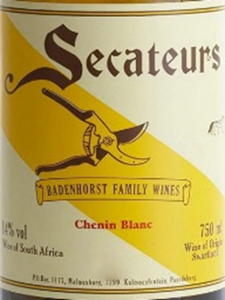
- Grape – 100% Chenin Blanc from old, dry-farmed bush vines
- Vintage – 2025
- Alcohol content – 13.5%
- Bottle – 750ml
- Soils – Granite-dominated
- Region – Swartland
- Aging – Foudres and neutral vessels; stony mineral influence
Pairings – seafood, chicken, salads, creamy sauces
Key Characteristics and Tasting Notes: Medium- to full-bodied and dry, this Chenin offers vibrant acidity, refreshing tannic structure, and exceptional texture from lees aging and old-vine intensity. Alcohol at 13.5% provides warmth but never overwhelms. Aromas feature honey, orange blossom, and white stone fruits (peach, pear). The palate reveals pink grapefruit, quince, persimmon, melon, honeysuckle, and stony mineral notes, with layered complexity and a grippy, concentrated mid-palate leading to a bright, tangy finish. Versatile for seafood, poultry, or spicy dishes, it evolves beautifully in the glass.
Winemaker’s Notes: The Secateurs Chenin Blanc 2025 is a benchmark South African white, delivering complexity, texture, and vibrancy. The flavor profile is aromatic with honey, orange blossom, peach, pear, melon, and citrus notes, balanced by minerality and a fresh finish. Aged in foudres, it displays a distinctive stony character, precise flavors of peach, pear, and pink grapefruit, substantial palate weight, and remarkable drinkability—a compelling introduction to Cape Chenin Blanc.
Wine #2. Grande Alberone, Quintis Vino Rosso D’Italia, Tuscany, Italy
Ginger’s Favorite Red: Grande Alberone Quintus is a non-vintage, multi-regional Italian red blend that delivers bold complexity and approachability at an exceptional value. This popular Italian wine is typically a blend of various red grapes, offering dark berries, cherries, and hints of chocolate on the nose, transitioning to flavors of dark fruits, spices, and velvety texture on the palate with a long, elegant finish. Frequently available through supermarket chains such as Aldi, it showcases Italy’s diverse winemaking heritage through harmonious integration of fruit, spice, and structure.
The Producer: Grande Alberone wines are produced by Provinco Italia, a Trentino-based subsidiary of Italian Wine Brands, one of Italy’s largest private wine groups. Provinco specializes in high-quality, accessible wines sourced from premier regions across the country, including Veneto, Trentino, Puglia, and Sicily. The focus is on sustainable practices, often incorporating organic grapes, and blending Italy’s extensive indigenous and international varieties to create expressive, personality-driven wines for large distribution outlets. Italian Wine Brands produces 24 proprietary brands of which some 80% is for export. Winemaker Loris Delvai, who holds a degree in biology from University of Padua, collaborates closely with growers to select optimal parcels, drawing on deep terroir knowledge to craft acclaimed blends that have earned numerous gold medals and high scores; hence proving that thoughtful curation yields extraordinary results.
Geography and Terroir: What sets Quintus apart is its embrace of Italy’s kaleidoscopic geography and terroir-driven nuances. As a Vino d’Italia IGT, Quintus embraces Italy’s geographic diversity, sourcing grapes from northern continental climates (cool nights and brisk winds that preserve acidity) to southern Mediterranean zones (ripe, generous fruit from volcanic and sun-drenched soils). Key regions include Trentino-Alto Adige, Friuli-Venezia Giulia, Veneto, Puglia, and Sicily, though specifics remain a guarded secret. Soils vary from clay-rich for structure, sandy coastal for elegance, mineral hills for finesse, and volcanic for smoky depth. Annual rainfall varies from 600mm in the wetter north to drought-prone 300mm south, stressing vines to yield small, flavorful berries.
The Wine: Grande Alberone Rosso is a popular Italian wine known for its bold, complex flavor profile, offering notes of dark berries, cherries, and hints of chocolate on the nose, transitioning to flavors of dark fruits, spices, and a velvety texture on the palate, with a long, elegant finish reminiscent of Amarone.
At its core, Quintus is a bold blend of emblematic red varieties: Primitivo (Zinfandel), Cabernet Sauvignon, Merlot, and Teroldego—all organically sourced. I refer to the blend as a “mongered mutt” but an extremely loveable (or in this case drinkable) one. The areas these grapes come from are Trentino-Alto Adige, Fiuli-Venezia Giulia. Veneto, Puglia, and Sicily. This quartet, all organic-sourced, exemplifies Italy’s grape diversity. combining Primitivo’s boldness, Merlot’s plushness, Cabernet’s structure, and Teroldego’s earthy herbal notes for a robust yet versatile wine.
Production and Vinification: Production for Quintus prioritizes purity and precision. Grapes are hand-harvested at peak ripeness, with modest yields (6-8 tons/hectare) ensuring concentration. In Profinco’s state-of-the-art facilities, they are destemmed, gently crushed, and macerated (7-10 days) at controlled temperatures to extract color, aromas, and balanced tannins. Fermentation occurs in stainless steel tanks (24-26°C) using selected yeasts, followed by malolactic conversion for silkiness and brief lees rest for creaminess. Aging lasts 4-6 months in predominantly second-use French oak barriques, adding subtle complexity without dominating fruit. The non-vintage designation allows annual selection of the finest parcels for consistency. Bottled with light filtration. Alcohol: 14.5%.

- Grape – Blend of Primitivo, Cabernet Sauvignon, Merlot, and Teroldego (organic).
- Vintage – Non vintage
- Alcohol – 14.5% ABV
- Bottle – 750ml
- Pairings – Roasted meats, tomato-based pasta, aged cheeses, chocolate desserts
Key Characteristics and Tasting Notes: Full-bodied with deep garnet hue, Quintus is dry, structured, and elegant, featuring firm yet integrated tannins, medium-plus acidity, and persistent length. Aromas evoke vibrant red berries, dark chocolate, dried tobacco, clove, and subtle spice. The palate offers plush blackberry, cherry confit, raisin, mocha, and balsamic earthiness, evolving to savory baking spices, mineral streaks, and oak-kissed vanilla. Texturally silky mid-palate with grippy finish, it unfolds over time in the decanter. Versatile for pairing, it’s food-friendly without being fussy. Approachable young but capable of developing tertiary notes through 2030. Ideal slightly chilled in summer or at room temperature with winter dishes.
Winemaker’s Notes: Full-bodied with deep garnet hue, Quintus is dry, structured, and elegant, featuring firm yet integrated tannins, medium-plus acidity, and persistent length. Aromas evoke vibrant red berries, dark chocolate, dried tobacco, clove, and subtle spice. The palate offers plush blackberry, cherry confit, raisin, mocha, and balsamic earthiness, evolving to savory baking spices, mineral streaks, and oak-kissed vanilla. Texturally silky mid-palate with grippy finish, it unfolds over time in the decanter. Approachable young but capable of developing tertiary notes through 2030. Ideal slightly chilled in summer or at room temperature with winter dishes.
Swirl to release intense ruby depths. Nose: Vibrant red berries, dark chocolate, dried tobacco, with a whisper of clove. Palate: Full-bodied entry of blackberry and strawberry confit, mid-palate blooming with raisin, mocha, and balsamic earthiness. Firm tannins frame bright acidity, leading to a spicy, fruit-pure finish with lingering plum skin and vanilla. Balanced and inviting—chill slightly for summer, or room temp for winter roasts. Decant for 45 minutes. Drink now through 2030 for peak harmony.
Wine #3. 2025 Club del Vino “Best of the Best” selection: Domaine de Remizières, ‘Cuvée Emilie’, Hermitage, Rhone, France, 2019
Émilie and Christophe Desmeure are making some of the most compelling Hermitage produced today. In fact, the 2019 Domaine des Remizières Hermitage Cuvée Émilie was rated the #1 of all 44 wines tasted by Club del Vino members in 2025. This opulent Syah from the legendary Hermitage appellation offers an intense and complex experience that embodies the region’s storied prestige—bold yet refined, structured for the cellar yet whispering an invitation to sip now.
The Producer: Domaine des Remizières, located in Tain-l’Hermitage, traces its origins to 1973 when Philippe Desmeure began selling grapes to the local cooperative. The estate pivoted to estate-bottled wines in 1977, marking a bold step toward independence. Today, the 38-hectare estate—spanning Hermitage, Crozes-Hermitage, and Saint-Joseph—is led by Philippe’s daughter Émilie Desmeure, who oversees winemaking with a blend of tradition and intuition. Her namesake cuvée debuted in 1995 as a tribute to her vision. High-density plantings (over 10,000 vines/hectare) of 40-year-old bush-trained Syrah in key lieux-dits, such as Les Grandes Vignes, yield low quantities (27–40 hectoliters /ha) for concentration. With a focus on organic-leaning viticulture and hand labor on steep terraces, the Domaine’s philosophy emphasizes minimal intervention, sustainable practices, and plot-specific harvesting. This has earned the winery Haute Valeur Environnementale (High Environmental Value) certification.
Geography and Terroir: Hermitage, France’s most revered Syrah enclave, rises dramatically from the Rhône River’s east bank, just south of Valence. This compact 136-hectare AOC features precipitous, south-facing granite slopes (up to 30% gradient) that bask in Mediterranean sun while tempered by the fierce Mistral winds.
Terroir is Hermitage’s magic: decomposed granite soils, laced with quartz pebbles and mica schist, impart a signature minerality and firm structure—think “stony elegance” that elevates Syrah beyond a mere fruit bomb. Les Grandes Vignes, at the hill’s base, offers slightly clay-influenced granitic sand for opulent ripeness, while higher plots add tension. Low rainfall (500-600mm annually) stresses the vines, fostering deep roots and small berries bursting with phenolic intensity. This interplay—sun-drenched exposure meeting wind-whipped resilience—yields wines of profound depth, where earth and ether converge. The 2019 vintage benefited from a warm, dry season with cool nights, delivering ripe fruit and preserved acidity.
The Wine: Domaine des Remizières Hermitage “Cuvée Emilie” is a stunning expression of Syrah from one of the most prestigious appellations in the Northern Rhone. This wine presents a deep profile with rich aromas of dark berries, such as blackberries and blackcurrants, alongside hints of spices, tobacco, and sutle earthy notes. On the palate, it is full-bodied with refined tannins, virant acidity, and a remarable balance of power and finesse. The wine’s depth is complemented by a long, elegant finish. A perfect match for roasted meats, game, or rich savory dishes, “Cuvee Emilie” is a wine that promises both immediate enjoyment and excellent aging potential.
Brought up all in new oak, the 2019 Hermitage Cuvee Emilie reveals a dense purple color as well as cassis and blackberry fruits, notes of scorched earth, graphite, crushed stone, and burning embers, full body, ripe, building tannins, and a great finish. It needs 4-5 years to integrate its oak and should have 25+ years of overall longevity.
The Grape: Syrah reigns supreme in Hermitage and old vines amplify complexity. The 2019 Cuvee Emilie is comprised of 100% Syrah grapes sourced from two prestigious Hermitage lieux-dits: Les Grandes Vignes (40-year-old vines on a granite hillside) and Les Rocoules (80+ year-old-vines on alluvial soils). Syrah thrives on granite, evolving from peppery youth to savory maturity. Émilie’s selection of fruit from prime parcels ensures vibrancy. In 2019’s benevolent climate, the Syrah grape ripened to 14%-14.5% ABV with silky skins, delivering ripe fruit and preserved acidity.
Production and Vinification: Production at Remizières is a labor of precision, starting in the vineyard with hand-harvesting over multiple passes to capture phenolic ripeness. Yields are rigorously controlled, with manual sorting at the winery eliminating all but the finest berries. Émilie favors reasoned sulfites and biodynamic impulses, fostering microbial diversity for authentic ferments.
Hand-harvested grapes undergo rigorous sorting and full destemming. Cold pre-fermentation maceration (5–7 days) extracts aromas gently. Alcoholic fermentation, sparked by indigenous yeasts, lasts 10-15 days in concrete and stainless-steel vats, daily punch-downs/pump-overs (28–30°C), and extended post-fermentation maceration (up to 30+ days). Malolactic fermentation softens acidity. This hands-on approach, rooted in the domaine’s 50-year evolution, yields wines of power and poise.
Aging occurs 15–18 months in 80–100% new French oak barriques, with lees stirring for creaminess. Minimal fining and filtration preserve authenticity.
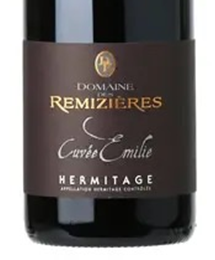
- Grape – 100% Syrah
- Vintage – 2019
- Appellation – Hermitage AOC, Northern Rhône
- Aging – Aged 15-18 months in 80% new, French oak barrels
- Alcohol – 14.5%
Aging potential – Cellar 4–5 years for integration; enjoy through 2040+
Pairing – red meats (grilled steaks), game, lamb, charcuterie, mushroom risotto.
Key Characteristics and Tasting Notes: This 2019 Cuvée Émilie is a full-bodied powerhouse cloaked in dense purple hues that hint at its depth. Aromas of cassis, blackberry, scorched earth, graphite, licorice, toasted clove, and subtle oak. The palate layers black fruits with smoky, mineral, and floral elements (mint, mesquite), evolving to olive and leather notes. Long, graphite-edged finish. Ripe, building tannins provide architecture without austerity—supple now, yet promising evolution. Medium-high acidity cuts through richness, ensuring freshness amid concentration. Texturally, it’s broad-shouldered with a velvety mid-palate, finishing with graphite-edged persistence (45+ seconds). Decant young bottles 2–4 hours; serve at 15–16°C. Cellar 5-7 years for silkier tannins; peak drinking through 2040.
Winemaker’s Notes: Full-bodied wine with a lot of sweetness, good acidity, and some pleasant bitterness. Color is Steady. Tannins are described as supple and soft tannic. On the nose, red fruits aromas when it is young, spices aromas after a few years. The wine is described as having an inky, licorice scent. On the palate, this Syrah offers flavors of boysenberry, black fig, and black currant, with hints of mesquite, vanilla, and clove. The wine also has a smoky, earthy undertone. It is expected to improve with cellaring.
Domaine des Remizières Hermitage when young, should be decanted at least 2-4 hours, give or take, allowing the wines to soften and open their perfume. Older vintages might need very little decanting, just enough to remove the sediment. Domaine des Remizières is best served at 15.5 degrees Celsius, 60 degrees Fahrenheit. The cool, almost cellar temperature gives the wine more freshness and lift.
-Wine #4. Ginger’s pick: Specialty Selection Ice-wine Vidal Reserve, Niagara Peninsula, Canada, 2021
This Ice-wine is produced from grapes naturally frozen on the vine in cold climates, concentrating sugars and resulting in an intensely sweet dessert wine. Sourced from the Niagara region in Ontario, Canada, this reserve offering exhibits high viscosity, a deep golden hue, and prominent fruity notes of peach, lemon, and toffee. Served chilled, it delivers a balanced profile where pronounced sweetness is offset by vibrant acidity.
The Producer: Specialty Selection is a curated collection from Andrew Peller Ltd., one of Canada’s largest and most respected wine producers. With flagship operations in the Niagara Peninsula, the company upholds rigorous VQA (Vintners Quality Alliance) standards. Their portfolio includes icons like Peller Estates and Wayne Gretzky Estates, but the Specialty Selection line spotlights premium, limited-production wines like this Vidal Reserve—sourced from select partner vineyards to showcase peak quality.
The grapes for this Ice-wine hail from mature Vidal vines in Niagara-on-the-Lake, planted in the 1980s and beyond, where low yields (often 1-2 tons per acre) ensure intensity. These “reserve” berries are rigorously selected: only the healthiest clusters, enduring multiple freeze-thaw cycles, make the cut. Peller’s winemakers, led by experts like Dr. Wendy Ing from the Cool Climate Oenology & Viticulture Institute, emphasize sustainable practices such as herbicide-free cultivation, cover cropping, and nocturnal hand-harvesting.
Geography and Terroir: Nestled on the southern shores of Lake Ontario, the Niagara Peninsula spans 150 km of rolling vineyards, with the sub-appellation of Niagara-on-the-Lake being Icewine central. This VQA zone, just minutes from the thundering falls, boasts a continental climate moderated by the lake’s thermal mass: balmy summers (up to 30°C) ripen grapes slowly, while brutal winters plunge to -10°C or lower, ideal for natural freeze. The Escarpment—a limestone ridge—shields vines from harsh northwest winds, creating micro-pockets of “lake effect” warmth that delay dormancy and concentrate flavors.
Terroir here is a glacial gift: clay-loam soils over ancient limestone bedrock retain moisture in summer and drain well in winter, imparting minerality and structure. Sandy subsoils add finesse, while the lake’s humidity fosters noble rot-like dehydration without Botrytis risk. Annual rainfall (800-900mm) and diurnal swings (15-20°C day-night) build acidity, essential for balancing Icewine’s sugars. In challenging years like 2024’s variable frost, only the hardiest sites produce.
The Wine: Ice-wine Vidal has a beautiful pale gold color with high viscosity (10.5% ABV, but plenty of RS). The nose has intense aromas of honey, apricot, orange peel, candied/sugared citrus rings, white blossom and yellow apple. The palate is sweet with high acidity and a full body. Rich flavors of honey, apricot, orange zest and a tropical note like candied pineapple combine for a medium-length finish that is silky smooth.
The Grape: Vidal Blanc, a resilient French hybrid, bred in the 1930s for Cognac, found its calling in Canada’s cold climate after arriving in the 1940s. Thick-skinned and resilient, it withstands -25°C freezes without splitting, It accounts for the majority (80%) of Ontario’s icewine production, achieving high sugar levels (35–40° Brix) while retaining sharp acidity.
Production and Vinification: Ice-wine production is extreme oenology. Grapes remain on the vine until temperatures drop consistently to –8°C to –12°C, typically in December or January. Harvest occurs at night, followed by immediate whole-cluster pressing to yield minimal (1 glass/vine), highly concentrated juice, yielding just 5-10% juice. Fermentation in stainless steel is slow and cool, stopping naturally to retain substantial residual sugar (approximately 220 g/L). Bottled in spring, it’s unfiltered to preserve aromatics—a testament to Peller’s cool-climate mastery.
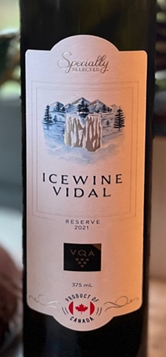
- Grape – 100% Vidal
- Vintage – 2021
- Region – Lake Ontario, Niagara region
- Appellation: VQA (Vintners Quality Alliance) – Niagara -on-the-Lake
- Alcohol – 10.5%
- Aging Potential: Drink now through 2035; develops honeyed complexity with time
Pairings: Blue cheese, fruit tarts, almond cake, dark chocolate, or spicy dishes
Key Characteristics and Tasting Notes: This golden-hued Reserve is viscous yet lively: full-bodied with 10.5% ABV, it coats the palate like liquid silk, balanced by piercing acidity that prevents cloying. The profile is a tropical reverie: ripe stone fruits lead, laced with floral honeysuckle and citrus zest. Aromas evoke peach jam, mango, and candied orange peel, with undertones of nutmeg and wet stone. Texturally, it’s ideal for sipping chilled (8-10°C) in small glasses. Versatile: elevates blue cheese, sorbets, or spicy Asian fare. Cellar 5-10 years for honeyed tertiary notes; sustainable viticulture adds ethical allure.
Chill and swirl the deep amber elixir. Nose: Explosive honeyed peach, ripe pineapple, orange blossom, with flinty minerality. Palate: Lush entry of mango and apricot confit, mid-palate blooming with tangerine, butterscotch, and subtle spice; vibrant acidity slices through, finishing with lingering grapefruit pith and candied ginger. Harmonious and hedonistic—pour sparingly for dessert. The sweet wine is sold in a skinny, half-size bottle (375 mL rather than the standard 750 mL), and typically served in portions of 1.5-2 ounces. Drink now through 2035.
6. CV Members Rating
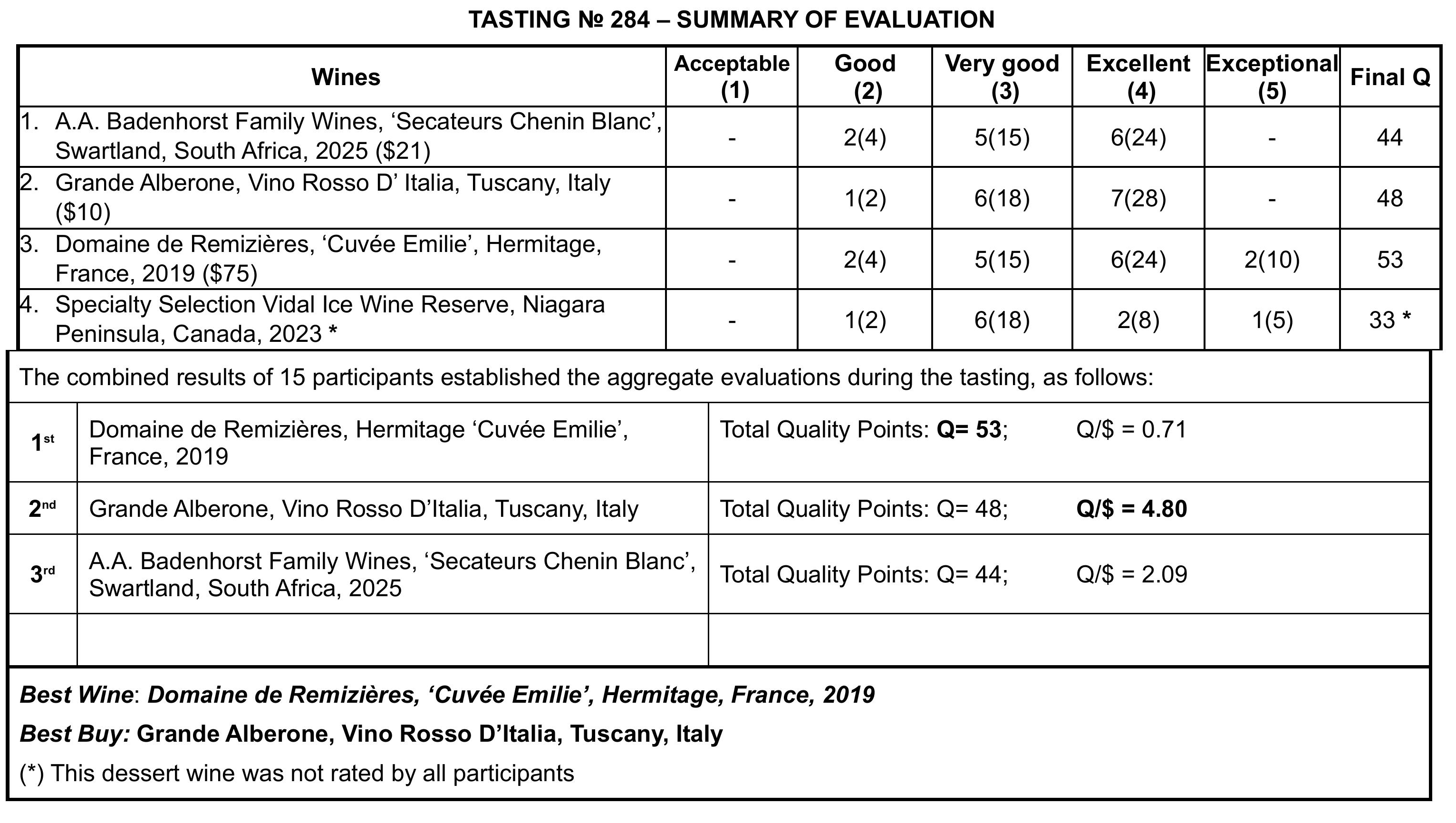
The wine tasting took place before revealing their prices, with 15 participants rating them individually from Acceptable to Exceptional.
The combined scores determined the ranking order, as shown in the following Table.
In the final results, Domaine de Remizières, Hermitage ‘Cuvée Emilie’, France, 2019 was the Best wine, while Grande Alberone, Vino Rosso D’Italia, Tuscany, Italy was the Best Buy.
.o0o.

.o0o.

 Club del Vino - Washington DC area