

Tasting No – October 28, 2025
Wines from Greece
-
Tasting Overview
The objective of this open tasting is to delve into the wines from Greece and also re-examine the information about their production and characteristics. The Club has celebrated two tastings of these wines – in October 2011 and in February 2013. After more than ten years, there have been advances in the wine production that
deserve to be updated.
Type of tasting: open
Presenters: Jaime Estupiñan
Participants: (to be completed after the meeting)

These are the wines:
- Douloufakis – Vidiano Crete, 2024
- GWC Assyrtiko Santorini, 2024
- Xinomavro Ramnista, 2019
- Ktima Mitravela Agiorgitiko, 2023
The Menu
- Greek salad with feta cheese.
- Seafood.
- Grilled lamb chops with brown sauce and vegetables.
- Dessert, tea or coffee.
-
Overview of Wine Production in Greece
Highlights
Thousands of years ago, the Greeks introduced viticulture to much of Europe; today, the world is discovering Greek wines all over again. The Greek wine industry is experiencing an exciting and radical transformation, thanks to international investment and a new generation of winemakers well-versed in the world’s best winemaking practices.
Greece has arguably one of the longest wine histories in the world as wine has always been an integral part of Greek culture since antiquity. Greece might not be the first country to produce wine, but what can be attributed to Ancient Greece is the development of a culture encompassing all aspects of wine: vine growing, wine production, legislation, trading and, of course, the art of consuming wine.
Wine makers who have studied in Bordeaux, Burgundy, California and Australia are leading the changes in the Greek wine industry, not by attempting to make international grape varieties work in Greece’s difficult terrain, but by focusing on the indigenous grapes that have succeeded there for millennia. The wine produced from these indigenous varietals represent the important wine industry of Greece. Some international varietals are cultivated but they represent a minimal part of the wine production here and are mainly used for blending with the local varietals.
Despite their huge heritage, the wines of Greece can promote themselves solely by virtue of their present attributes and not past glories. In the last three decades, a wind of change has been blowing through Greek wine production, turning a relatively traditional agricultural sector into a cutting-edge entity in today’s wine world. Greek producers have invested heavily in people, education, know-how and technology, starting a steep learning curve. The level of quality of wines currently coming out of Greece can match any other country, but there are several other features that make the Greek wines stand apart.
Greece’s vine production area is spread across various regions, with a total of approximately 64,000 hectares dedicated to wine grapes. The country’s wine production has seen fluctuations in volume, with an average annual output of around 2.3 million hectoliters in 2020 and 1.7 million hectoliters in 2021. However, challenging weather conditions have led to a significant decrease in production in 2023. Despite these challenges, the Greek wine market continues to grow, with a projected market value of around US$665.3 million by 2029. The industry is also benefiting from the country’s economic recovery and a vibrant tourism sector, where visitors actively seek local wines.
Greece produces more white than red wine, with the latter accounting for just a third of total production. An impressive 90% of plantings consist of the country’s rich stock of indigenous grape varieties (Greece has approximately 200 grape varieties).
The most important indigenous grape varieties include: Assyrtiko, Moschofilero and Vidiano, which produce elegant and aromatic white wines; Mavrodaphne, which is the source of a luscious, fortified dessert wine; and Agiorgitiko and Xinomavro, red grapes that thrive on Greece’s south and northern mainland. Other white grapes of note are Lagorthi; Malagousia, Savatiano and Roditis, while other indigenous red grapes include Kotsifali; Liatiko; Mandilaria; Limnio; Xinomavro; and Mavrotragano. Naturally, these Greek wines make excellent pairings with Mediterranean cuisine and simple grilled foods.
Retsina is an ancient style of wine that is influenced by the presence of pine sap or resin. For a long time, Retsina was synonymous with Greek wine, and many still assume that all Greek wine tastes like Retsina, which is not the case. Retsina is just one style of wine within a sea of more familiar wines that Greece produces.
The U.S. is the world’s second-largest export market for Greek wine, and the caliber of bottles sent this way continues to climb.
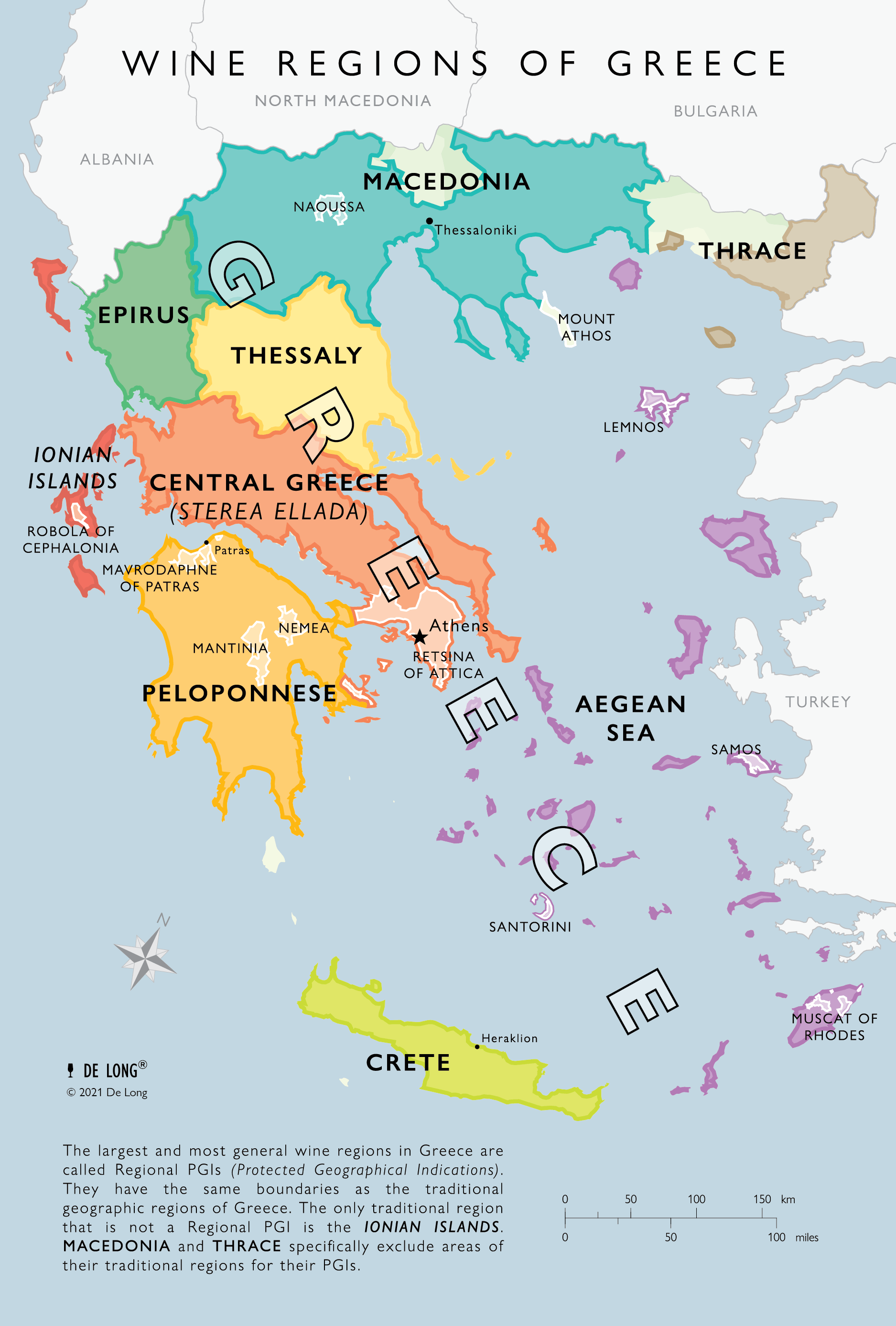
Wine Regions and Denominations
 The very first thing to understand is that Greece is much more diverse in terms of climate than most people realize. The country has everything – from arid Mediterranean islands to wet, mountainous pine forests that receive snowfall in the winter. With such a diverse climate, you can expect Greek wines to be quite varied as well. So, one of the best ways to wrap your head around Greek wine is to split the country up into four overarching wine zones based on their climates.
Greece has many regions, which can essentially be divided up into four primary climatic zones:
♦Northern Greece: Wet climate; Epirus, Macedonia and Thrace.
White Grapes: Malagousia and Assyrtiko, often blended with Sauvignon Blanc or Chardonnay.
Red Grapes: Mostly Xinomavro with a little bit of Merlot, Limnio, Cabernet Sauvignon, and Syrah. Xinomavro is being hailed as “the Barolo of Greece,” where it grows in the regions of Naoussa and Amyndeo. This wine can taste strikingly similar to Nebbiolo (hence the correlation with Barolo), with dark cherry fruit, licorice, allspice, and occasionally subtle tomato notes.
♦Aegean Islands: Arid climate, Mediterrarean islands of Santorini, Samos, Límnos, etc.
White Grapes: Assyrtiko (Santorini), Muscat Blanc (Samos), Athiri, Malvasia (called Monemvasia). Santorini, a volcanic island, is the homeland of Greece’s most famous white wine, Assyrtiko.
Red Grapes: Limnio (Límnos), Mandilaria (Paros), and Mavrotragano.
♦Central Greece: Modulating Mediterranean climate; Central Greece, Thessaly, and Attica.
White Grapes: A lot of Savatiano and a little bit of Malagousia, Assyrtiko, Athiri, Begleri, and Chardonnay.
Red Grapes: A lot of Xinomavro and a little bit of Agiorgitiko, Krasato, Stavroto, Limniona, Vradiano, Cabernet Sauvignon, Merlot, and Syrah.
♦Southern Greece: Hot stable Mediterranean climate; Crete, Peloponnese, and Kefalonia.
White Grapes: Moschofilero, Muscat Blanc, Robola (Kefalonia), Vidiano (Crete), and Roditis.
Red Grapes: Agiorgitiko (Peloponnese), Mavrodaphne (Kefalonia; Peloponnese), Kotsifali (Crete), Liatiko (Crete),
Mandilaria (Crete), Syrah, Cabernet Sauvignon.
♦Protected Designation of Origin (PDO) and Protected Geographical Indication (PGI).
The origins of Greek PDO and PGI wine designations date back to the late 20th century, when Greece emerged as a serious player in the wine world. The introduction of these designations aimed to reinforce the concepts of authenticity and typicality, with specific geographical boundaries and varietal compositions set. PDO Wines of Greece are produced in historically significant regions and adhere to strict production methods and regulations. These wines must meet quality standards that demonstrate the unique characteristics and traditions of the region. PGI Wines of Greece are made from grapes grown within a broader geographical area and may use a wider range of grape varieties and winemaking techniques. They often showcase regional character, while allowing for more experimentation and diversity in style. Depending on their geographical breadth, PGI zones are divided into three levels: PGI Regional Wines; PGI District Wines; and PGIArea Wines.The regulations governing these designations einsure that Greek wines maintain the identity
and quality reflecting the country’s rich wine
making heritage.
 The Best Wines from Greece – a summary
Greek wine is ancient, and bottles made from the country’s 300-plus indigenous grapes are food-friendly with serious value for money. Why, then, aren’t more people drinking them?
Some think the problem is linguistic: the names of Greek wine varieties intimidate many Anglophones. “If you look at the labels, they can be quite confusing, and it’s hard to decipher what you’re looking at,” says John Stanley, founder of Stanley’s Wet Goods in Los Angeles. Some Greek winemakers even label their bottles of Agiorgitiko, a native red grape planted throughout Greece, as “St. George” in English-speaking markets.
Whites:
Assyrtiko [ A seer’ tee ko ] is a classy white grape, possibly some of the greatest varieties found in the Mediterranean basin. It originated in Santorini (Assyrtiko-Santorini) but it spread all over Greece, becoming, in terms of quality, one of the most important native varietals. It produces mainly dry white wines, some of which are being aged in oak. However, a number of sweet wines are made, from sun dried grapes. Assyrtiko is one of these rare white grape varieties that can grow on hot and dry climatic conditions, while at the same keeping the high alcohol in perfect balance by its crisp acidity. It is more of a textural variety, emphasizing extract, body and structure, rather than an aromatic grape. The smoky, salty and cellar–worthy white wine borne of Santorini’s moonscape-like volcanic vineyards dates back more than 3,500 years. Grown in sandy, nutrient-poor soils resistant to the Phylloxera pest that decimated vineyards across the world, Santorini was left untouched. This enabled the development of hearty vineyards, some of which are more than 150 years old. In fact, the island boasts some the few self-rooted vines left in Europe. In these more nutrient-rich soils and under less traumatic conditions, Assyrtiko displays a softer, fruitier character that appeals to a broader range of palates. However, it maintains a hallmark acidity and minerality that sets it apart from other international wines.
The flavor profile of Assyrtiko is dominated by fresh citrus notes, such as lemon, lime, and grapefruit, alongside a characteristic minerality that gives the wine a refreshing, almost salty finish. The acidity in Assyrtiko is vibrant, making it an ideal wine to pair with a variety of seafood dishes, as well as Mediterranean cuisine like grilled vegetables and roasted chicken. Some Assyrtiko wines also show hints of herbs and floral notes, adding further complexity to the wine.
Vidiano from Crete is one of the most exciting grapes to emerge. This viscous, mineral-driven grape has incredible texture that reminds of a cross between France’s Marsanne and Santorini’s Assyrtiko. We are just scratching the surface on this grape, and there will be a lot to love as we continue to watch winemakers work with it.
Historically, the Savatiano and Roditis grapes were the workhorses. For decades they made simple white wines that were crowd-pleasing café staples for easy mezza pairings. There has been a lot of focus on leveling up these grapes, and we will continue to see more exciting ones to come over the next few years.
The aromatic grapes Moschofilero and Malagousia are making some of the most exotic and engaging whites. Moschofilero is perfumed like Muscat but has a dryer finish, while Malagousia reaches towards floral tones but takes a step back to show off more of its stone fruit flavors.
Reds:
Reds definitely took a back seat to their white counterparts when Greek wines reemerged on the international wine scene a decade ago. The red grapes’ popularity suffered from difficult-to-pronounce names and a decided rusticity at the time. So much has advanced over the last decade.
The main native grape in the north is Xinomavro (kseen-o-mav-ro), widely regarded the finest red wine of the country, which is often referred to as Greece’s Nebbiolo. This grape is known for its dark color (mavro means black) and its high acidity and tannic texture (xino means acid). There are so many styles emerging from the classic regions of Amyndeon and Naoussa in Macedon). This is mountainous country with a mix of high-altitude vineyards and great terroirs from alluvial runoff. There are some truly exciting wines coming from these regions.
In the south there is Agiorgitiko (—eye-your-gitty-ko), the most planted native red grape in Greece, that can be found throughout Greece, but particularly in the Nemea region of the Peloponnese where it forms a PDO zone. Some Greek winemakers label their bottles of Agiorgitiko, as “St. George” for English-speaking markets. A low- to medium-yielding variety producing medium- to high-acid wines depending on elevations and soil profiles. Deep red fruits (plum and cherry) and spice. Considered to be one of Greece’s best red varietals and biggest producing red variety. This grape has a juicer profile often described as Sangiovese-like, closer to Nero d’Avola from Sicily, with darker berry fruit but sweeter warmer tannic structure. It is easy to drink on its own.
A host of other reds are beginning to find their footing too, including Mavrodaphne, Mavrotragano, Limniona, and Liatiko, sometimes seen on their own and sometime in blends.
-
Information on the Wines
♦Wine #1. Douloufakis ‘Dafnios’ Vidiano PGI Crete, 2024
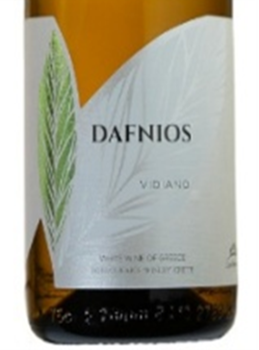 The Producer: Domaine Douloufakis Winery: In 1930, Dimitris Douloufakis became one of the first winemakers in Crete to produce wines professionally in his traditional, old winery. Their privately owned vineyards of 200 acres are located in the heart of the wine-growing zone of Crete, in Dafnes, Heraklion and at an altitude of 350 – 450 meters. The limestone soils of the area and the microclimate that prevails are considered ideal for the production of good quality grapes. This region has a long history in viticulture and also has been established as a Protected Designation of Origin for Liatiko wines .The privately owned vineyards are certified 100% organic and span over 70 acres of rolling hills in the Dafnes sub-region, a village close to Iraklio in Crete.
– The wine:
- Vintage: 2024 Grape: 100% Vidiano
- Region/appellation: PGI Crete
- Viticulture: certified organic farming
- Winemaking entirely in steel.
- 13.5% APV
Winemaker notes: The 2024 “Dafnios” has a pronounced bouquet of ripe peach, apricots, honeydew melon, papaya, and gardenia. The palate is broad and creamy, balanced by crisp acidity and peachy tropical fruit flavors. It’s reminiscent of a Northern Rhône Viognier, but with a nervier backbone.
Critic’s review: “Douloufakis was the estate that resuscitated Vidiano from a scant 10 hectares at the turn of the 20th century. The estate now farms a total of 25ha organically with a strong focus on Vidiano grown on Crete’s abundant limestone. Although famous for the single-vineyard, barrel-fermented Aspros Lagos, this steel-fermented wine is a brilliant introduction to the variety. Fleshy and bold with some of the richness and decadence of Viognier, with attractive flavors of fresh peach, melon and apricot, but the palate is a completely different game: alert, spicy, structured by notable acidity and with real drive and concentration through to the finish.”(Pam Roberto, 2025).
♦Wine #2. Greek Wine Cellars – GWC, ‘Flowers’ Assyrtiko, Santorini, 2024.
 – The Producer: Greek Wine Cellars, formerly known as Kourtaki Wines, is a large, historic wine producing and blottling company in Greece. The company was founded in 1895 by Vassili Kourtakis, one of the first Greeks to gain a diploma in oenology. In 1905, the company established in Markopoulo, Mesogia, an old wine-growing region where it continues to operate today. The company has continuously expanded its operations to include several regional wineries across Greece, including Ritsona, the Peloponnese, and Crete. It encompasses several brands split in three divisions: Kourtaki, Calliga and Oenoforos. Their wines are produced under PDO and PGI appellations. The winery’s annual production is approximately 30 milion bottles, half of which is exported. The The Ritsona winery in central Greece has always been at the forefront in implementing new methods and investing in modern technology with the aim of constantly improving the wines it produces.
The wine: made from 100% indigenous Assyrtiko grapes, once fruiting begins, the grapes grow sheltered in baskets called kouloura, creating a natural work of art. Most wines are unoaked, though some very good examples of oaked Assyrtiko are made and boast the same great ageing potential.
- Vintage: 2024
- Grape: 100% Assyrtiko
- Region/appellation: Santorini PDO
- Aging: 5-7 months 13% ABV
Winemaker’s notes: Golden yellow color, with hints of citrus & apple on the nose. Crisp clean fruit on the palate with the development of a pleasant acidity and minerality, the latter derived from the unique character of the geology of this dramatic volcanic island. Great with seafood.
♦Wine #3. Kir-Yianni Estate, ‘Ramnista’ Xinomavro, 2019
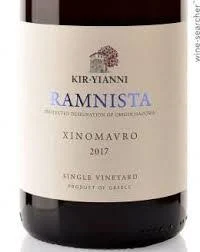 – The Producer: Kir-Yianni Estate was established in 1997 by Yiannis Boutaris, one of the leading figures in the Greek wine industry. Kir-Yianni, “Mr. John” in Greek, is best known for producing premium Xinomavro from the slopes of Mt. Vermio in Northwestern Greece. Today, Stellios Boutaris, son of Yiannis, actively manages the winery and their two 30+ year-old estate vineyards located in Naoussa and Amyndeon. The Kir-Yianni philosophy is a desire for innovation, respect for tradition and true knowledge of the wine, from the grape to the consumer.
– The Wine: The Ramnista vineyard has a southeast exposure at an altitude of 120-280m. The grapes for Ramnista are carefully handpicked. They use grapes mostly from the vineyard blocks of lower pH and with lighter soil type in order to maximize the aromatic intensity and complexity.
- Vintage: 2019
- Grape: 100% Xinomavro
- Region/appellation: Naoussa PDO
- Vinification: grapes are handpicked and carefully sorted before being crushed. Fermentation is done in 5,000ltr French Oak wooden vats at controlled temperatures with regular Pigage. The final blend is made five months after harvest.
- Ageing: 80% of the wines spends 16 months in 225L barrels, 20% in 500L barrels. Both French and American oak casks are used, plus further ageing in bottle for another 12 months.
- 14% ABV
- Dintinctions/Awards: Gold (Mundus Vini, 2023); Gold (Thessaloniki Intnl. Wine Competition, 2023); Bronze (Decanter World Wine Awards, 2023); Bronze (Intnl. Wine Competition, 2023).
Winemaker’s notes: Garnet red, typical color to Xinomavro. Vibrant red and black fruit on the nose, with aromas of strawberry, cherry, and plums. A crisp and fruit-forward mouth with delicate notes of sweet spices and tobacco. Full body with good acidity and smooth tannins adding structure and leading to a pleasant finish. This exceptional vintage showcases the Xinomavro grape’s complexity, offering notes of ripe red berries, dried plums, and subtle hints of olive and tobacco. On the palate, you’ll enjoy its vibrant acidity and well-integrated tannins, leading to a smooth, lengthy finish. Perfect for pairing with grilled meats or savory Mediterranean dishes. This wine can taste strikingly similar to Nebbiolo (hence the correlation with Barolo), with dark cherry fruit, licorice, allspice, and occasionally subtle tomato notes.
Tasting notes: “An aromatic complex wine which combines powerfully fresh red fruits and notes of rose, make up the new vintage of 2019 Ramnista. On the palate, gentle tannins, and round mouth feel, with distinctive sense of the oak barrel. The unexpected full body and robust acidity showcase a great wine with aging potential up to 15 years.”
♦Wine #4. Mitravelas Estate, ‘Ktima’ Agiorgitiko, Nemea, 2023
 – The Producer: Mitravelas Estate was founded in the city center in 1913 and later in the 1950’s the three Mitravelas brothers Andreas, Spyros and Nikos took over the winery. By the end of the 20th century, the family owns about 10 hectares of vineyards in various areas of Nemea zone. The winery is located in Achaldia, one of the best sites in Nevea. Some pieces of the land are formed of extremely old vines which are dry farmed non irrigated. This results in very small annual production and on the other hand excellent concentrations and ripeness of the grapes. Elements necessary for the highest quality in the wines produced.
– The Wine: Fir this wine, the ensemble of vineyards are located mainly on the hillside around the area of Nemea, in the winery’s privately owned area of 10 hectares, yet also in cooperating viticulturists’ land with long-term contracts, where the yields are minimized, in order to maximize the quality. Different soils and altitudes depending the wine to be produced in each vineyard. Ktima Agiorgitiko wine have received awards for quality since its 2005 vintage.
- Vintage: 2023
- Grape: 100% Agiorgitiko
- Region/appellation: Nemea PDO
- Vinification: grapes are destemmed and inoculated with autochthone yeasts selected from the Nemea area; followed by a long stay with the grapes, about 15 days, at relatively low temperatures in order to preserve the fruity aromatic characteristics and to extract only the fine tannins. Alcoholic fermentation is followed by malolactic fermentation.
- Ageing: 6-8 months ageing in French oak barrels, 2nd and 3rd use. It is expected that for the next at least 8 years it will become more complex and velvetiy.
- 14.5% ABV
Winemaker’s notes: The 2023 Ktima Agiorgitiko from Mitravelas Estate is a deep red-violet color wine with aromas of blackcurrant, pomegranate, and plum. It features flavors of sour cherry, dark fruits, and hints of leather, pepper, and vanilla. The wine is known for its velvety tannins and rich acidity, making it suitable for pairing with red meats, game, and spicy dishes. It has received positive reviews for its complexity and aging potential, with a tasting note describing it as a firm and medium-fruity red with a dusty finish.
- CV Members Rating (after the tasting)
References:
The Wine Regions of Greece (Maps) | Wine Folly
The Ancient Greek Varieties Making Thoroughly Modern Wines | Wine Enthusiast Magazine
The history of Greek wine Archives – Wines of Greece
PDO, PGI, IDO – What is this? | The Greek Wine Experience
The Best Greek Wines to Drink Right Now | Wine Enthusiast Magazine
A Guide to the Most Popular Greek Wine Varieties
8 of the Very Best Greek Wines: What They Are and Where to Find Them
Top 13 Greek Red wines in United States right now
Douloufakis Winery, Crete (Greece) Vidiano “Dafnios” 2024 ($18) – Wine Review Online
Greek Wine Cellars (Markopoulo) – Wines of Greece
Naoussa Cuvée Villages — Ktima Kir-Yianni
2023 Ktima Mitravelas – Agiorgitiko Nemea Estate Red (750ml). MacArthur Beverages
.o0o.
Laughing Matter:
It is a full bodied wine with hints of acrimony, partisanship, and moral outrage.
.o0o.

 Club del Vino - Washington DC area