
Tasting No 280 – August 26, 2025
Aromas in White Wines
-
Tasting Overview
The objective of this blind tasting was to explore and discuss the characteristics of key aromas in white wines, without any attempt to identify the wines being tasted. White wines of different grape varieties and/or winemaking techniques were selected for this tasting.
Type of tasting: Blind
Presenters: Sergio Ardila and Cesar Falconi
Participants: S. Ardila; J. Brakarz;J. Claro; R. Connolly; Y. Cutler; C. Falconi; M. Fryer; J. García; R. Gutierrez; A and C. Perazza; J. Requena; C. Santelices; L. Uechi; and G. Vega.
-
The Menu
- Fruit salad with goat cheese
- Ravioli with white sauce
- Roasted pork with potatoes
- Dessert, tea or coffee
-
Overview of Wine’s General Characteristics
When evaluating red and white wines, you’re looking for a balance of several key characteristics that contribute to the overall experience. While some characteristics are universal, others are more pronounced or specific to one type of wine.
The main characteristics we look for in a good wine are:
- Acidity: This gives wine its refreshing, crisp, and sometimes tart quality. It’s the “mouth-watering” sensation you feel. Acidity acts as a preservative and provides structure. Higher acidity can make a wine feel lighter.
- Sweetness (Residual Sugar): Wines can range from bone-dry (no perceptible sugar) to lusciously sweet. Sweetness is due to residual sugar left after fermentation. It balances acidity and can contribute to body.
- Body/Mouthfeel: This refers to how the wine feels in your mouth – its weight and richness. Factors like alcohol content, residual sugar, and oak aging contribute to body.
- Aroma/Flavor Profile: This is what you smell and taste. Wines can have a vast array of aromas and flavors, often categorized according to their origins:
- Primary Aromas/Flavors: From the grape itself (fruits, florals, herbs, spices, earthy notes).
- Secondary Aromas/Flavors: From the winemaking process (e.g., yeast, butter from malolactic fermentation, toast or vanilla from oak aging).
- Tertiary Aromas/Flavors: From aging in the bottle (e.g., dried fruit, leather, mushroom, nutty notes).

- Balance: This is crucial for a good wine. It means all the elements (acidity, sweetness, tannin, alcohol, fruit) are in harmony, with none overpowering the others.
- Finish/Length: This is the lingering impression of the wine in your mouth after you’ve swallowed it. A long, pleasant finish is a sign of quality.
- Complexity: A complex wine reveals multiple layers of aromas and flavors that evolve as you taste it. It’s not one-dimensional.
- Clarity & Color:
- Clarity: The wine should be clear, not cloudy, unless it’s a specific style of natural wine that intentionally has some haze.
- Color: The hue can indicate age, grape varietal, and winemaking techniques.
In red wines, Tannins is a key characteristic, derived primarily from grape skins, seeds, and stems, and sometimes from oak aging. They provide structure and allow red wines to age well. Tannins can be described as ripe, smooth, rustic, or green.
Specific Characteristics for White Wines
- Acidity: generally, white wines tend to have higher acidity than red wines, contributing to their refreshing quality.
- Color: White wines range from pale straw yellow with green tinges (young, unoaked) to deeper golden hues (oaked, older, or from warmer climates).
- Typical Flavors: white wines commonly exhibit: i) citrus notes (lemon, lime, grapefruit), ii) tree fruits (apple, pear), iii) stone fruits (peach, apricot), iv) tropical fruits (pineapple, mango), v) floral notes, and often vi) mineral or herbaceous undertones.
- Absence of Tannins (mostly): white wines are typically made without skin contact during fermentation, meaning they have very little to no tannin (unless aged in new oak barrels, which can impart some).
-
The Influence of Aroma on Flavor
When tasting wines, the influence of aroma on their flavor and other characteristics, especially in white wines, is fundamental and crucial. In fact, the perception of flavor is overwhelmingly linked to the sense of smell. The sense of smell accounts for 80% of what we perceive as flavor. While the tongue detects basic tastes (sweet, salty, sour, bitter and umami), it is the nose that distinguishes the nuances and specific notes, such as fruits, flowers, spices, etc. To prove this, one only needs to hold their nose while tasting a food or drink: the flavors are perceived as much more muted and less defined.
What distinguishes white wines from reds or rosés are the essential aromas and sensations perceived on the palate. White wine is therefore fresh, light, and subtle, and presents flavors highly appreciated by the finest palates.
The wine releases different aromas, each one coming from the terroir, the grape variety, the winemaking technique, or even the wine’s aging process. These aromas are revealed in different stages of the tasting:
- Olfactory analysis of white wine
The olfactory examination allows for the identification of the wine’s “nose” (the aromas), thanks to the phenomenon of retro-olfaction. Even before bringing the wine to the mouth, the sense of smell can guide us and deliver the wine’s “bouquet” through two stages:
- The first nose: This first step consists of smelling the wine in the glass, even before swirling it. It allows for the discovery of possible wine defects, such as cork taint or a vinegar smell.
- The second nose: This second step consists of swirling the wine in the glass to aerate it and release the aromas. In the second nose, the olfactory analysis already allows us to become aware of the wine’s origins (grape variety, wine region, winemaking method, etc.).
The olfactory analysis of a white wine can indicate whether the wine is “closed” or “open”. We speak of a closed wine when no striking aroma is discovered in the first nose. The wine seems bland and monotonous, very unexpressive. This can then indicate that the white wine is in a so-called “transition phase” of its evolution. The best thing to do then is to help it evolve by decanting it.
- Retro-olfactation
When drinking wine, volatile aromatic molecules travel from the mouth through the internal passages to the olfactory receptors in the nose. This process, known as retro-olfaction, is what creates the perception of “flavor” that we associate with the specific notes of the wine.
-
Aromas in White Wines
White wines offer a delightful and diverse range of aromas, influenced by the grape varietal, the climate it’s grown in, and winemaking techniques. These aromas can be broadly categorized into three types:
- Primary Aromas (Varietal Aromas): These come directly from the grape itself. They are the freshest and often most prominent scents in young white wines. This aroma category includes: citrus fruits; tree fruits; stone fruits; tropical fruits; floral; herbal/vegetal; mineral.
- Secondary Aromas (Winemaking Aromas): These develop during the fermentation and aging processes.These include: yeast/bread/brioche; dairy/cream/butter; nutty; vanilla/toast/spice.
- Tertiary Aromas (Aging Aromas): These develop as the wine matures in the bottle over time. Not all white wines are meant for long aging, but those that are can develop fascinating complexities. These include: dried fruit; honey/caramel; nutty, sherry-like notes; earthy/mushroom; petrol/kerosene.
Understanding these different aroma categories and how they relate to grape varietals and winemaking methods will greatly enhance your enjoyment and appreciation of white wines. To help guide our tasting, Sergio distributed a tasting sheet detailing the specifics of these categories of aromas, and explained how we should carry out the tasting.
Examples of aromatic profiles in white wines
White wines offer a fascinating spectrum of aromas. Here you can find a breakdown of some white wines with distinct aromatic profiles (link pdf). aromaticprofiles
6. The Wines
After the tasting Sergio and Cesar revealed the wines described below, and more detailed
description about their main characteristics and profiles was shared with the participants.
A. Merry Edwards Sauvignon Blanc, 2023
Merry Edwards winery is located in the Russian River Valley, California, and is committed to sustainable practices. The winery is highly acclaimed for its Sauvignon Blanc and Pinot Noir, and its portfolio also includes Chardonnay.
This 100% Sauvignon Blanc varietal is known for its crisp, bright acidity, which is balanced by a silky, creamy texture. Technical data for the 2023 vintage indicates a pH of 3.35 and an alcohol content of 14% ABV.
In terms of aromas, the wine is described as highly aromatic, with a prominent tropical fruit profile. Notes of white pineapple, passionfruit, mango, and guava are complemented by floral hints of plumeria, gardenia, and honeysuckle, as well as citrus accents like lemon curd, lime zest, and ruby red grapefruit. The palate is clean and bright with a long, refreshing finish.
B. Ramey Russian River Valley Chardonnay, 2023
Ramey Wine Cellars is an iconic California winery located in Healdsburg, Sonoma County. Their Russian River Valley Chardonnay is a benchmark for the region, known for its balance of richness and bright acidity. It is a blend from several cool-climate, low-vigor vineyard sites in the Russian River Valley, primarily planted with the UC Davis Clone 4, known for its prominent acidity. The wine is celebrated for its energetic and vibrant acidity, which provides a crisp, fresh backbone and sense of structure, balancing its rich texture.
The alcohol content can be 13.5% or 14.5% ABV, depending on the specific bottle.
In terms of aromas, the nose is complex and inviting, with aromas of green apple, Meyer lemon, pear, and hints of tangerine and lime.
Subtle notes of lemon blossoms and baking spices from the oak aging add to the complexity. On the palate, the wine is full-bodied and layered, with flavors of ripe stone and orchard fruit (white peach, apricot) complemented by vanilla, toasted brioche, and a distinctive minerality.
The finish is long, expressive, and showcases a beautiful balance of creamy texture and lively acidity.
C. Chablis Premier Cru Fourchaime, 2023 Rated Best Buy and Best Wine by the participant Club members.
Domaine des Chenevières is a family-run winery located in Mâcon region of Burgundy, France, with a history spanning six generations. The Chablis Premier Cru Fourchaume is a classic expression of Chablis unique, mineral-driven style. Sourced from the esteemed Fourchaume vineyard, this wine benefits from the Kimmeridgian limestone and clay soils that are characteristic of the region, which impart a distinctive flinty quality. The 2023 vintage is described as having a vibrant acidity that provides a fresh and lively backbone to the wine. This acidity is a key component that makes the wine feel crisp and well-structured, balancing out its richness.
In terms of aromas, the wine is noted for its complexity and finesse. It offers a
bouquet of citrus, such as lemon and lime, along with green apple, white peach, and hints of floral notes. The palate is rich and full-bodied but maintains a mineral edge, with a long, clean finish that lingers.
Alcohol content for this vintage is generally around 13.5% ABV.
D. Trimbach Riesling Sélection de Vieilles Vignes, 2019
Maison Trimbach is one of the most esteemed and historic wineries in Alsace, France, with a legacy dating back to 1626. The Riesling Sélection de Vieilles Vignes is a special bottling from Trimbach, a testament to the depth and complexity that old, low-yielding vines can achieve.
The 2019 vintage is characterized by its vibrant, incisive, and very precise acidity. This racy acidity provides a clean, fresh backbone that balances the wine concentration and structure.
The alcohol content for this vintage is approximately 14% ABV.
In terms of aromas, the wine is celebrated for its superb aromatic concentration. It presents a complex bouquet of citrus, including lemon, lime, and tangerine, along with notes of white flowers, white peach, and wet slate. On the palate, it is rich, full-bodied, and silky, with a long, mineral-driven finish. As it ages, classic Riesling notes of petrol and honey may emerge.
-
CV Members Rating
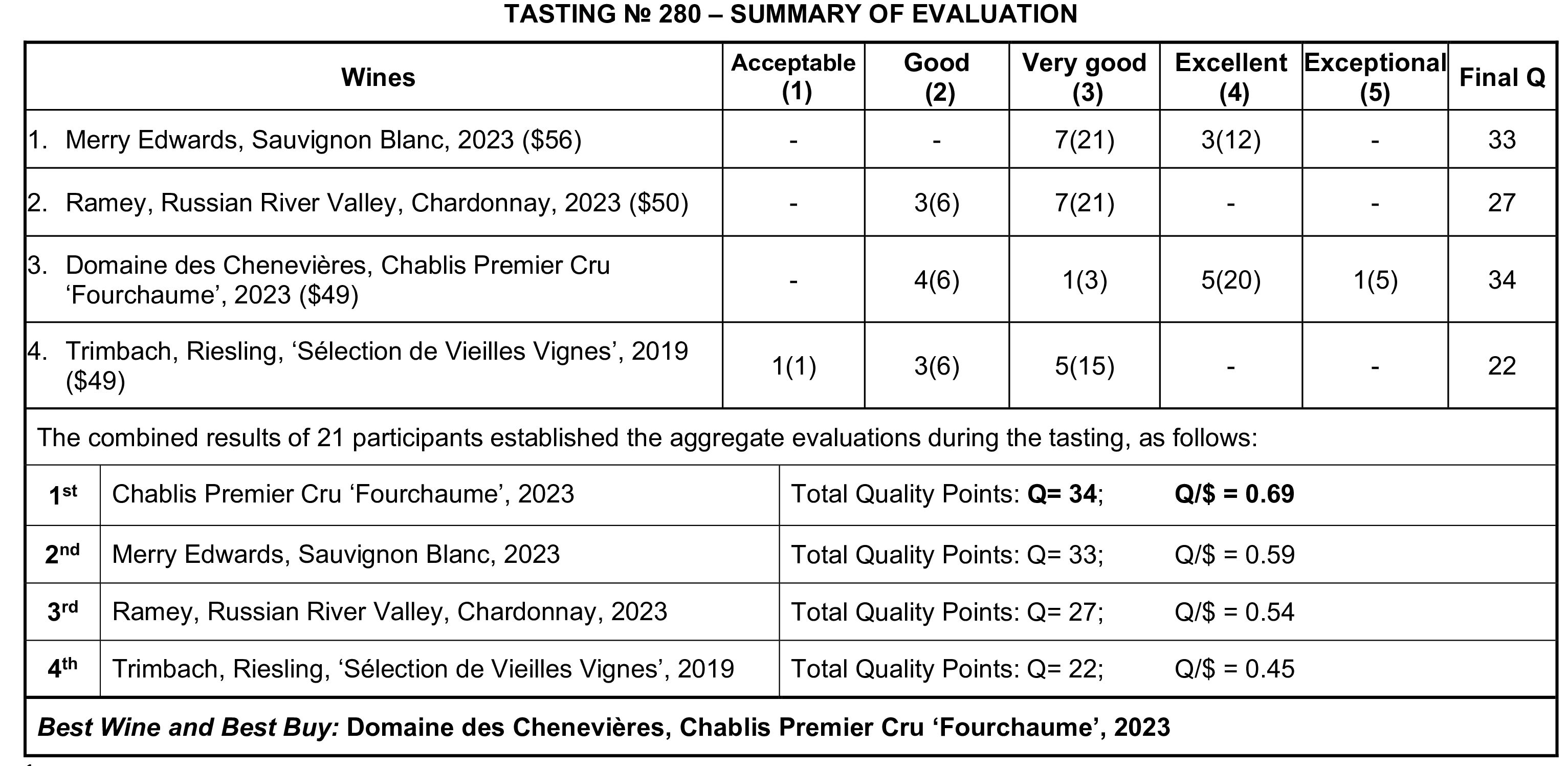
The wine tasting took place before revealing their prices, with 10 participants rating them individually from Acceptable to Exceptional. The combined scores determined the ranking order, as shown in the following T able. In the final results, the Chablis Premier Cru ‘Fourchaume’, 2023 was the Best Wine and the Best Buy.
.o0o.
.o0o.

 Club del Vino - Washington DC area