
 Tasting No 278 – June 24, 2025
Highlights from Central Europe: wines from Austria and Hungary
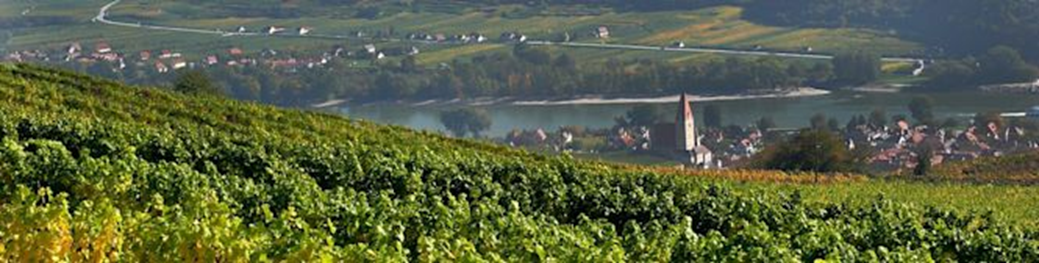
Wachau, DAC Austria
-
Tasting Overview
The objective of this tasting is to explore some notable wines produced in two countries in Central Europe: Austria and Hungary. This is an open tasting.
Presenters: Claudia and Agilson Perazza
Participants: M. Averbug; L. Bocalandro; J. Brakarz; R. Connolly; Y. Cutler; C. Estrada; J. García; R. Gutierrez; A. and C. Perazza; C. Santelices; P. Turina; L. Uechi, G. Vega and C. Falconi (guest).
These are the wines
- Rudi Pichler ‘Terrassen’ Smaragd Gruner Veltliner, 2023
- Disznoko, Tokaji Dry, Furmint, 2023
- Erich Sattler Zweigelt, Burgenland, Austria, 2021
- Paul Achs, Blaufrankisch, Heideboden, 2021
- Disznóko ‘1413’ Edes Szamorodni, 2021
The Menu
- Smoked salmon with greens
- Cheese Raviolis in tomato sauce
- Veal marsala with vegetables.
- Dessert, coffee or tea.
-
Austria and its Wines
A mountainous, landlocked country in Central Europe, Austria is enjoying a renaissance as a wine-producing nation. It has worked its way free from decades-old controversy caused by a careless few, and has emerged as a role model for modern European wine – a leader in quality and innovation.
Viticulture in Austria dates back to Roman times. Evidence of vineyard cultivation surrounding Carnuntum DAC and the Thermen regions suggests that vines were planted here 2000 years ago. The steep terraces along the Danube River and its tributaries in Wachau and Kamptal were built by monks from monasteries in Bavaria and Salzburg. The vineyards of Vienna have a rich tradition of ‘Heurigen’ (meaning both wine tavern and the wine served inside), where locals can enjoy the proprietor’s homemade wines.
For much of the 20th Century, Austria was associated with sweet, mass-produced wine made of Gruner Veltliner and Muller-Thurgau. Producers are now focusing more on crisp, dry wine styles, some of which age very well.
This move to drier wines partly resulted from the 1985 “anti-freeze scandal”, in which diethylene glycol was found to have been added to some bulk-produced wines to increase levels of sweetness and body, reminiscent of a late-harvest dessert style wine. The scandal led to the collapse of the Austrian wine industry – in terms of both exports and reputation – but stricter wine laws were enacted, and the industry has recovered.
Balancing the traditional with the modern, the Austrian wine industry has retained such classics as sweet Ausbruch and Strohwein, while actively developing modern, consumer-friendly wines such as its signature style: the crisp, white, aromatic Gruner Veltliner.
Geography and climate of wine regions
Located right at the heart of Europe, between the latitudes of 46°N and 48°N, Austria lies parallel with central France and south of Germany. Logically, the climate is slightly warmer than that of Germany, and this is reflected in the wine styles.

Austria’s wine regions can be found primarily in the northeast of the country. Niederösterreich (Lower Austria) is the largest wine region with 24,145 hectares (59,663 acres) of vineyards responsible for approximately half of the total wine output. It is where you’ll find the country’s most popular and important wine varieties including Grüner Veltliner and Riesling. Within Lower Austria, the regions of Wachau, Kamptal, and the prestigious Kremstal consistently produce the highest rated wines in the region.
Very little Mediterranean influence makes it over the Alps into Austria, creating a strongly continental climate, with pronounced temperature shifts from day to night and from summer to winter. Numerous varied mesoclimates lie in between the extremes, moderated by large bodies of water such as the Danube River (which flows through the northern regions), and Lake Neusiedl.
Moving south, the climate is a bit warmer where it’s moderated by Lake Neusiedl in Burgenland. Just south of Vienna, a warmer pocket of wine regions produces outstanding red wines, including Zwiegelt, Blaufränkisch, and Saint Laurent.
Burgenland region on Austria’s eastern border is the second largest with 12,249 ha (30,267 acres). Vienna is often described as a prominent wine region despite its relatively small vineyard area and wine output, in comparison to other regions, followed by Styria with 4324ha (10,684 acres).
In Steiermark (Styria), it is cooler, and there are some incredible examples of Sauvignon Blanc, a spicy rosé called Schilcher, and Muskateller (an aromatic but dry Muscat Blanc wine).
Wine classifications: Austrian wine laws are strongly influenced by those of neighboring Germany. The country’s wine quality classification system is based on must weight (sugar content) of the grapes, measured on the Klosterneuburger Mostwaage scale (KMW). There are three basic quality levels: Tafelwein, Qualitätswein and Prädikatswein.
Austria wines also follow the ‘Districtus Austriae Controllatus’ (DAC) appellation system, introduced in 2003. In a similar way to France’s AOP classification, the DAC wine laws impose certain constraints covering permitted grape varieties, alcohol levels and oak maturation regimes. The goal of these is to ensure that wines bearing a DAC title represent an authentic example of the classic regional style. As of 2020, Austria had sixteen DAC titles. Here are some of the titles or appellations are relevant to today’s tasting:
Wachau – is a small but important wine district on the Danube River in northern Austria. One of Austria’s most famous and respected wine regions, Wachau is known for its full-bodied, pepper-tinged Grüner Veltliner and rich, steely Riesling. Wachau has a unique set of wine designations for its white wines – Steinfeder, Federspiel and Smaragd. This three-tier classification was developed by the region’s producers as a way of communicating the style of their wines, beyond region and grape variety.
Steinfeder wines are the lightest: fresh and tangy, with a maximum of 11.5 percent ABV;
Federspiel wines are the middleweight category (11.5–12.5 percent ABV), with the racy, precise, elegance of a hunting falcon; and
Smaragd wines are the richest and fullest-bodied, with a minimum of 12 percent ABV.
Neusiedlersee – Burgenland’s Lake Neusiedl (Neusiedlersee) is one of the viticultural focus points of the region. It stores summer heat from the Pannonian Plain, an expansive, warm area covering much of Hungary and eastern Austria, effectively lengthening the ripening season into autumn. Best-known for its sweet white wines, the Neusiedlersee region is a DAC designation that is also forging a reputation for red wines made entirely from Zweigelt – the only other wine style covered by the DAC title (others are labeled “Burgenland”).
Additionally, other non-DAC Neusiedlersee wines include “Heideboden” – a regional name for an area extending east of Lake Neusiedl. The soils are sandy-calcareous and permeable, which is ideal for growing grapevines. Wines from Heideboden are often full-bodied and fruity.
Key Grape varieties
Officially, 35 grape varieties are permitted for use in Austrian quality wine, of which almost two-thirds are white-wine varieties.
Gruner Veltliner: is by far the most important white grape, followed by Riesling. Other varieties important to Austrian white wine include Chardonnay, Sauvignon Blanc, Welschriesling and Pinot Blanc (known here by its German name Weissburgunder).
Almost half of Austria’s vineyards are planted with Gruner Veltliner, which is known as the nation’s signature grape variety, occupying 14,376 hectares (35,523 acres) of the variety is found planted primarily in the Niederösterreich and Burgenland regions.
‘Herbaceous and zesty’ – expect racy acidity with an herbaceous tingle of pepper. Grüner Veltliner is often likened to Sauvignon Blanc because of its green flavors of white pepper and green bean. Most people who start with an affordable Grüner Veltliner will taste this, but what’s interesting is what happens when you spend a little more. The higher-quality Reserve, Smaragd, or Steiermark denominations are much richer, almost like an oaked Chardonnay from Burgundy.
With its green herbaceous notes, Grüner Veltliner makes a perfect accompaniment with sushi. However, it will work wonders with cilantro-driven Mexican dishes as well.
Austria’s red wines are made primarily from Blaufränkisch, Zweigelt, Saint-Laurent and Pinot Noir (aka Blauburgunder).
Blaufränkisch (aka Lemberger and Kékfrankos) is a black-skinned wine grape grown widely in Austria and Hungary, and to a lesser extent in neighboring Germany, Slovakia, the Czech Republic, Bulgaria and Croatia. In Austria, Blaufränkisch is the second most popular red wine variety, behind Zweigelt. It is grown in almost every wine region, to some extent, but its stronghold is in Burgenland, where approximately 2,632 hectares (6,504 acres) were cultivated in 2015.
Blaufränkisch is Austria’s champion age-worthy red wine with a vein of acidity and big tannins. They’re often a little harsh when young, but Blaufränkisch wines become wonderfully subtle and lush with age. Expect blackberry, tart cherry, and an elegant citrus-like spice in Blaufränkisch wines along with a pronounced burst of tannins in the mid-palate. Blaufränkisch is rich with moderate tannin and should be paired with rich, grilled foods. Try it with your next BBQ tenderloin or smoked tofu burger.
Zweigelt – While native to Austria, Zweigelt is actually a fairly recent cross bred by Dr. Zweigelt in 1922. He crossed two native varieties, Blaufränkisch, for its peppery bite, with St. Laurent, chosen for its elegance. Zweigelt is the most-planted red wine grape variety, occupying 6311ha (15,594 acres).
It is a lighter red wine, similar to Grenache or Gamay, that is rarely oaked. Since it’s a cool climate red, the finish will often have a slightly bitter note. Even though most Zweigelt is on the affordable side, there are a few age-worthy examples that give off rich cherry flavors with a touch of oak.
A ‘cherry bomb’: the best advice to someone who wants to try Zweigelt is to give it about an hour to decant. A Zweigelt that may initially have a bitter or tart finish suddenly becomes deeper and fruitier, exhibiting black cherry and raspberry notes.
Zweigelt has moderate acidity and pairs with Austria’s traditional Spätzle and Schnitzel. However, try chicken tenders and tater tots for a more American version.
St. Laurent (or Sankt Laurient), it is worth mentioning, even though accounts for only 2% of Austria’s vineyards, this wine grape has a surprising similarity in flavor to Pinot Noir. Some DNA profiling suggests that it is even a direct offspring of Pinot Noir, but this finding remains unsubstantiated, and debate continues on whether there is a relationship.
“Raspberry and baking spice”- Sankt Laurent wines tend to be dark purple in color, structured yet silky with a characteristic dark-cherry. Blackberries, smoke and spice are also commonly exhibited. The wines are often matured in oak and show good aging ability. Although the demand for St. Laurent has increased, making it a bit more expensive and harder to find, it offers a great alternative to Pinot Noir. As such, St. Laurent loves delicately flavored foods with an element of richness. Pairing examples include ricotta-stuffed tortellini with a St. Laurent-based Beurre-Rouge. Food pairings for St. Laurent wines include Rheinischer Sauerbraten (baked pickled beef marinated with juniper berries, cloves and nutmeg); blackened pork with apple sauce; barbecued beef ribs with caramelized onions.
-
Hungary – the best-kept secret of the old wine world
Hungary, in central Europe, has gained its reputation in the wine world through just a couple of wine styles, but for centuries it has been a wine-producing nation of considerable diversity.
“Ever-associated in the minds of enophiles with the sumptuous sweet white wines of Tokaji, Hungary boasts a proud, longstanding – and diverse – wine heritage”.
In addition to the sweet wines of Tokaj and the deep Bull’s Blood of Eger, the Hungarian wine portfolio includes dry whites from the shores of Lake Balaton, Somló and Neszmély, and finer reds from various regions, notably Villány, Sopron and Szekszard.
Hungarian wine culture stretches back to Roman times and has survived numerous political, religious and economic challenges, including Islamic rule during the 16th Century (when alcohol was prohibited) and the Phylloxera epidemic of the late 1800s.
Geography and terroir
The country is located between the 46th and 49th parallel, which is actually the same latitude range as many of France’s top wine regions from Northern Rhône to Champagne. Hungary’s rolling hills are rich in volcanic soils and limestone–idyllic soil types for fine winemaking.
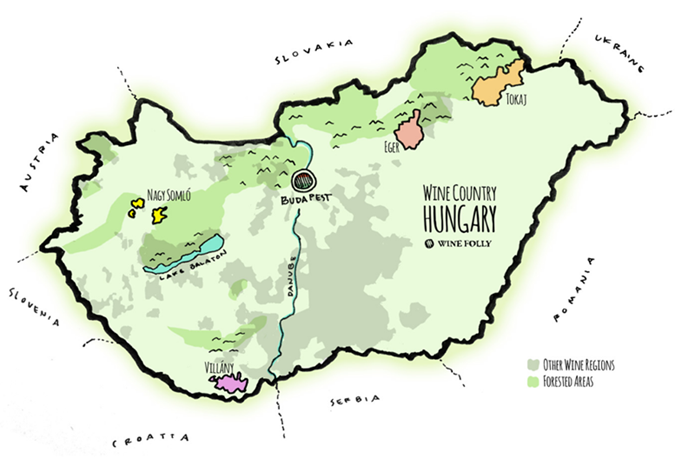
The modern Hungarian wine regions are distributed around the country. The country has 22 official wine districts within 6 wine regions, each of which have their own particular blend of culture, history, terroir and wine style. The wine district is what is usually indicated on the wine bottle and is the perfect delimitation of the wine’s place of origin for consumers.
The eastern side of Hungary is wrapped by the Carpathian Mountains, which have a considerable impact on the local climate, protecting the land from the cold winds that would otherwise blow in from across Poland and western Ukraine. The generally continental climate is also moderated by lakes Balaton and Neusiedl, allowing for a longer, more temperate growing season.
The largest wine region is the Danube wine region, located between the Danube and the Tisza rivers. The wine districts around the “Hungarian Sea” comprise the Balaton wine region. The wine districts in the Northern Central Mountains form the Upper Hungary wine region. Travelling from Sopron to Budapest, you pass through the Upper Pannon wine region, while the southernmost wine districts in Transdanubia make up the Pannon wine region.
The top wine districts and grape varieties in Hungary
The Tokaj region is the gold standard of the Hungarian wine regions. It is Hungary’s most famous wine region, the oldest classified wine region in the world, a UNESCO World Heritage Site, and home to the world’s first noble rot wine–the sweet golden Tokaji Aszú, and more recently the dry Furmint.
The Tokaj wine district has such special historical traditions and natural endowments that it is an independent wine region in its own right. The region and its wine are held in such esteem in Hungary that the national anthem thanks God for it: “Tokaj szolovesszein nektárt csepegtettél” (into the vineyards of Tokaj you dripped sweet nectar).
The region is located in the northeast of Hungary, near the border with Slovakia. Comprising roughly 30 small towns and villages scattered along rolling hills and nestled between the rivers Tisza and Bodrog. The rivers create a special microclimate in the area with high levels of moisture in the air, offset by wind and abundant sunshine. This creates optimal conditions for botrytized wines. The region sits on a range of clay-dominant soils of red, yellow, brown, and white clay, along with loess, strewn atop volcanic rock subsoil that’s rich in iron and lime.
Tokaj had a major wine economy in the 1700’s, when Poland and Russia were ravaging fans of the sweet Tokaji Aszú. Peter the Great was such an Aszú fanatic that he stationed a permanent military barrack in Tokaj to ensure there would be no interruption to his constant stream of liquid gold to the royal palace in St. Petersburg.
Furmint is the dominant white grape variety in the Tokaj region, where it occupies almost two-thirds of total vineyard area. The varietal has already proven itself as one of the great white varieties of the world, with an impressive minerality and structure. Furmint dominates the Tokaji blend and is renowned for its naturally high acidity, high sugar levels and spicy aromatic profile. The first two of these characteristics are responsible for the wine’s phenomenal ageing potential, while the latter provides a flavor distinct from any other sweet wine. When blended with Harslevelu and Muscat Blanc a Petits Grains, Furmint can produce some of the most complex and longest-living wines in the world.
As a varietal Furmint is remarkably versatile, too – depending on where it was made and who was at the helm, it can taste like a bright, crisp Grüner, a floral, off-dry Riesling, or a supple full-bodied Chardonnay. A dynamic acidity slices through every Furmint, regardless of style, and flavors of apples and wet tree bark are persistent.
The sweet Tokaji Aszú wine is made from individually picked botrytized grapes that are then mashed and soaked in dry wine or must. The resulting wine, after aging, is golden, extremely sweet (120-180 grams per liter) and has the potential to age indefinitely (when properly stored). To receive the Tokaji denotation, a wine can only contain the six native varieties of Furmint, Hárslevelü , Kabar, Kövérszölö, Zéta, and Sárgamuskotály.
An Aszú is characterized by its amount of sugar, which is designated by its “Puttonyos.” This original measure of sugar was measured by the number of baskets of noble rot grapes or “puttonyos” that were added to a barrel of wine; the more that were added, the sweeter the wine. Originally there were 6 different levels, but today there are only 2 allowed levels. More specifically, three puttonyos indicates 25g/l – the lowest sugar content and thus the least sweet of the Aszú wine styles. Each additional puttonyo thereafter indicates an increase of 5g/l of residual sugar. Eszencia is the very sweetest Aszú style. With around 800 g/l of residual sugar, it is so sweet, and so low in alcohol (about 5 percent ABV) that it hardly qualifies as wine at all. It is the undiluted, barely fermented juice of botrytized berries. Unsurprisingly, Eszencia is one of the rarest and most expensive wines on earth.
The Eger region is in the north, about 86 miles northeast of Budapest. Grapes grow natively on Eger’s rolling terrain; in fact, scientists actually identified a 30 million-year-old wine grape fossil in Eger, among the modern-day vineyards.
Top Wines are native blends Egri Bikavér (red blend), and Egri Csillag or “Star of Eger” (white blend). Eger is best known for its Egri Bikavér wine, popularly known as ‘Bull’s Blood’. Several grapes go into the robust Bikavér blend ,, with Kadarka and Kékfrankos (aka Blaufränkisch) typically the majority components. Good-quality Bikaver is deep, purple-crimson in color, with softish tannins a middleweight body and plummy, spicy aromatics. Although Tokaji remains unrivaled as Hungary’s most famous wine overall, ‘Bull’s Blood’ is surely the country’s most famous red.
- Information about the Wines
Wine #1. Rudi Pichler ‘Terrassen’ Smaragd Gruner Veltliner, 2023
The producer: at Weingut Rudi Pichler, the Pichler family has been growing vines in Wösendorf since 1731. The estate consists of 15 hectares of vineyards spread between Wösendorf, Joching, and Weisenkirchen, where south-facing terraces look down at the Danube River. Currently vineyards produce 65% Grüner Veltliner, 30% Riesling and some Pinot Blanc and Red Veltliner. Rudi Pichler is among the elite growers of the Wachau, producing wines of precision, power, and longevity. The producer belongs to the prestigious Vinea Wachau and vinifies under the strict parameters of their codex.
The wine:
 Grape: 100% Grüner Veltliner
Viticulture: 1800 vines/acre; 22-40 years old; yield 1.2-2.16 tons/acre.
Vinification: fermented in stainless steel talks for 14 days at 64-72oF
Aging: 5 months in stainless steel tanks before bottling plus 1 month in the bottle.
Alcohol: 13.5% vol.
Residual sugar: 1.3 g/L
Tasting notes: Soil characteristics of many small, excellent sites come together so nicely in this wine: fine minerality, subtle fruit flavors, tobacco spices and peppery elegance. Drinking window: 2025-2036
“The 2023 Grüner Veltliner Smaragd Terrassen is a blend of the five to seven top sites in the Wachau region, known for its high-quality vineyards. Yeast and white miso come imbued with citrus and russet pear peel on the nose. The palate brings on the full savoriness of that yeasty core on a surprisingly light-footed body. This is all texture and fluidity, with deep notions of white miso, juicy russet pear flesh and peel and a salty, peppery savor. The finish tapers back to lemon and has a lasting echo of pepper. The 2023 is slender for a Smaragd, yet really concentrated. (Bone-dry)”. (Vinous media).
Wine #2. Disznókő, Tokaji Dry Furmint, 2023
The producer: The Disznóko estate was classified as a first growth property at the time of the initial classification in 1772 and remains so today. The estate consists of a single tract of land that spread over 250 acres at the southwest entrance of the Tokaji region. Four of the approved noble grape varieties are planted in this single vineyard – Furmint, Harslevelu, Zeta and Sagamuskotal. The estate makes a range of wines, from five and six ‘puttonyos’ wines and an Aszú Eszencia, to a floral, dry wine made of Furmint. https://www.disznoko.hu/
The wine:
 Grapes: 100% Furmint
Viticulture: Manual harvest of fully ripened, healthy bunches in small boxes of 20 kg (44 lbs) between the 13th and 22nd of September. Many different plots of the Disznókő vineyard were harvested and vinified separately.
Vinification: The fruits of the different plots were vinified separately. The grapes were full bunch pressed (directly without destemming), allowed to settle for a night and then fermented in stainless steel vats at a temperature controlled between 16-18°C. No malolactic fermentation.
Aging: The different lots were blended in November and the wine was aged on its fine lees in stainless steel vats for 4 months. Bottled in March 2024 in 750 ml Tokaji bottle with glass stoppers.
Alcohol: 12.78% vol.
Tasting Profile: Light straw yellow robe with green reflex. Fresh, fruity nose with almond, white peach, stone fruits, pear aromas together with some floral and vegetal hints like hay. On the palate, it reveals a crisp acidity with saline notes. This wine is medium bodied, offering a pleasant texture, with a good mineral finish. Serve this wine at 10°C. Drink young to enjoy the full expression of its fresh fruit and minerality.
“Very attractive nose with notes of dried lemons, orange blossoms, dried herbs, and crushed stones. Medium-bodied, textural and crisp on a lively, energetic palate. I like the tension and crunchiness. Refreshing, citrusy finish.”
Food pairings: Disznókő Tokaji Dry Furmint 2023 is an exceedingly drinkable wine perfect for so many occasions; quenching your thirst on a hot summer’s day, the perfect companion to light meals, great for an evening with friends around the barbecue. Excellent as an aperitif, with fish and light sauces (e.g. herring) or seafood (superb with oysters and caviar), as well as poultry, game birds and salads.
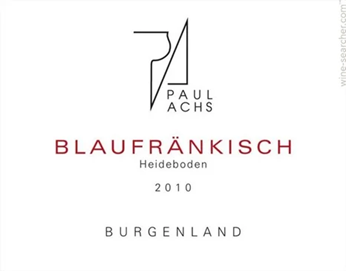
Wine #3: Paul Achs, Blaufrankisch, Heideboden, 2021
The producer: Weingut Paul Achs is in Gols is located 60 km southeast of Vienna, near the Hungarian border in the Northern Burgenland. The vineyards are located in and around Gols. 25 hectares, spread over 40 plots, each with individual potential. This wide range gives us a variety of soils and small climates – ideal basics to create exciting, authentic wines year after year. The entire spectrum of wines includes 14 red, 6 white wines and 2 pomace brandies. Their wines are characterized by considerable shelf life. Even wines from the 90s show ( with good storage conditions ) a convincing fruit depth. But even at a young age, our wines offer drinking pleasure. The red wines are all aged in wooden barrels – from 225 L gripping barrique up to the large, 3,400 liter oak barrel. https://www.paul-achs.at/
The wine:
 Grapes: 100 % Baufränkisch
Vineyards: grown on permeable, calcareous gravel and black earth soils of the Heideboden region. These soils lend the wine richness and a warm texture. Some of the grapes also come from cooler hillside vineyards with gravel and volcanic soils, which contribute freshness and elegant fruit.
Vinification: fermented in steel tanks and then aged for 12 months in used barriques.
Alcohol: 12.5%
Tasting profile: This Blaufränkisch shows ‘notes of crushed blackberry and plum sauce form the core of this wine, with graphite flowing underneath. The silky palate swathes the sinewy tannins and carries mouthwatering acidity.
“Very youthful, slightly tobacco nose of black berries and cherries with a little laurel. Cool, clear, youthful, tart blackberry fruit, smoky and tobacco notes, a hint of pepper and juniper again, some meaty juice on the palate, toasty traces, fine sandy, youthful tannin, a little Brazil nut in the background, good persistence, some acid bite, good to very good, again cool and tart-juicy finish.”(Wein-plus wine reviews)
Food pairings: the wine’s flavor profile is characterized by fruit and minerality, and it pairs perfectly with dishes such as homemade pâté, game terrines, braised dishes, dark poultry, steak, or grilled meat, as well as semi-hard and hard cheeses.
Wine #4: Erich Sattler Zweigelt, Burgenland, Austria, 2021
The producer: The winery: Weingut Erich Sattler has its vineyards located in the Neusiedlersee wine-growing district in Burgenland, on a unique gravel bank. It was formed over two million years ago from the side arms of the ancient Danube and stretches today over more than 5 km. Our vineyards around the small municipality of Tadten are mainly planted with St. Laurent and Zweigelt vines. Some of the vines are well over forty years old. https://erichsattler.at/
 The wine: For Austria, the 2021 vintage has been described as phenomenal.
Grape: 100% Zweigelt
Alcohol: 13% vol.
Residual sugar: 1g/L
Tasting Notes: The 2021 Erich Sattler Zweigelt from Burgenland, Austria, is a red wine made from the Zweigelt grape, which is one of Austria’s most widely planted red grapes. It exhibits bright red fruit flavors such as cherry and raspberry, often complemented by hints of spice and a touch of pepper. The wine is medium-bodied with moderate tannins and refreshing acidity, making it versatile and food-friendly.
“Vibrant bright purple on the pour. Surprisingly light on the palate (my first zweigelt). Moderately tannic. With about an hour of air…a little bitterness on the palate, a lightly savory. Oak is showing. Pepper is coming through a lot more with air (at about 75 minutes now). Much more savory approaching the two hour mark. Dominant note is white pepper. Would likely confuse this with Syrah blind. Also, some vegetal notes building on the nose. A great food wine. Perfect for a summer barbeque.” (Eric Wright at Cellar-tracker).
Wine #5: Disznókő ‘1413’ Tokaji Ēdes Szamorodni, 2021
The producer: (see wine #2). Acclaimed as one of the three most favorable sites of Aszú in Tokaji. Morning autumn mists and warm breezes ensure optimal conditions for noble rot.
 The Wine:
100% Furmint
Vinification: For about half of the lots composing the final blend the clusters were destemmed, followed by a short skin contact before pressing. In the case of the other lots, the grapes were full bunch pressed without destemming. 90% of the lots fermented in stainless steel vats and 10% fermented in barrels of two-three wines.
Maturing: aged for 12 months in the traditional underground cellar of Tokaj, in oak barrels of two-three wines, with a capacity of 225 litres. Bottled in September 2023.
Alcohol: 12.4% vol.
Residual sugar: 141 g/L
Tasting notes: Pale to rich gold. When young, you will discover wildflowers, fresh and candied fruits (apricot, citrus, tropical notes) as well as almonds and woody spices. As it ages in the bottle, Disznókö 1413 Tokaji develops notes of honey and dried fruits while the crisp acidity gently softens. This is a wine with finesse and balance. The barrel-ageing gives balance and complexity to the fruit of this deliciously fresh wine, giving it marvelous flexibility for pairing with many dishes.
- CV Members Rating
The wine tasting took place before revealing their prices, with 14 participants rating them individually from Acceptable to Excellent. The combined scores determined the ranking order, as shown in the following Table. In the final results, Erich Sattler Zweigelt, Burgenland, Austria, 2021 was the Best Wine, and also the Best Buy.

References:
https://winefolly.com/wine-regions/hungary/#winestoexplore
https://winefolly.com/deep-dive/hungarian-wines-for-the-win/
https://www.rudipichler.at/en/our-wines/gruener-veltliner-terrassen-smaragd/
About Us – Tasting Meeting Synopses – Annual Tasting Programs – Membership and Operations – Talks About Wine-Members Corner – Club Members – Moments Some Club del Vino History in Pictures
.o0o.
Laughing Matter:
Vinho não faz penalty, so faz falta!
Wine does commit penalties, it just may be missing!

.o0o.

 Club del Vino - Washington DC area