
 Tasting No 275 – March 25, 2025 – Wines from South Africa
-
Tasting Overview
The main objective of this tasting is to explore the wines from South Africa’s Coastal Region in the Western Cape. We will taste four wines: one white, two red blends (one a Bordeaux Blend) and one Pinotage. This is an open tasting.
Presenters: Gabriela Vega and Janet Entwistle
Participants: TBA
The wines
- Fairvalley, Chenin Blanc, Western Cape 2024
- Rupert & Rothschild Vignerons, ‘Classique’, Western Cape, 2020
- Kaapzicht, Rooiland, Pinotage, Stellenbosch, 2021
- Boekenhoutskloof, ‘The Chocolate Block’, Swartland, 2022
The Menu
- Seafood salad
- Risotto with mushrooms
- Steak and mixed vegetables
- Dessert, coffee or tea
-
South Africa Wine and its History
The Wine of Origin system is the legal structure introduced in 1972 to acknowledge and protect the diversity of terroir in the country. It classifies South Africa wine-growing areas into four categories: Geographical Units – generic labeling terms, such as ‘Northern Cape’ or ‘Western Cape’; regions, encompassing many districts, such as ‘Coastal Region’); districts, such as ‘Paarl’, ‘Stellenbosch’ and ‘Franschhoek Valley’, within the Coastal Region; and wards, the smallest of all Wine of Origin (WO) categories. An example is Constantia in the Cape Point district.
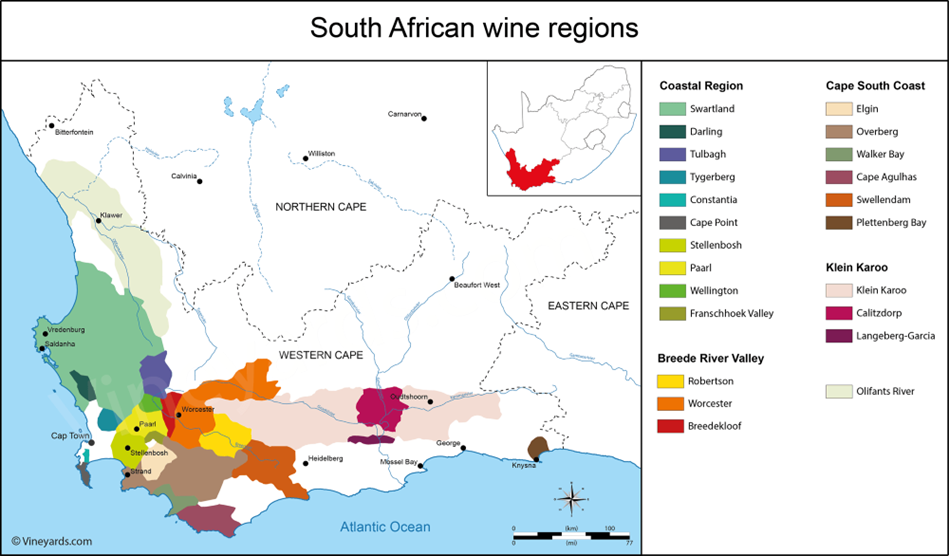 South African vineyards are concentrated in the Western Cape, one of nine of the country’s provinces, located in the southwest of South Africa (see red area on map above). There are four winemaking regions with the Western Cape: the Coastal Region, Breed River Valley, Cape South Coast and Klein Karoo. Each region has multiple wine districts.
In 1652 the Dutch East India Company established the Cape Colony to provision its ships making the journey between Europe and Asia. The first governor, Jan van Riebeeck, arrived in what would be Cape Town in 1652 and requested that vine cuttings be sent. Records show that vines (including Chenin Blanc and Semillon) arrived in three different shipments in 1655 and 1656, and the cuttings were “uit Vranckryk” (from France). Van Riebeeck records the first pressing of Muscat and Chenin Blanc grapes on February 2, 1659. Thus, South Africa was producing its first wine a hundred years before Thomas Jefferson’s unsuccessful experiment to grow French varieties at Monticello. Riebeeck’s successor, Simon van der Stel, created the first modern vineyard and winery on his mountainside estate and called it Constantia, which produced a world-famous sweet wine enjoyed by European royalty. Some of today’s prominent wineries—Buitenverwachting, Constantia Uitsig, Groot Constantia, Klein Constantia— were once part of the original Constantia estate. In 1679 Van der Stel also founded what was to become the principal locus of wine production in South Africa and named it after himself—Stellenbosch. A little later, he also founded the Vergelegen estate, one of today’s premiere wineries. With the arrival in the 1680s of French Huguenot immigrants, familiar with viticulture and the making of wine and brandy, South Africa’s wine future was set. Many of the original wine-producing estates continue to exist today, such as Simonsig (established by Jacques Malan in 1688), Fairview (1699), Boschendal (established in 1685 as Bossendaal), Cape Chamonix (part of the original 1688 La Cotte estate), Diemersdal (1698), and many more.
The 20th century was a time of extraordinary ferment in South Africa’s wine history. Abraham Perold created the Pinotage variety and brought new varieties from Europe to South Africa. Like many other wine-producing countries, South Africa has experienced times of boom and bust. In the early 19th century, wine was South Africa’s most important export. But the removal of UK preferential tariffs in 1825 threw the industry into depression. Another bust occurred late in the 19th century when Phylloxera decimated vineyards. In the 20th century, another boom and bust was followed by the creation of a large cooperative, KWV, to provide greater stability of income to growers, and in 1924 the government empowered it to set prices for the entire South African wine industry. It reduced the supply of table wine by distilling large amounts into brandy and fortified wine and produced large quantities of inexpensive wine for the domestic market. As with most such cooperatives, there were few incentives for improving quality. With many twists and turns, KWV’s role remained dominant until the advent of deregulation with the 1994 election of the Government of National Unity. In 1997, KWV was converted to a private company.
The South African wine industry was also adversely affected by a global boycott resulting from the government’s apartheid policy. By the 1980s South Africa found its wine export markets shrinking. Foreigners shunned investing in the industry, and winemakers found themselves increasingly isolated. The removal of sanctions in the mid-1990s combined with the privatization of KWV opened up export markets, stimulated domestic and foreign investment, and introduced incentives to raise quality and produce wines demanded by the rest of the world. However, by then South Africa was playing a game of catch-up to countries like Australia and Chile. Still, exports grew rapidly, from 50 million liters in 1994 to 400 million liters in 2010. The dying days of apartheid and birth of the new republic coincided with hugely positive shifts in the wine industry, both in terms of investment and ideas. Winemakers began introducing new varieties and exploring new regions with marginal growing conditions.
The Coastal Region
All the wines selected for this tasting are from the Coastal Region in the Western Cape. There are ten wine districts/wards (Wine of Origin) in this region. Wines chosen for the tasting are from four of these districts: Paarl, Stellenbosch, Franschhoek Valley and Swartland.
While the geographic area devoted to wine making in the Western Cape is relatively small, proximity to oceans on both the south and west and the mountainous nature of much of the terrain provides incredible variety in terms of microclimate. Altitude, exposure, temperature, rainfall, and soils vary greatly over small distances. Differences in microclimates and soils provide the rationale for more than 100 appellations currently in existence. The soils in these appellations tend to be degraded sandstone, granite and shale mixed in different portions with clay depending on location. The climates of the different regions vary greatly depending on proximity to the sea, altitude, and prevailing winds.
Paarl. Paarl’s vineyards are found on the lower slopes of Paarl Rock, on the northern side of Simonsberg Mountain and in the valley of the Berg River. The two mountains provide well-drained granite and shale soils for the vines, while the soil on the valley floor is more sandstone-based.
Paarl’s climate is relatively hot compared with average summer temperatures of 24°C. Long, hot summers and cold, rainy winters are typical of the area. Rainfall is moderate to high, but such is the heat that vineyards are often irrigated over summer to help cool the plants. The Atlantic Ocean, 60km away, has a small amount of influence in the form of a cooling afternoon breeze.
Stellenbosch. The Stellenbosch district is the second oldest wine region in South Africa, after Constantia ward, and is responsible for around 14% of the country’s annual wine production. It is a complex district with hills and mountains offering widely varying altitudes and soils (mostly sandstone and granite), multiple exposures, and access to sea breezes. Average summer temperatures are about 21.5°C.
Franschhoek Valley. It has predominantly sandstone soil and slightly warmer weather (23.5°C summer average) than Stellenbosch.
Swartland. Soil tends to shale and sandstone, and at 23.3°C, average summer (February) temperatures are about 2° higher than Stellenbosch.
-
Grape Varietals of Note
In 2015, SAWIS (South African Wine Information and Systems) reported that the country had 100,146 hectares of vineyards, with about 55% planted with white varieties. Many grape varietals are planted in South Africa and red blends are popular. Chenin Blanc and Pinotage both have important histories unique to South Africa.
 Chenin Blanc. This grape has long been the most widely planted variety in South Africa, still accounting for over 18% of all grape area planted as of 2015, though it is slowly decreasing in overall share of vineyard area. South Africa produces about twice as much Chenin Blanc as the Loire Valley in France, where the original wine cuttings taken to the Cape Colony originated, as early as 1655. The Mediterranean climate and ancient decomposed dolomite granite and Table Mountain sandstone soils of the South African Western Cape produce wines that are more fruit driven and higher in alcohol than the Chenin of the Loire, but the wines are equally well-balanced with excellent acidity. As is true in the Loire, the oaked Chenin Blanc of South Africa generally improves with a couple of years in the bottle.
Chenin Blanc became the workhorse of South African wine, used to produce inexpensive wine for drinking and for distillation. It was only in the early 1990s that winemakers discovered the treasure that was old bush vine Chenin Blanc and began producing high quality wines. By the mid-90s, winemakers were experimenting with the use of barrel aging, and Hilko Hegewisch (Boschendal) won the first Chenin Blanc Challenge in 1996 with wooded wine.
Among South Africa’s several wine associations organized to facilitate exchange of learning between producers and to promote their wines, The Chenin Blanc Association (CBA) is one of the most successful.
Chenin Blanc is a grape that is sensitive to its terroir, especially the type of soil in which it is grown. Soils affect the aroma, flavor and minerality of the wine. For this reason, some producers blend grapes from both granite and sandstone-based soils for complexity and balance. The training of the vine also affects fruit quality. Compared to trellised vines, bush vines produce lower yields and more dense clusters of smaller grapes with thicker skins. Chenin Blanc is grown throughout the warmer, interior growing regions, with clusters of old vines in the Swartland, Paarl, and Stellenbosch.
Chenin Blanc styles run a continuum from stainless-steel fermented, unwooded wines that are easy drinking with straightforward fruit flavors, to barrel fermented and aged wines that are rich, ripe and complex. The best Chenin Blancs are rich, judiciously oaked, and densely flavored wines with 6-11 g/l residual sugar. Many are made from the fruit of dry-farmed, extremely low-yielding, old (35+ years) bush vines, that are fermented in partially new oak (mostly 400 L barrels), spend extended time on the lees in barrel, and may even have a small amount of botrytis or even ‘raisined’ fruit. As in the Loire, producers like Miles Mossop do multiple passes (tries) through the vineyard to select optimally ripe fruit. Fermentation is sometimes slow and long, using ambient yeasts, with extended time (up to 12 months) on the lees and at least partial malolactic process to provide the creamy texture one expects from these wines.
Pinotage. Pinotage is South Africa’s national grape though with only 6% of plantings. In 1924 Professor Abraham Izak Perold at the University of Stellenbosch crossed Cinsault and Pinot Noir with the goal of creating a wine that had classic Burgundy flavors and the disease resistant quality and vigor of the Rhône’s Cinsault. His work and that of others (Dr. Charlie Niehaus and Professor C.J. Theron) resulted in the creation of a new grape known as Pinotage. Kanonkop planted Pinotage as early as 1941, but the variety first acquired fame when Bellevue Pinotage won the 1959 National Young Wine Show. The Stellenbosch Farmer’s Winery subsequently marketed the wine—the first to be sold as Pinotage—in 1961 under the Lanzerac label.
Pinotage is mostly grown in the Stellenbosch-Franschhoek-Paarl belt, with the Bottelary Hills offering a concentration of excellent producers including Kaapzicht. Grapes are normally harvested early to mid-February, well before Shiraz and Cabernet Sauvignon. Harvesting Pinotage ripe, but not over-ripe, is key to making quality wine. The best producers of Pinotage craft wines that are fruit-forward, fresh and elegant using winemaking methods similar to those for Pinot Noir. They use pre-fermentation cold soaks and short hot alcoholic fermentations in open top fermenters. These techniques help promote the fruity aromatic qualities of the wine (eliminating acetone or burnt rubber smells) and ensure good color. The fermenters are of differing materials (Kanonkop uses epoxy tanks) and differing sizes (small tanks allow for fermenting small lots). Most winemakers use cultured yeast and punch down the cap by hand. Pressing is done with bladder, or basket presses and after settling, the wine is transferred to barrels for maturation. The top winemakers use medium toast barrels and rarely use new oak. Maturation in barrels can last for 12 to 18 months before blending or bottling.
-
Information on the Wines
♦ Wine #1. Fairvalley, Chenin Blanc, 2024
The Producer: The Fairvalley wines are produced by the Fairvalley Farm Workers Association a group of black South African employees from the Fairview Wine and Cheese Estate in South Africa and are Fairtrade certified. Fairview’s owner, Charles Back, is probably the most awarded wine producer in South Africa, a receptor of the International Wine Challenge Lifetime Achievement Award. He supported the creation of the association in 1997, set up by 36 families, to develop and manage their own property. The following year saw the first vintage of Fairvalley wines, produced using all the facilities of Fairview cellar. Launched as a socio-economic empowerment venture, today Fairvalley relies on the available skills amongst workers who all have long years of experience in grape cultivation, wine production and packaging. The association’s profits fund community projects like education and housing.
 The wine:
- Vintage: 2024
- Grape: 100% Chenin Blanc
- Region/Wine of Origin (WO): Coastal Region, Western Cape
- Soil: decomposed granite and sandstone
- Winemaking: Grapes come from Paarl, Stellenbosh and Swartland; fermentation in stainless-steel tanks for 3 weeks, then aged in non-oak barrels in fine lees for 4 months.
- Alcohol: 13%
- Residual sugar: 2.9 g/l
- Total Acidity: 6.5 g/l
- pH: 3.38
Tasting notes: Fruity with citrus, pineapple, pears tones with a bit of honey to balance the crisp, fresh acidity.
Pairings: Works well with light, fresh dishes, salads, shellfish, and seafood pasta in creamy sauces.
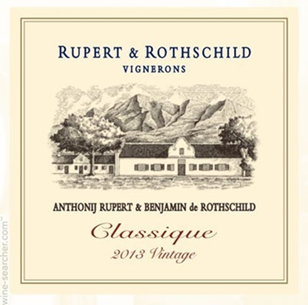
♦ Wine #2. Rupert & Rothschild Vignerons, ‘Classique’, 2020
The Producer: Production at Franschhoek Valley, at the foot of the Simonsberg mountain, started in 1997, as a joint venture of the Baron Edmond de Rothschild from France and Anton Rupert, a South African businessman. They focused on the production of only three crafted wines – two Bordeaux blends (Classique and Baron Edmond) and one Chardonnay (Baroness Nadine).
 The wine:
- Vintage: 2020
- Grape composition: Bordeaux blend of Merlot (41%), Cabernet Sauvignon (39%), Cabernet Franc (11%), Petit Verdot (8%), Malbec (1%)
- Region/Wine of Origin (W.O.): Franschhoek Valley, Paarl, Coastal
- Soil: granite and sandstone
- Fermentation: in stainless-steel tanks. Aging in French oak barrels for 12 to 16 months.
- Alcohol: 13.5%
- Residual sugar: 2.7 g/l
- Total Acidity: 6 g/l
- pH: 3.56
Tasting notes: Aromas of red plum, raspberries, and cherries; forest floor and oak spice; toasted caramel and walnut. The palate has a fresh red fruit core with soft tannins and good persistence.
Pairings: pairs well with dishes like beef sirloin, lamb, venison, and dishes featuring mushrooms, roasted beets, goats’ cheese, and kalamata olives.
♦ Wine #3. Kaapzicht, Rooiland Pinotage, 2021
The Producer: It is a production of the Kaapzicht Wine Estate from the Steytler family, at the Rozendal farm, in Bottelary, Stellenbosch starting in 1946. The first Pinotage vineyard was planted on the farm in 1959 – a pioneering move, as this was still a young, fairly unknown, South African variety. Among the many wines produced by the Steytler family are three other Pinotage: two cheaper wines, Pinotage Rosé and Skraalhans Pinotage, and the Steytler Pinotage that in 2006 won Decanter’s best red wine in the world, cementing Kaapzicht’s position as one of the top Pinotage producers in South Africa.
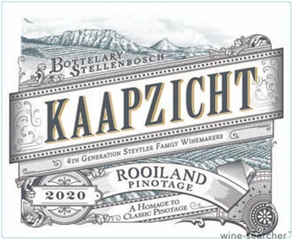 The Wine: Rooiland Pinotage’s name comes from the red gravel soil it grows on (Rooiland means red land).
- Vintage: 2021
- Grape: 100% Pinotage
- Region/Wine of Origin (WO): Stellenbosch, Coastal Region
- Soil: red gravel
- Viticulture: unirrigated bush vines planted in 1995 and 1997 respectively, which yield between 4.2 and 6 tons per hectare
- Fermentation and ageing: Grapes are hand-picked, then crushed and destemmed into stainless-steel tanks for fermentation. Biodynamic yeast is used to inoculate the fermentation to enhance and preserve terroir characters in stainless-steel tanks. Ageing in 300L barrels between 16 and 18 months. After blending the wine is aged 5 to 7 years in concrete tanks until bottling
- Alcohol: 14%
- Residual sugar: 4.7 g/l
- Total Acidity: 6.1 g/l
- pH: 3.52
Tasting notes: aromas of blackberry, mulberry and blackcurrant, while rich oak and vanilla spice creates a lasting and textural finish.
Pairings: Pinotage pairs well with rich, savory dishes like grilled meats, barbecue, stews, and a strong cheese, thanks to its smoky, earthy, and full-bodied characteristics.
♦ Wine #4. Boekenhoutskloof, ‘Chocolate Block’, 2022
The Producer: The Boekenhoutskloof farm and winery has existed since the 18th century but was bought and reconstructed in the 1990s. It is located in the furthest corner of the beautiful Franschhoek valley. The farm’s name means “ravine of the Boekenhout”. Boekenhout is an indigenous Cape Beech tree greatly prized for furniture making.
The first vintage of the Chocolate Block wine was released in 2002.
The Wine: The Chocolate Block is often compared to France’s Cote du Rhône, Chateauneuf du Pape.
- Vintage: 2022
- Grape composition Syrah 77%; Grenache 9%; Cinsault 8%; Cabernet Sauvignon 5%; Viognier 1%
- Region/Wine of Origin (W.O.): Swartland, Coastal Region
- Soil: granite-rich soils
- Fermentation: Whole berries fermented in a combination of concrete and stainless-steel fermenters with no additions being made.
- Aging: 95% of the juice aged in seasoned 225L French barrique, and 5% (Cabernet Sauvignon) in new 225L French barrique, using an OXO system to rotate the barrels for 12 to 14 months
- Alcohol: 14.5% ABV
- Residual Sugars: 3.36 g/l
- Total Acidity: 5.16 g/l
- pH: 3.85
Tasting notes: Aromas of boysenberry and dark cherry, with brambly red fruit, mocha, and crushed violet. The palate has soft tannins, with an engaging graphite-tinged finish.
Pairings: serve with roast beef, spaghetti in rich tomato sauce, or game. It’s also the perfect partner for cheese like brie or stilton, or a deep dark chocolate ganache.
-
CV Members Ratings: TBA after the tasting
References
https://rupert-rothschildvignerons.com
https://www.boekenhoutskloof.co.za
https://vineyards.com/wine-map/south-africa
The International Wine Review, Report #30, The Wines of South Africa, February 2012 chrome-extension://efaidnbmnnnibpcajpcglclefindmkaj/https://i-winereview.com/sample/i-WineReview-R30-Wines_of_South_Africa.pdf
The International Wine Review, South African Chenin Blanc, May 13, 2010
.o0o.
Laughing?

.o0o.

 Club del Vino - Washington DC area