
 Tasting No. 271 Wines of Puglia – November 19, 2024
Wines of Puglia
-
Tasting Overview
The main objective of this tasting is to compare and contrast red wines of Puglia. We endeavored to choose red wines that we believe are distinctive and represent the region and varietals. We selected two Negroamaro, a Primitivo, and an Aglianico.
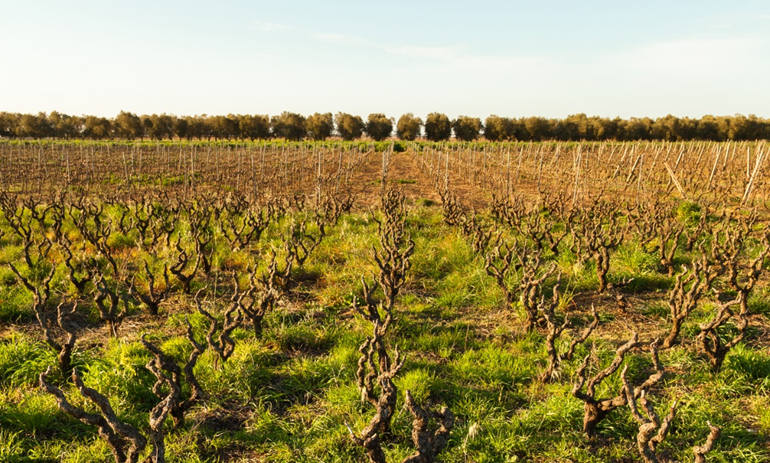
Type of tasting: Open. All wines presented together
Presenters: Nick Marzella and Erico Silva
Participants: S. Ardila; R. Arroio; M. Averbug; C. Estrada; M. Fryer; J. García; N. Marzella; O. Mason; C. Perazza; J. and L. Redwood; R. Santiago; E. Silva; M. Simões; L. Uechi; and G. Vega.
These are the Wines:
- Cantine San Marzano Anniversario 62 – Primitivo di Manduria Reserva -2018
- Cantine San Marzano F – Negroamaro, 2020
- Tormaresca Bocca di Lupo – Aglianico, 2016
- Tormaresca Massseria Maime – Negroamaro Salento, 2021.
- The Menu
- Insalata Caprese
- Orecchiette con Broccoli
- Lamb chops with roasted potatoes
- Dessert, coffee or tea.
-
Information about the region
 Apulia also known by its Italian name Puglia is a region of Italy, located in the southern peninsular section of the country, bordering the Adriatic Sea to the east, the Strait of Otranto and Ionian Sea to the southeast and the Gulf of Taranto to the south. The region comprises 19,345 square kilometers (7,469 sq mi), and its population is about four million people. It is bordered by the other Italian regions of Molise to the north, Campania to the west, and Basilicata to the southwest. The regional capital is Bari.
Vineyards cover 106,715 ha (263,980 acres) in Apulia, which is 1st place among Italian grape-growing regions. But in the production of quality DOC and DOCG wines, Apulia has only ranked 12th of 20 with 297,667 hectoliters. There are four DOCGs in Puglia: Castel del Monte Bombino Nero; Castel del Monte Nero di Troia Riserva; Castel del Monte Rosso Riserva; and Primitivo di Manduria Dolce Naturale. The region holds six IGT titles and just over 30 DOCs.
-
The grape varietals
Negroamaro (seldom Negro amaro – meaning “black [and] bitter”) is a red wine grape variety native to southern Italy. It is grown almost exclusively in Apulia and particularly in Salento, the peninsula which can be visualized as the “heel” of Italy. The grape can produce wines very deep in color. Wines made from Negroamaro tend to be very rustic in character, combining perfume with an earthy bitterness. The grape produces some of the best red wines of Apulia, particularly when blended with the highly scented Malvasia Nera, as in the case of Salice Salentino DOC.
History and Etymology
While negro is from an Italian and Latin word meaning “black”, there is some dispute as to whether amaro is from the Italian word for “bitter” or whether it derives from the ancient Greek mavro also meaning “black”. If the latter theory is correct, mavro may share a root with merum, a wine brought to Apulia by Illyrian colonists before the Greeks arrived in the 7th century BC. Horace and other Roman writers mention mera tarantina from Taranto, and Pliny the Elder describes Manduria as viticulosa (full of vineyards). But after the fall of the Roman Empire winemaking declined until it was only kept alive in the monasteries – Benedictine on Murgia and Greek Orthodox in Salento. Negroamaro could be the grape used in merum, or it could have been brought by traders from the home of winemaking in Asia Minor at any point in the last 8,000 years.
Zinfandel (also known as Primitivo) is a variety of black-skinned wine grape, which is grown in over 10 percent of California vineyards. DNA analysis has revealed that it is genetically equivalent to the Croatian grapes Crljenak Kaštelanski and Tribidrag, as well as to the Primitivo variety traditionally grown in Apulia, Italy, where it was introduced in the 18th century, and Kratošija in Montenegro. The grape found its way to the United States in the mid-19th century, where it became known by variations of a name applied to a different grape, likely “Zierfandler” from Austria.
The grapes typically produce a robust red wine, although, in the United States, a semi-sweet rosé (blush-style) wine called White Zinfandel has six times the sales of the red wine. The grape’s high sugar content can be fermented into levels of alcohol exceeding 15 percent.
The taste of the red wine depends on the ripeness of the grapes from which it is made. Red berry fruit flavors like raspberry predominate in wines from cooler areas, whereas blackberry, anise and pepper notes are more common in wines made in warmer areas and in wines made from the earlier-ripening Primitivo clone.
Most Primitivo is grown in Puglia, and it is estimated to be the country’s 12th most widely planted grape variety. The main three DOC areas are Primitivo di Manduria, Gioia del Colle Primitivo (Riserva) and Falerno del Massico Primitivo (Riserva o Vecchio). The Manduria DOC covers still red wines, as well as sweet (Dolce Naturale) and fortified (Liquoroso Dolce Naturale, Liquoroso Secco) wine. Falerno requires a minimum of 85% Primitivo; the others are 100% Primitivo. Gioia del Colle Rosso and Rosato contain 50–60% Primitivo, and Cilento Rosso/Rosato contains around 15%.
Historically, the grape was fermented and shipped north to Tuscany and Piedmont, where it was used as a blending grape to enhance the body of thin red wines produced in those areas. When the link between Primitivo and Zinfandel began to emerge, plantings in the region and production of non-blended varietals increased. Today, most Italian Primitivo is made as a rustic, highly alcoholic red wine with up to 16% alcohol by volume (ABV). Some Italian winemakers age the wines in new American oak to imitate American-style Zinfandel.
Aglianco. Making its home in the mountainous southern Italy, Aglianico is a bold red variety that is late to ripen and often spends until November on the vine. It thrives in Campania as the exclusive variety in the age-worthy red wine called Taurasi. Aglianico also has great success in the volcanic soils of Basilicata where it makes the robust, Aglianico del Vulture. The name “Aglianico” bears striking resemblance to Ellenico, the Italian word for “Greek,” but no evidence shows it has Greek ancestry. However, it first appeared in Italy around an ancient Greek colony located in present-day Avellino, Campania.
-
Information on the Wines
Wine 1: Cantine San Marzano Anniversario 62 Primitivo di Manduria Riserva 2018
 The Producer: Cantine San Marzano. San Marzano is a small town in the center of the Primitivo di Manduria DOP, a strip of land between the seas that wash over the Puglia region. It was here that 19 winegrowers founded Cantine San Marzano. Long before the appellation of origin was created and Primitivo di Manduria was recognized worldwide, they were chasing a dream.
In 1962, 19 vine growers from San Marzano, whose families had farmed the land for generations, combined their efforts to establish Cantine San Marzano. Now in this cooperative there are 1200 wine growers, and it has become one of the most popular and well-known wineries in Puglia. Just the bond with the land is the starting point for the work of this winery. Not surprisingly, Cantine San Marzano is devoted mainly to two great red grapes of Puglia: Primitivo and Negroamaro.
In addition to the red wines, Cantine San Marzano is also dedicated to the sweet wines, with the great variation of Primitivo Passito.
Technical Data:
- Grape: Primitivo.
- Appellation: Primitivo di Manduria DOP Riserva.
- Production area: High temperatures all year round, very little rainfall and a wide temperature range between night and day. Vineyards with 60-year-old Alberello training vines (bush-vines). Loam soil, finely textured and rich in iron oxides that give the topsoil the distinctive red hue. Calcareous subsoil (limestone) with few emerging rocks.
- Harvest: Mid-September, hand- harvested grapes
- Fermentation: Malolactic fermentation with autochthonous yeasts in stainless steel tanks.
- Aging: 12 months in French and American oak barrels.
- Alcohol: 14.5%.
- Winemaker notes: “…wide and complex bouquet, fruity with prune and cherry jam aroma, hints of tobacco. Full- bodied wine, well-balanced, soft and rich in elegant tannins; long finish with notes of cocoa, coffee and vanilla.”
- Awards: Gold medal, The New Zealand International Wine Show 2022; Gold Medal, Selections Mondiales des Vins Canada 2022; Gold Medal, Vintaste international Wine Contest 2022; Gold Medal, Berliner Wein Trophy 2022 – Winter Tasting; Silver Medal Hiobg Kong International Wine & Spirit Competition 2022.
Wine 2: Cantine San Marzano ‘F – Negroamaro’, 2020
The Producer: Cantine San Marzano (see above)
Technical Data: 
- Grape: Negroamaro
- Appellation- Salento IGP
- Production Area: Contrada di Monte la Conca, between San Marzano and Francavilla Fontana, Salento. The climate is characterized by high temperatures all year round, with very little rainfall and a wide temperature range between night and day, which has a positive influence on the quality of the grapes. Loam soil, finely textured and rich in iron oxides that give the topsoil the distinctive red hue. Calcareous subsoil (limestone) with few emerging rocks.
- Harvest: Last week of September, hand-harvest of slightly overripe grapes.
- Fermentation: Malolactic fermentation in stainless steel tanks.
- Aging: 12 months in French and Caucasian oak barrels.
- Alcohol: 14.5 %
- Winery tasting notes: Very deep purple red; wide and complex to the nose, with notes of spices, soft fruit, and cherry jam. A full-bodied wine, soft and balanced, rich in fine tannins, with a pleasant long-lasting finish.
- Awards: Best Negroamaro, 1st Best Red Wine of Italy (98 points), Annuario Dei Migliori Vini Italiani Luca Maroni 2023; Gold Medal, Vinarium International Wine Contest 2022. Gold Medal, Berliner Wein Trophy 2022 – Winter Tasting; Gold Medal, Mundus Vini 2022 – Spring Tasting; Silver Medal, Hong Kong International Wine & Spirit Competition 2022.
- Critic tasting notes. “The 2020 Cantine San Marzano F Negroamaro is rich, yet stylish. This wine offers aromas and flavors of lovely, fragrant spices, black fruits, and hints of licorice. Serve it with a generously deep-dish pizza topped with pepperoni and a grating of well-aged Parmesan. (Tasted: July 19, 2024, San Francisco, CA)” Wilfred Wong of Wine.com.
Wine 3: Tormaresca ‘Bocca di Lupo’, 2016
 The Producer: Tormaresca, San Pietro Vernotico. The Tormaresca winery in Puglia is Marchesi Antinori’s flagship winery on the heel of Italy’s boot and a tribute to this ancient and wonderful wine-growing region, where wine has been produced since ancient Greeks.
Tormaresca is the only producer with vineyards in both of Puglia’s two elite wine-growing sub-regions: Salento and Castel del Monte DOCs.
Technical Data:
- Grape: Aglianico
- Appellation: Castel del Monte DOC
- Production area: the Tormaresca estate is composed of two properties. Bocca di Lupo is located in the Castel del Monte DOC of northern Puglia. It offers an ideal growing environment for Chardonnay, Aglianico and Cabernet Sauvignon. Masseria Maime is located on the Salento peninsula in Southern Puglia. Its vineyards extend over half a mile along the Adriatic coast and are planted with Negroamaro, Primitivo, Cabernet Sauvignon and Chardonnay.
- Aging: French Oak and then bottles for a least one year
- Alcohol: 14.5 %
- Winemaker Notes: Graceful, with lively but silky tannins. Long and persistent finish with pleasant sensations of freshness and complexity. A wine that reveals excellent aging potential.
Wine 4: Tormaresca Masseria Maìme, Negramaro Salento, 2021
The Producer: Tormaresca (see above).
 The wine:
- Grape: Negroamaro
- Appellation: Negroamaro IGT Salento
- Production area: The Masseria Maìme estate is located in one of the most beautiful areas of Upper Salento not too far from the town of San Pietro Vernotico in the province of Brindisi. The estate extends along the coastline forming a unique countryside of vineyards that lies between woodlands and pine forests stretching out as far as the eye can see until blending into the sea. The most prevalent grape varieties grown here are Negroamaro, Primitivo, Chardonnay and Fiano.
- Fermentation: Stainless steel vats.
- Aging: 60% of the wine aged in 500 liter-capacity tonneaux and the remaining 40% in French oak barriques., and 15 months in the bottle.
- Alcohol: 14.5 %
- Winemaker notes: Ruby Red in color, it presents fruity notes of sour cherries and plums accompanied by sweet notes of rose and irises with vanilla and a slightly spicy note of black pepper on the finish.
- Critic tasting notes: “Initial tones of coconut, anise and cola carry the nose, with dense blackberry and black cherry aromas eventually chiming in. It’s full and rich on the palate, oozing with seductive warm spice tones and gripping dark fruit, all while polished tannins and well-integrated acidity lend to the ample structure. It’s surly in its infancy, needing time to stitch together. Drink 2023–2030. (Alexander Peartree @ Wine Enthusiast).
Club del Vino Members Evaluation of the Wines tasted:
The tasting took place before revealing their prices. 14 participants rated them from Acceptable to Exceptional. The combined results established the preference order during the tasting as follows:
Cantine San Marzano, ‘Negroamaro F’, Salento IGT, 2020 was the Best Wine, and the Best Buy. The following Table presents the details of ratings and combined results. 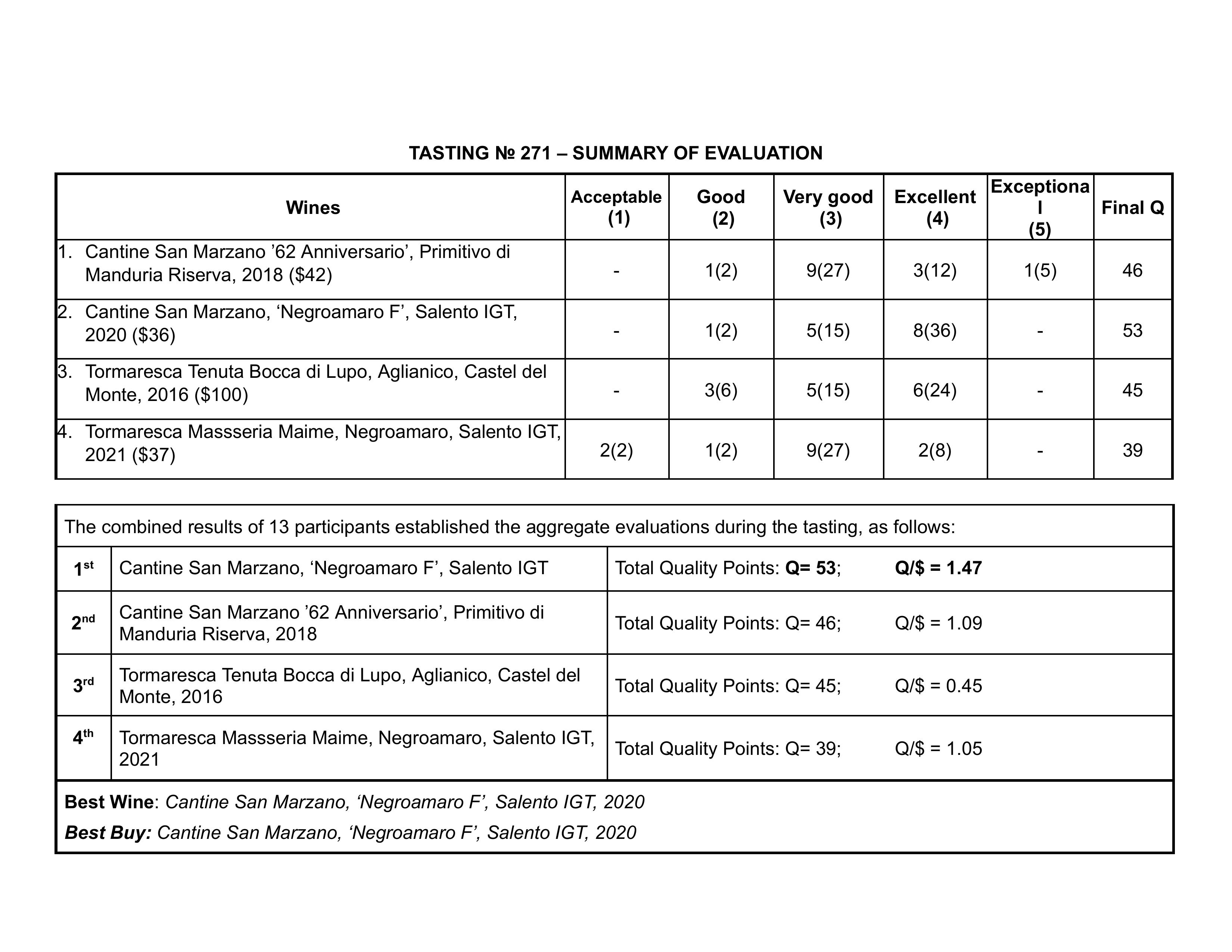
References:
https://en.wikipedia.org/wiki/Negroamaro
https://en.wikipedia.org/wiki/Zinfandel
https://en.wikipedia.org/wiki/Aglianico
https://en.wikipedia.org/wiki/Apulia
.o0o.
A dose certa de vinho
.o0o.

 Club del Vino - Washington DC area