

Tasting No 270 – October 29, 2024
Chiavennasca: Il Nebbiolo delle Alpi
-
Tasting Overview
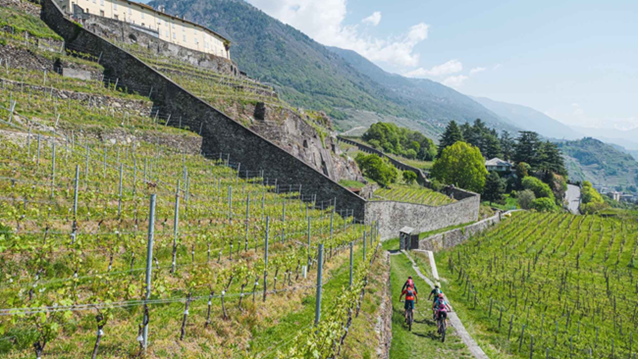
 The main objective of this tasting is to explore lesser-known wines from Valtellina in Lombardia. They are red wines produced in relatively small but high-quality wineries. The wines are a unique expression of the Nebbiolo grape, locally called Chiavennasca.
All the wines in the tasting are 100% Nebbiolo and are from renowned wineries from the three appellations of Valtellina
A file format .pdf of this post is available here 2024 10 29 Degustation 270
Type of tasting: Open
Presenter: Ricardo Santiago
Participants: S. Ardila; M. Averbug; C. Berndsen; J. Brakarz; J. Claro; C. Estrada; J. Estupiñan; M. Fryer; J. García; R. Gutierrez; C. Perazza; J. and L. Redwood; J. Requena; C. Santelices; R. Santiago; G. Smart; and L. Uechi.
These are the wines:
-
-
- Arpepe, Rosso di Valtellina, 2021
- Tenuta Scerscé, Valtellina Superiore, Essenza, 2017
- Mamete Prevostini, Valtellina Superiore, Sassella, Marena, 2019
- Nino Negri, Sforzato di Valtellina, Sfursat, Carlo Negri, 2019.
-
The Menu
- Portobello al forno
- Ravioli di vitello
- Scaloppine di vitello con risotto alla milanese
- Dolci, caffè o tè.
-
The Valtellina Winegrowing Area in Lombardy Region
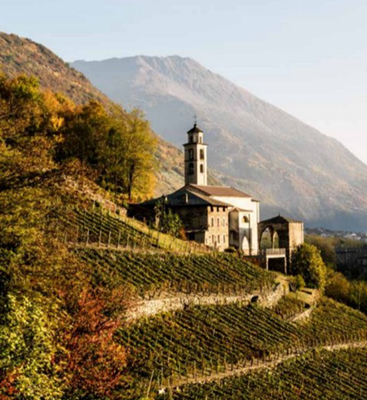 “Wine production in Valtellina is the result of an endless dialogue among the Alps, the energy of the Sun, the breeze blowing from Lake Como and the agricultural activity on the terraces.”
Consorzio di Tutela dei Vini di Valtellina
Lombardia is Italy’s most populated region, wealthy and industrialized. Milan is the second largest city in Italy and center of finance and fashion. The region is a smaller wine producer than neighboring Piemonte, Veneto, and Emilia-Romagna and has smaller number of indigenous varieties compared to other regions.
Lombardia’s topography sectors are: Alps, Prealps, Padana Plain, and Appennines foothills. The Climate is Continental with considerable variation (mountain ranges, hills, rivers, and lakes).
It is home to the respected appellations of Valtellina, Lugana, and Franciacorta.
 Valtellina is Lombardia’s most northerly wine producing area. Vineyards lie in a rare east-west direction along a very narrow strip of land, on the northern bank of the Adda River, in the foothills of the Alps.
- Vineyards are divided into a multitude of small parcels planted on small terraces sustained by dry-stone retaining walls (2,500 km of walled terraces!).
- Topsoil is extremely thin in many places: earth has had to be brought up
- Vineyards lie up to 700-800 m in altitude
- A labor of love “heroic” viticulture: labor-intensive and costly ‘rarified air’ vineyards
- Vineyards have a perfect south-facing aspect
- The Adda River flows into Lake Como, which provides warm air that travels back up the valley to remain trapped by the mountain ranges.
- Large stones in walls catch and store daytime heat and release it slowly during the night to the hanging grapes.
Valtellina Appellations and Varieties
 Valtellina is the only major winegrowing area outside of Piemonte where the Nebbiolo grape thrives and where a considerable quantity of wine from the variety is produced.
Wines in all three appellations must be made from a minimum of 90% Chiavennasca (Nebbiolo), while local varieties Brugnola, Rossola, and Pignola are used to complement (up to 10%).
Chiavennasca: The ‘Nebbiolo of the Alps’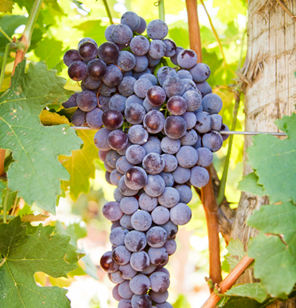
- Nebbiolo Italy’s greatest native grape probably original to Valtellina (close genetic ties to local varieties).
- Chiavennasca: a local Nebbiolo biotype of Valtellina
- Requires specific terroirs: Piedmont, Valle d’Aosta, Lombardy and Sardinia in Italy.
- Strong tannins and high acidity.
- “Tar and Roses”: Magical perfume of sour to ripe red cherries, delicate sweet spices, and red rose petals and, with age, notes of tar add complexity.
- “Ciù Venasca”: local dialect meaning “a grape variety with great vigor” or “a grape variety that gives more wine”.
- The word chiavennasca first appeared in literature in 1595.
- Benedictine monks were growing the variety as early as the tenth to twelve centuries.
The three Appellations are: Rosso di Valtellina (Valtellina Rosso) DOC; Valtellina Superiore DOCG; and Sforzato (Sfurzat) di Valtellina DOCG.
Rosso di Valtellina DOC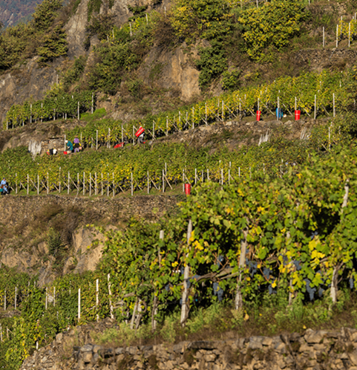
- The ‘entry level’ wine of Valtellina
- The simplest wine produced in the region in terms of quality and complexity
- Traditionally made from 90% Nebbiolo complemented by local varieties.
- Local varieties up to 10%: Brugnola, Rossola, and Pignola
- Minimum aging requirement: 6 months
- Represent a more approachable and straightforward version of Nebbiolo.
Valtellina Superiore DOCG
- Most wines are made from 100% Nebbiolo although the official requirement is 90%
- Minimum age requirement is 2 years (at least 1 year in oak). Riserva requires a minimum of 3 years of aging
- Compared to Barolo or Barbaresco, Valtellina Superiore tends to be more approachable and perfumed with a leaner overall structure
- Finesse and elegance rather than power and depth.
- Wine labels can carry the name of one of the five official subzones:
- Valgella: Largest and most easterly – soft, floral, and forward wines.
- Inferno: Steep, rocky vineyards and hotter conditions – structured, tannic, and austere
- Grumello: Fragrant wines with soft tannin.
- Sassella: Long-standing renown – elegant wines.
- Marrogia: Smallest and most recent sub-zone – velvety with firm tannins.
- It is not easy to distinguish the wines of each subzone even for the specialist. Climate and altitude appear to play a more important role in determining the qualities of the finished wine.
Sforzato di Valtellina DOCG 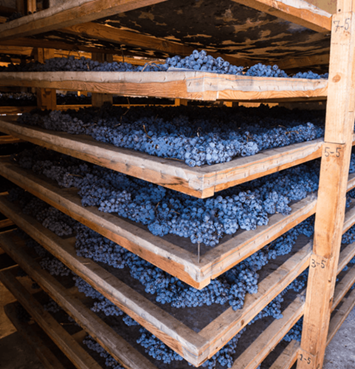
- The pinnacle of the wines of Valtellina (best and richest).
- Healthy, fully ripe clusters of Nebbiolo are picked and airdried via the appassimento
- Grapes are required to be desiccated until at least December 10th after Harvest. (it is common practice to prolong the drying process for 3 to 4 months before starting vinification).
- Minimum ageing: 20 months (at least 12 months in oak)
- Wine: Dry and minimum alcohol level of 14% abv.
- Compared to Amarone della Valpolicella DOCG: both are smooth and velvety. Sfursats tend to be less powerful but more elegant (refined and ‘lighter’).
-
The Wines
Wine #1. Arpepe, Rosso di Valtellina, 2021
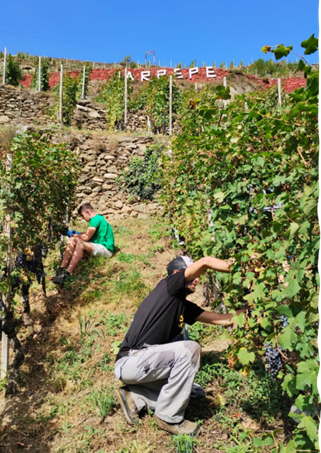 – The Producer: Arpepe: ‘Il giusto tempo del Nebbiolo’
- 1860: Original winery known simply as “Pelizzatti”.
- 1984: Arturo Pelizatti Perego using his own acronym (ArPePe) regained possession of his part of the vineyards and of the premises used for aging.
- 2004: Modern winery Arpepe (5TH generation).
- Vineyards in Sassella, Grumello, and Inferno.
- Harvest: Manual (impossible to use tractors).
- Fermentation: Large concrete and mostly large wooden barrels.
- Annual production: 100,000 bottles
- Hectares under vine: 15.0
- Gambero Rosso: The winery won 10 Tre Bicchieri
 – The Wine:
- Grape Variety: 100% Nebbiolo (Chiavennasca)
- Vineyard: South/East exposure – Altitude 350/400 m
- Vines, which average more than 50 years old growing deep into fragmented rocky soils.
- Manual harvest on October 11th, 2021.
- Fermentation: Native yeast and large wooden vats
- Ageing: 12 months total with 6 months in big barrels (50 HL)
- Alcohol: 13.5% abv.
Wine #2 Tenuta Scerscé, Valtellina Superiore, Essenza, 2017
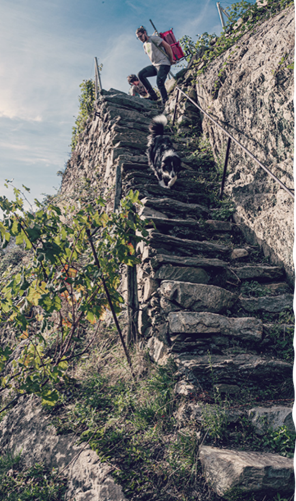 – The Producer: Tenuta Scerscé: ‘Vini chi siano diretta espressione del territorio.’
A new entry into the world of valtellinese wines. Cristina Scarpellini, a trained lawyer, first visited Valtellina in 2006 while working on a business project. She fell in love with Valtellina’s dramatic landscape and its Nebbiolo-based wines, and began dipping her toe into viticulture, buying a few small plots while still commuting to her home in Bergamo. By 2010, she decided to commit herself fully to making wine, despite the difficulties of working in a region with slopes so steep that all vineyard operations require intense manual labor. “I thought this was the place to make wine in the right way,” she says. “It is not easy, but it is unique.”
- Annual Production: 45,000 bottles
- Area under vine: 7.00 hectares.
– The Wine:

- Grape: 100% Nebbiolo (Chiavennasca).
- Harvest: end of October, rigorously by hand.
- Vineyard location: Municipality of Villa di Tirano, 450-650 m above sea level.
- Vinification: Classical natural red vinification with pumping over and délestage. Maceration of at least 30 days.
- Ageing: In 50 hl truncated oak vats for about 14 months, followed by at least 10 months in bottle.
- Alcohol content: 13% abv.
- Tasting Characteristics: “Ruby red color tending to garnet. Fresh and momentum, intense aroma of red fruit are reminiscent of plum, morello cherry and their jams with light spicy notes. Elegant and harmonious.”
Wine #3. Mamete Prevostini, Valtellina Superiore, Sassella, Marena, 2019
 – The Producer: Mamete Prevostini: ‘Il rispetto per la terra e la passione nel lavoro’. The Prevostini family has been producing wine on the terraced slopes of Valtellina since the mid-1940s. The grandfather, Mamete, made wines for his restaurant customers. He cellared the wines in crotti (natural caves) which provided ideal cellar conditions. The new cellar of Postalesio has the CasaClima Wine certification. Today the winery is run by winemaker and grandson M. Prevostini.
- Annual production: 180,000 bottles
- Area under vine: 20.00 hectares
- Gambero Rosso: The winery won 18 Tre Bicchieri
– The Wine:

- Grape Variety: 100% Nebbiolo (Chiavennasca)
- Vineyard: South exposure, altitude between 350 and 550m asl.
- Manual harvest from October 7th.
- Vinification: fermentation in stainless steel tanks and 13 days of maceration.
- Ageing: 12 months in oak barrels of different capacities and 8 months in bottle.
- Alcohol: 14% abv.
- Organoleptic Note: “Bright ruby red color. Intense and fine aroma with hints of morello cherry, hazelnut and small red fruits. Harmonious, velvety, and warm flavor.”
Wine #4. Nino Negri, Sforzato Di Valtellina, Sfursat, Carlo Negri, 2019
– The Producer: Nino Negri: ‘l’impronta della nostra terra’.
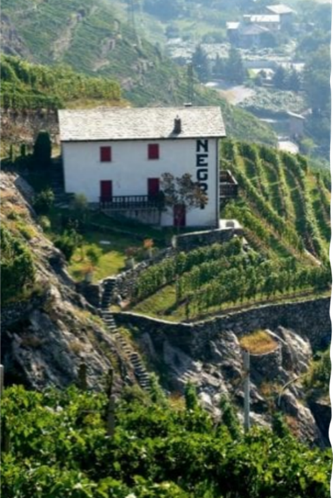
- Founded by Nino Negri in 1896. Today it is the property of Gruppo Italiano Vini. It is the most important winery in Valtellina for figures and surface. It has represented the territory for its role of winemaking and reference cellar for hundreds of associated viticulturists.
- Annual production: 750,000 bottles
- Area under vine: 160.00 Hectares
- Gambero Rosso: ** The winery won 29 Tre Bicchieri
– The Wine:

- Grape Variety: 100% Nebbiolo (Chiavennasca)
- Vineyard: South facing, at altitudes between 300 and 550 m above sea level.
- Harvest: selected grapes entirely handpicked from the end of September onwards.
- Appassimento: grapes are left to dry for 3 months in the fruttaio (fruit shed). “Forced” (forzato) natural drying (grapes lose almost 30% of their weight).
- Vinification: Fermented in stainless steel tanks with prolonged maceration (15-20 days). No wine clarification.
- Ageing: Two Years with at least one year in big oak casks.
- Alcohol: 16% abv
- Sensory profile: “Medium ruby hue, accompanied by a concentrated, complex nose with notes of ripe berry fruit and spice (black pepper and cinnamon). At the palate, it’s dry, with ripe dark fruit notes, firm austere tannins. Full-bodied, persistent, long finish with notes of clove and licorice.”
-
References
- D’Agata, I. Native wine grapes of Italy, U. California Press, 2014.
- D’Agata, I. Italy’s native wine grape terroirs, U. California Press, 2019.
- Fiordelli, Aldo, “In Rarified Air”, Decanter, July 2021, p. 20-28.
- Napjus, Alison, “Valtellina’s Distinctive Nebbiolos”, Wine Spectator, Oct. 31, 2020.
- Wine Scholar Guild, Italian Wine Scholar, Unit 1: The Wines of Northern Italy, n.d.
- Arpepe: Family Pelizzatti Perego, personal communication, October 15, 2024.
- https://www.arpepe.com
- | Consorzio di Tutela dei Vini di Valtellina
- Mamete Prevostini | Vini di Valtellina
- Mamete Prevostini: Galanga, Greta, personal communication, October 11, 2024.
- Nino Negri Winery – Gruppo Italiano Vini
- Nino Negri: Alongi, Claudio, personal communication, October 11, 2024.
- Tenuta Scerscé – Vini di Valtellina (tenutascersce.it)
- Wines from North Italy: Tasting No. 232 – July 27, 2021- Wines from North Italy | Club del Vino – Washington DC area (clubvino1.com)
Club del Vino Members Rating of the Wines
The tasting took place before revealing their prices. 16 participants rated them from Acceptable to Exceptional. The combined results established the preference order during the tasting as follows:
The red Nino Negri, Sforzato di Valtellina, ‘Sfursat Carlo Negri’, 2019 was the Best Wine, and Mamete Prevostini, Valtellina Superiore, ‘Sassella’, Marena, 2019 was the Best Buy. The following Table presents the details of ratings and combined results.

.o0o.

 Club del Vino - Washington DC area
Pingback: A Few Pictures of the October Degustation of the Club | Club del Vino – Washington DC area