
Tasting No269 – September 24, 2024
Classic Tuscany – Wine & Food

-
Tasting Overview
The main objective of this tasting is to learn about Tuscany and three of its most important red wines – Chianti, Brunello di Montalcino, Super Tuscan – and also Vermentino, a traditional Tuscan white. Also, we’ll learn about Sangiovese, considered one of the greatest red grapes of Italy. And finally, to learn about the wine revolution of the 1970’s and 1980’s that led to wines of immensely higher quality as well as the creation of the Super Tuscans, a group of avant-garde, expensive wines made in an untraditional manner.
Type of tasting: Open
Presenters: Ruth Connolly and Ginger Smart
Participants: M. Averbug; J. Brakarz; Y. Cutler; C. Estrada; J. Estupiñan; M. Fryer; N. Marzella; J. García; J. and L. Redwood; P. Meduña; R. Santiago; E. Silva; G. Smart; P. Turina; and G. Zincke.
These are the wines:
- Toscana Vermentino, Casanova Della Spinetta, 2022 Organic Grapes
- Chianti Classico, Carpineto, 2021, Countryside between Florence and Siena
- Super Tuscan, Poggio Antico, Lemartine, 2019, Siena, Italy
- Brunello di Montalcino, Campogiovanni, 2018, Montalcino, Italy.
The Tasting Menu
- Steamed mussels
- Fettuccine with veal ragu
- Lamb with vegetables
- Dessert, with coffee or tea.
-
Tuscany and its Classic Wines
As visitors to Tuscany quickly discover, there doesn’t seem to be a straight line in the entire region. Winding back and forth and up and down along Tuscany’s rural roads, it’s impossible not to fall in love with the patchwork of vineyards that cover a landscape undulating so magically. The region is roughly 68 percent hills. Nearly every vineyard is on a slope of some kind, gentle or steep, and two vineyards are only a stone’s throw apart, which often produce wines of very different characters.
Tuscany stretches from the Tyrrhenian Sea in the west to the low mountains that separate the region from Emilia-Romagna, Marche, and Umbria, its neighbors in the east. At nearly 9,000 square miles, it is the fifth largest region in Italy, yet most of the important wine zones are more or less in the middle of the region, from Florence in the north to Siena in the center and then south to the tiny hill town of Montalcino (famous for Brunello wine).
The climate in this central zone is warm, though not as warm or humid as along the Tyrrhenian coast. Nights are cool, helping to preserve the natural acidity of the grapes, particularly Sangiovese. Soil varies considerably, but the well drained slopes of the central hills tend to be sandy or stony, calcareous, and interspersed with schist and galestro (a crumbly stony marl).
The grape varieties in Tuscany
 Like many Italian wine regions, Tuscany was once home to dozens of grape varieties (in the mid-eighteenth century, more than two hundred were officially recognized). But in modern times, the region has been identified almost exclusively with two grapes: the indigenous variety Sangiovese, for centuries Tuscany’s single greatest grape, and Cabernet Sauvignon, the international variety that since the 1980’s has been responsible for making up – in whole or part- of the blend in numerous famous upper Tuscan wines.
Sangiovese is an exacting, troublesome grape. It doesn’t ripen easily or uniformly. In sites that are not consistently sunny or in rainy, overcast years, it’s common around harvest time to see bunches of soft, purple, ripe grapes as well as slightly green, underripe ones. Unevenly ripe bunches can lead to thin or unbalanced wines. This is just one of the challenges Sangiovese presents.
There’s another vexing issue: Sangiovese’s genetic disposition to reinvent itself as different variations, known as clones. Central Italy is literally strewn with multiple clones of Sangiovese. Though no one knows precisely how many different clones there are, winemakers are convinced that the main ones vary enormously in flavor and that the future of Tuscan wine lies in clonal research. An ambitious study of grape clones was begun in Chianti in 1987. With knowledge from this research, wine producers can pull out inferior, poor tasting clonal types. Among the top clone types are Sangioveto, one of the clones found in the best Chianti Classico wines; Brunello, the clone used for Brunello di Montalcino, and Prugnolo, the primary clone used for Vino Nobile di Montepulciano.
As for Cabernet Sauvignon, although it was brought to Tuscany in the XVIII century, reportedly by Grand Duke Cosimo de Medici III, the variety was largely unimportant until the grapes were used in Super Tuscans.
White grapes have never been very important in Tuscany, although Trebbiano and Malvasia were used to make “vino santo”, while the remainder were used in making Chianti and Nobile de Montepulciano. Vernaccia, Tuscany’s most traditional white grape, is grown around the hill town of San Gimignano and is the only white grape of any character. Italian experts consider it a serviceable and charming white.
Chianti and Super Tuscans as they relate to each other.
Chianti wine has come a long way from its role as companion to spaghetti and meatballs. Not that this association in the United States was always pejorative. After World War II, being cheap and easy to drink was pretty ideal. Chianti implied neither snobbish nor wealth; it was just plain easy to drink. But, as time went on, the wine grew increasingly disappointing. Part of the problem was the Chianti formula. Traditionally, Chianti was a blend of Sangiovese and Canaiolo grapes == and white Malvasia and/or Trebbiano. The formula was developed in the mid 1800’s by Baron Bettino Ricasoli, whose family had been making Tuscan wine since the twelfth century. Ricasoli decided that adding a small amount of Malvasia to Chianti would heighten its vivacity, boost its flavor, and make it more drinkable when young. Imbedded in this notion were the beginnings of disaster.
The more popular Chianti became the more it was “lightened” with white grapes – and not just with Malvasia but with a fairly dull type of Trebbiano. Far from adding character, it turned it into an anorexic red, gaunt, unbalanced and hollow. Even more trouble lay ahead because, after the war, the government gave the winegrowers funds for agricultural development and, in the rush to grow more, vineyards were planted beyond Chianti’s traditional region -between Florence and Siena. Nurseries supplied vineyards with plantings of a different type of Sangiovese, a clone called Sangiovese di Romagna, brought in from the nearby region of Emilia-Romagna and less well suited to Tuscany. As a result, the quality of Chianti collapsed, and by the late 1960’s, Chianti was bought as much for its straw covered bottle (the candle holder of the era) as for the liquid inside.
Faced with the possibility of the industry’s demise, in the mid 1970’s, a handful of innovative producers began taking steps toward making wines that would be the polar opposites of “spaghetti Chianti.” Their inspiration was Sassicaia, made by Marchese Mario Incisa della Rocchetta at his estate Tenuta San Guido, near the coast in Bolgheri. An artisanal wine that broke every rule, Sassicaia did not have a drop of Sangiovese in it but, instead, was made from Cabernet Sauvignon from vines that had come indirectly from Chateau Lafite. The Sassicaia vineyards were planted in what was considered just about the worst possible location in Tuscany. And the wine was aged in barriques – small, new French-oak barrels – when every other wine in Tuscany was aged in large old barrels, made of Slavonian oak.
The first Sassicaia made in the 1940’s were awkward, even coarse wines, but by the 1960’s, Incisa della Rocchetta had refined his techniques considerably, and the wine, defying expectation, turned out to be impressive. Piero Antinori, who was Incisa della Rocchetta’s cousin, was the head of a centuries-old Tuscan winemaking family. Sassicaia then became the catalyst for Antinori’s Tignanello – the first well known non-Chianti Chianti.
Made in 1971, Tignanello had no white grapes, was based almost entirely on Sangiovese (later Cabernet Sauvignon and Cabernet Franc were added), and was aged in barriques. Tignanello was like a flashlight in the dark. Other top producers immediately followed suit, making expensive proprietary wines of their own, sometimes from Sangiovese blended with Cabernet Sauvignon, sometimes from either grape alone. What unified these wines was what they were not. They were not made according to the traditional Chianti formula specified in the DOC laws. As a result, the government considered them mere “Vini da tavola”; the press nicknamed them the Super Tuscans.
The eclectic group of Super Tuscans motivated winemakers to further improve the quality of Chianti. The Chianti DOC title was created in 1967, and in 1984 Chianti was elevated to DOCG status, paving the way for additional improvements commensurate with the region’s enhanced status. The DOCG laws for Chianti were revised and made more liberal. The Super Tuscan concept has such marketing cachet that it is undoubtedly here to stay. Most wines considered Super Tuscans aren’t really traditional, no matter how close they come to fitting into the DOCG laws. These wines are made in an international style, generally flamboyant, dense and powerful, packed with tannin and wrapped in the vanilla note flavor that new oak imparts.
Traditional Chianti is something quite different. Sangiovese is a grape the entire flavor profile of which seems built for food. It’s more supple and less tannic than Cabernet Sauvignon, more elegant and lighter in body than Syrah or Primitivo and, most importantly, wines made from Sangiovese often possess a fascinating suggestion of saltiness and a good bit of acidity that clears your palate and makes you want to take another bite of food.
Chianti Classico – The area that historically yielded the richest, fullest Chianti was the original small hilly central region known as Chianti Classico. In 1996 the uniqueness of Chianti Classico was underscored when it was awarded a DOCG of its own. The microclimates of the Chianti Classico are multiple and diverse, thanks to the undulating hills and the variations in geology. By law, Chianti Classico can be composed of 75 to 100% Sangiovese, up to 10% Canaiolo, up to 15% other red grapes, including Cabernet Sauvignon and Merlot, and up to 6% white Trebbiano or Malvasia. The best basic Chianti Classico has plum and dried cherry flavors and sometimes a touch of salt and spice.
Brunello di Montalcino – Brunello (dialect for the nice dark one) is Tuscany’s most revered wine. It is also Tuscany’s rarest, most expensive, and longest lived. It is made in Montalcino, a walled medieval village clinging to a rocky hilltop, about an hour’s drive south of Chianti Classico. This southern subregion is warmer, and the wines have historically been bigger bodied than Chiantis. The extra bit of warmth provides winemakers with more assurance that each year Sangiovese grapes will ripen and produce wines of nuance and complexity. As a result, from the start Brunello of Montalcino has been based on Sangiovese alone. Brunello di Montalcino wines is made exclusively from Sangiovese Grosso, which is the large-berried form of Sangiovese. Brunello, its name here, translates roughly as ‘little dark one‘. The use of this synonym, and its inclusion in the name of the wine, was part of a clear strategy to differentiate the wine from Chianti.
The vineyards of Brunello di Montalcino cover a modest area of 3,000 acres (by comparison, Chianti covers more than 41,000 acres.) The best vineyards, as well as the village, are some 1,800 feet above sea level, where they are blanketed by a luminous swatch of sunshine. There is more limestone in the soil than in Chianti, and there are strips of clay, volcanic soil and plots of galestro. The best vineyards are planted on slopes facing south and southwest. The Monte Amiata range to the southeast helps to protect the vineyards from sudden rain and hail.
 Brunello di Montalcino is made from a special clone of Sangiovese called Brunello. In good years the Brunello clone yields a lavish wine, fleshier in texture than Chianti, with complex aromas and flavors of blackberry, black cherry, and black raspberry fruit and chocolate, violet, and leather. By law, Brunello di Montalcino must be aged longer than most other Italian wines – four years, two of which must be in oak, for regular Brunello, and five years, two and a half years of which must be in oak, for the Riserva. In great vintages Brunello can take on stunning elegance, suppleness, and concentration.
In 1980, Brunello di Montalcino was awarded DOCG status; it was one of the first Italian reds to be given this designation. Today, slightly more than 100 producers continue to shape and improve what has been considered a venerable wine for the last hundred years.
Brunello di Montalcino has a reputation for longevity. One of the most legendary wines in this regard –not just in Tuscany, but in Italy – is the Biondi-Santi Brunello di Montalcino. After a hundred years, it can still be remarkable. Brunello di Montalcino was initially the vision and creation of Ferruccio Bondi-Santi, who in the 1870’s isolated the Brunello clone of Sangiovese and planted it throughout his estate, some 1,700 feet above sea level. His Brunello could not have been more unconventional. At that time, most wines there were white and sweet. Those who preferred red would drink Chianti, which was light in style and not very age worthy. Biondi-Santi’s Brunello was the exact opposite: ample in body, packed with flavor, intensely colored, and capable of being cellared for decades. During fermentation, the grape skins sit with juice for maximum color extraction, then, the resulting wines are aged for years before releasing them. Though common today, each of these practices was virtually unheard of in the mid-nineteenth century, especially in a rural village in agrarian central Italy.
Vino Nobile di Montepulciano – These wines were made for just that: noblemen, popes, and poets who drank it regularly. Today, Vino Nobile does not necessarily live up to so lofty a name. Ask any number of Italian sommeliers what they think of Vino Nobile and invariably they will pause or shrug a bit, then meekly suggest that there are some good ones. Many are just plain thin and tart, without sufficient structure, fruit, or flavor. Vino Nobile is made primarily from its own clone of Sangiovese – Prugnolo – and then blended with a small amount of Canaiolo, Malvasia, and/or Trebbiano.
-
Information on the Wines
Wine #1. La Spinetta, Toscana Vermentino IGT, 2022
 – The Producer. La Spinetta is an Italian wine producer making wines predominantly in Piedmont. La Spinetta is co-owned by Giorgio Rivetti, where he is the head winemaker. The Rivetti family arrived in Bricco di Neive, Tuscany in the early 1800s. The place where the main house now stands was once the location of an ancient, vaulted cellar from the 17th century. It is particularly known for its single-vineyard Barbaresco wines and the Barolo Campe, plus an innovative blend of Nebbiolo and Barbera called Pin.
No chemical fertilizers or pesticides are used, and 75% of vineyards are farmed biodynamically. The grapes are picked by hand by long-serving harvest teams. More recently, La Spinetta has expanded its operations to Tuscany, and makes several wines there from Sangiovese, Vermentino and Colorino. Vermentino comes from Terricciola vineyard, which is characterized by the presence of oceanic sediments in the soil.
– The wine:
- Year: 2022
- Region/appellation: Terricciola Municipality; Toscana Vermentino IGT
- Grape: 100% Vermentino
- Viticulture: Organic grapes; no chemical fertilizers or pesticides are used, 75% of vineyards are farmed biodynamically; grapes are picked by hand by long-serving harvest teams.
- Vinification: Alcoholic fermentation with natural yeasts; aging of about 4 months in steel tanks on its lees.
- 13% APV %
Winemaker notes: Terricciola’s soil is sandy and rich in marine sediments, which gives the Vermentino an incredibly aromatic profile. Color is straw yellow with greenish hues; bouquet of citrus notes, white flowers and rosemary; fresh and decisive palate, herbal and floral notes with petroleum scents shape its clean and mineral finish. The wine has notes od Mediterranean scrub blended with mineral and white flower scents. The flavors are a perfect match of fresh and savory. https://www.la-spinetta.com/en/product/toscana-vermentino-igt/.
Wine #2 Carpineto, Chianti Classico DOCG, 2021
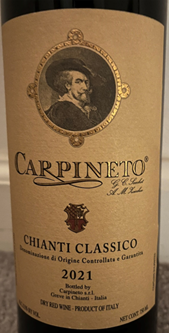 – The Producer: Carpineto is an Italian producer with several estates that encompass 424 hectares across highly regarded Tuscan DOCG regions. It was founded in 1967 by Giovanni Carlo Sachet and Antonio Mario Zaccheo with the aim of being a high-quality Chianti Classico producer, but its estates spread among Tuscany’s most prestigious appellations, stretching from the heart of the Chianti Classico region to their extensive Vino Nobile holdings in Montepulciano. It has five estates in total, two in Chianti Classico and one each in Maremma, Montepulciano, and Montalcino. It was the first Italian winery to receive the Robert Mondavi Trophy for excellence as well as being nominated Best Italian Wine Producer at the 34th International Wine and Spirits Competition.
Approximately 95% of the entire production consists of red wines, and most of this is made up of wines that are aged three years or more before they are released. Sangiovese is easily the most important variety, dominant in Carpenito’s most prestigious wines: Chianti Classico, Brunello di Montalcino and Vino Nobile di Montepulciano.
Carpineto also has a range of single-vineyard selections and proprietary blends at the IGT level, including a few Super Tuscans. Cabernet Sauvignon plays a significant part in these wines, while Chardonnay is the most represented variety in its limited selection of white wine. Carpineto is now exported to more than 70 countries.
– The Wine:
- Year: 2021
- Region/appellation: Chianti Classico DOCG
- Composition/varietals: 90% Sangiovese; 10% Canaiolo.
- Vinification: maceration of the skins in the must and fermentation in stainless steel tanks for 3-4 weeks at controlled low temperature; after the final blend is assembled, the wine is aged in oak casks for 18 months. The wine is bottled during the second year.
- Alcohol: 13.5% ABV
Winemaker notes. Ruby red color, garnet reflections on aging; intense aroma with hints of violets, berries and cherries; taste is velvety, well rounded and well balanced. https://www.carpineto.com/ .
Critic tasting notes: “The nose is warm, sanguine and slightly herbaceous, with aromas of Bing cherry, potting soil, orange peel and wild fennel leading the way. On the palate, a chocolate-vanilla swirl brings out sweeter cherry and orange flavors, which provide a playful balance to chalky, chewy tannins.” (Wine Enthusiast).
“Produced in the countryside between Florence and Siena, it’s a jeweled ruby color. This 2021 Chianti Classico is ripe and has a great nose of fresh wild herbs, pure raspberry, graphite and fresh violets. Medium bodied, its more cedar tones come through on the palate, with ripe, very well integrated tannins, clean lift, and a hint of its toasted incense on the finish. A very well-balanced wine from Carpineto, it’s showing beautifully now but will certainly improve in time. Drink ’24-’34” (Audrey Frick & Jeb Dunnuck).
Wine #3. Poggio Antico ‘Lemartine’, Toscana IGT, 2019
 – The Producer. Poggio Antico is a wine producer in Tuscany, particularly known for its Brunello di Montalcino wines. The Poggio Antico estate sits in Montalcino denomination and extends to around 200 hectares (500 acres) including woods, pastures and olive groves. Around 33 Ha (80 acres) are planted with vine, most of which is Sangiovese Grosso, with a small parcel of Cabernet Sauvignon. The vineyards are some of the highest in Montalcino, on sunny, south-facing slopes at around 450 m (1500 feet) above sea level. The hilltop breezes help dissipate fog and frost, and dry the grapes after rain, reducing the pressure of mildew diseases. The acres under vine develop two parallel Brunello worlds – the more traditional, larger barrel Brunello, aged longer in Slavonian oak, and the modern, finesse driven Altero, aged in tonneaux of French oak. Grapes undergo rigorous sorting prior to fermentation in stainless steel tanks. 2020 was the first certified organic harvest.
The wine portfolio has a range of wines, from the IGT Toscana appellations, from both traditional Tuscan varieties like Sangiovese and more international varieties like Cabernet Sauvignon and Petit Verdot. Brunello is the most important variety for the company with three Brunello di Montalcino DOCG wines produced.
The wine. ‘Lemartine’ is named after one of the three original properties. An opulent and intense Super Tuscan that has been produced since 2010. A blend of Sangiovese, each variety used is vinified and aged separately in French oak barrels. https://www.poggioantico.com/en/
- Vintage: 2019
- Grape composition: 50% Sangiovese, 25% Cabernet Sauvignon; 25% Petit Verdot
- Region/appellation: Montalcino (Siena); Toscana IGT
- Vinification: The two varieties were harvested and fermented separately in truncated cone-shaped steel vats with temperature controlled. Both fermentations were regular with long macerations and gentle extractions.
- Maturation: Sangiovese and C. Sauvignon were blended right after the fermentation and aged for 12 months in 225L French oak barriques prior to bottling.
- Alcohol: 14% ABV.
Critic’s tasting notes: Raspberry, blackberry, chestnut, mushroom and earth on the nose. Full bodied with chewy tannins. Structured with a chalky texture in the mouth and a long, flavorful finish (James Suckling).
Wine #4. San Felice ‘Campogiovanni’ Brunello di Montalcino DOCG, 2018
– The Producer. Agricola San Felice is a Tuscan wine producer with estates in Chianti Classico and Montalcino denominations. It is most famous for its Sangiovese-based wines under the Campogiovanni and Il Grigio labels, and also its Vigorello cuvée, which is reckoned to be the first example of a Super Tuscan.
The ‘Campogiovanni’ Brunello di Montalcino wine comes from an estate of the same name, purchased by the winery in the 1980s. It covers 65 Ha. (16

0 acres) on the southwestern side of the Montalcino hill, near San Angelo in Colle, where weather conditions and a particular combination of soils favor optimal growing and ripening of the Sangiovese Grosso (known as Brunello here).
– The Wine. Campogiovanni Brunello is absolutely classic in style, averaging three years in Slavonian oak casks and 500-liter tonneaux, then another 12 months in the bottle. It is recognized for its finesse and longevity.
- Vintage: 2018
- Grape variety: 100% Sangiovese
- Appellation: Brunello di Montalcino DOCG
- Viticulture: Vineyard located at Campogiovanni Estate (Montalcino, Siena). Soil Profile Medium textured, largely silt-sand with some clay, on sandstone and calcareous marl.
- Vinification: 20-day maceration at 28-30oand malolactic fermentation in steel.
- Maturation: 36 months in 500-liter French oak barrels and in 60 hl Slavonian oak, followed by a further 12 months in the bottle.
- Alcohol: 14% ABV
Winemaker notes. Deep ruby red. Offers up aromas of well-ripened wild berries, blackberry preserves, tobacco leaf, and tanned leather. An expansive, generous palate displays a rich mouthfeel, developing into a lengthy finale marked by fruit liqueur. https://www.sanfelice.com/en .
Critic tasting notes. “Very Sangiovese, this red wine combines both fruit and savory elements – cherry, strawberry, hibiscus, wet hay, iron and tobacco – with a firm structure. Expressive, balanced, vibrant and long, with stiff tannins on the finish.” It’s a full bodied, concentrated style of red Sangiovese wine from the Tuscany region of Italy. Montalcino is south and a tiny bit east of Siena. It tastes of dried cherry and black currant.” (Wine Spectator).
“The nose is metallic and stony, with a puff of petrol, like a road trip in winter, but also brighter notes of bergamot, black currant and black cherry. The palate embraces the bitter fruitiness of bergamot before savory notes return for a bitter finish. A balanced, polished and integrated wine.” (Wine Enthusiast).
- CV Members Rating
The tasting took place before revealing their prices. 13 participants rated them from Acceptable to Exceptional. The combined results established the preference order during the tasting as follows:
-The red San Felice ‘Campogiovanni’, Brunello di Montalcino DOCG, 2018 was the Best Wine;
-Poggio Antico ‘Lemartine’, Toscana IGT, 2019 was the Best Buy.
The following table presents the details of ratings and combined results.

.o0o.
Laughing matter
.o0o.

 Club del Vino - Washington DC area