
 Tasting No 266 – June 25, 2024 – Tuscany beyond Chianti and Sangiovese

1.Tasting Overview
While Tuscany is mostly known for the Chianti and Sangiovese based wines, this tasting is devoted to wines that are mostly based on other grapes.
Type of tasting: Open
Presenter: Jorge Requena
Participants: S. Ardila; R. Connolly; C. Estrada; J. Estupiñán; M. Fryer; J. García; A. C. Perazza; J. and L. Redwood; J. Requena; R. Santiago; P. Turina; G. Zincke and Y. Cutler (guest).
2. These are the wines:
- Terre di Talamo ‘Vento Teso’, Viognier, 2022
- Batzella Bolgheri ‘Tam’ Super Tuscan, 2017
- Le Macchiole Bolgheri Rosso Tuscany, 2021
- Caiarossa Rosso di Toscana IGT, 2019.
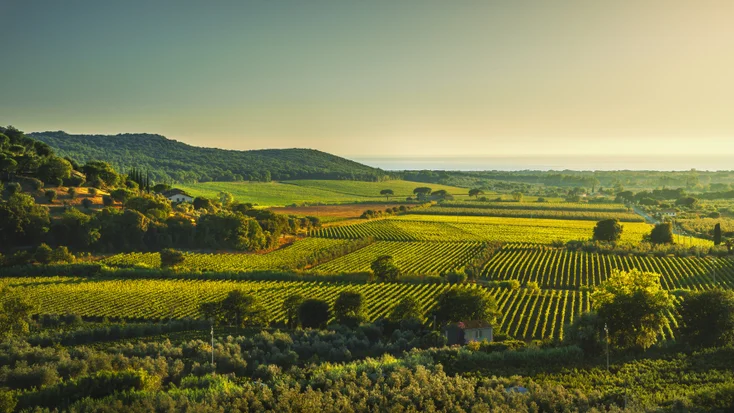
The Menu
- Seafood salad,
- Veal Ravioli in aurora sauce
- Grilled steak in brown mushroom sauce with grilled vegetables
- Coffee and dessert.
-
The Tuscany Region
Tuscany stretches from the Tyrrhenian Sea in the west to the low mountains that separate the region from Emilia-Romagna, the Marche, and Umbria, its neighbors to the east. At nearly 9,000 square miles (23,300 square kilometers), it is the fifth largest region in Italy. Yet most of the important wine zones are more or less in the middle of the region, from Florence in the north to Siena in the center and then south to the tiny hill town of Montalcino (famous for Brunello).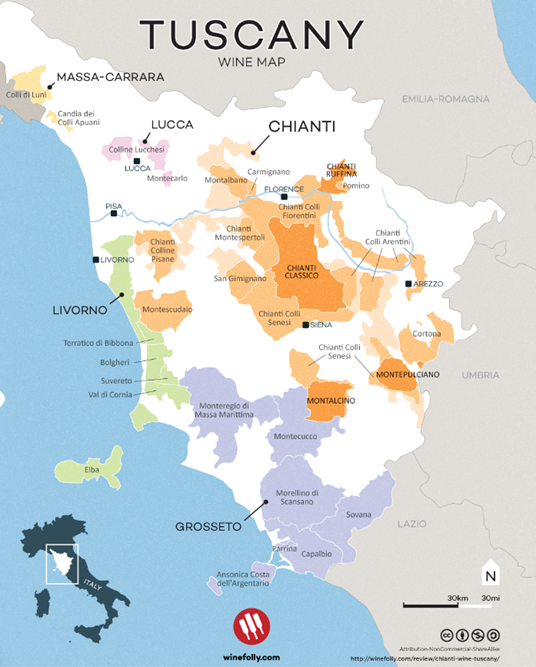
The Tuscany region is roughly 68% hills. The paucity of flat land means that nearly every vineyard is on a slope of some kind, gentle or steep, and that even two vineyards that are only a stone’s throw apart often produce wines of very different character.
The climate in this central zone is warm, although not as warm or humid as along the Tyrrhenian coast. Nights are cool, helping to preserve the natural acidity of the grapes, particularly in sangiovese. Soil varies considerably, but the well-drained slopes of the central hills tend to be sandy or stony, calcareous, and interspersed with schist and galestro (a crumbly, stony marl).
The region’s top wines are officially recognized and protected by a raft of 41 DOC and 11 DOCG titles. There are six more flexible IGP/IGT designations, including the pan-regional Toscana IGT.
Tuscany is renowned for its Chianti and Sangiovese-based wines, but beyond these traditional wines, Tuscany is also recognized for a diverse array of other exceptional wines that highlight the region’s versatile terroir and innovative winemaking.
The region has become famous for its “Super Tuscans”, a category of high-quality wines that often break traditional DOC/DOCG regulations by incorporating international grape varieties such as Cabernet Sauvignon, Merlot, and Syrah. These wines emerged in the late 20th century, as winemakers sought to experiment and elevate the quality of their wines. Notable examples of such wines include Sassicaia, Tignanello, and Ornellaia, that blend traditional Sangiovese with these international varietals.
Super Tuscans are typically aged in new French oak barrels, which impart additional complexity and elegance, characterized by bold flavors, smooth tannins, and impressive longevity.
One of the notable wine appellations of Tuscany that has gained prominence in recent years is Bolgheri, located along the Tuscan coast. Bolgheri’s unique terroir, characterized by its proximity to the Tyrrhenian Sea, mild climate, and diverse soils – including clay, limestone, and sand – provides an ideal environment for growing international grape varieties. Bolgheri is particularly celebrated for its Bordeaux-style blends, featuring Cabernet Sauvignon, Merlot, and Cabernet Franc. Iconic wines from this region have set a new standard for Italian winemaking, combining the elegance and structure of Bordeaux with the distinctive character of Tuscany.
Sassicaia, the most famous of the Super Tuscan red wines, was added to the Bolgheri DOC in 1994. This appellation had been established for white wines only a decade earlier. The estate now has its own Bolgheri Sassicaia designation for its reds.
Another significant appellation in Tuscany is the Maremma Toscana , which has been gaining attention for its innovative and high-quality wines. Maremma’s varied microclimates and fertile soils support a wide range of grape varieties. Vermentino, a white grape variety that thrives in Maremma’s coastal climate, produces wines with vibrant acidity, floral aromas, and crisp citrus flavors, often with a saline minerality imparted by the sea breeze. Maremma also excels in producing robust reds from varieties like Alicante (Grenache) and Syrah, which showcase intense fruit flavors, spice, and balanced tannins. The region’s commitment to sustainable and organic farming practices further enhances the quality and distinctiveness of its wines.
-
Information about the Wines
Wine #1 Terre Di Talamo ‘Vento Teso’ Viognier, 2022 (IGT)
Producer: Terre di Talamo winery is located south of Grosseto on the coast of Tuscany, in the Morellino di Scnasano. The 52-hectare estate is on a hillside facing the sea, with 32 hectares planted. The wide range of soil types at Terre di Talamo has led to its being dubbed “minestrone soil”.
The Wine: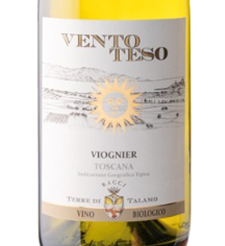
- Vintage: 2022
- Varietal: 100% Viognier
- Region/appellation: Toscana IGT.
- Vinification: grapes grown without the use of irrigation, herbicides or pesticides; all the grapes are grown organically. The wine ferments in stainless steel tanks.
- Alcohol: 14% APV
Tasting notes: The nose has notes of white flowers, apricot, melon, lemon curd. On the palate the flavors are honeysuckle, jasmine, apricot, peaches, yellow cherries, acacia flowers, melon skin undertone.
Fruity nose of pineapple, guava, grapefruit and fresh herbs. Medium-bodied, juicy and succulent, with crisp acidity. Touch of white pepper bringing some dryness to the fruit at the end. From organically grown grapes.
Wine #2 Batzella ‘Tam’ Bolgheri Rosso Superiore, 2017.
Producer: The Batzella winery is located in Bolgheri on the central Tuscan coast. It was founded in 2000 by Khanh Nguyen and Franco Batzella. The owners are committed to producing elegant and authentic wines, with personalities that best express the character of the region.
The wine is called Tâm, a Vietnamese term meaning passion, and reflects the passion that drives the owners in the search for a balance between power and elegance for this cuvée. The motif of the label was taken from the Chinese calligraphic representation which also means heart and passion.
The Wine: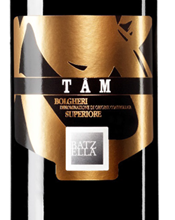
- Vintage: 2017
- Composition/Varietal: 65% Cabernet Sauvignon and 35% Cabernet Franc
- Region/appellation: Bolgueri DOC.
- Vinification: The harvest, entirely manual, generally takes place in September for the red grapes. The wine ferments in stainless steel tanks at a controlled temperature for 12–18 days. The wine is aged for 24 months in French oak barriques and then at least 18 months in the bottle.
- Alcohol: 14.5%
Tasting notes: Deep ruby red color, the nose has notes of ripe black fruits (blackberries), underbrush, smoke, mint, licorice, roasting. In the mouth it has good structure, and concentration with balanced and elegant tannins and a long finish.
Rich, impenetrable ruby-purple. Opens on the nose with lots of dark berry fruit, cassis and tobacco and earthy notes in the background. Develops well on the palate with grippy, layered tannins, dark berry fruit and lots of tobacco, firm and grippy on the finish
Wine #3. Le Macchiole Bolgheri Rosso DOC, 2021
Producer: Le Macchiole is one of the historic wineries in Bolgheri, dating back to the beginning of the 1980s, and over the years it has become a reference point for quality Tuscan wine. The founders Eugenio Campolmi and Cinzia Merli were among the region’s pioneers, and they contributed in a significant way to Bolgheri’s growing fame, thanks to their work in creating wines full of character and personality that have become a symbol of the region. The Estate is located in Bolgheri, on the on the Etruscan Coast between the hills and the sea. The characteristics of the land together with the dry, gently ventilated climate, the temperatures that are slightly lower than the rest of the Tuscan coast, and the unique brightness of the area all contribute to the definition of a typically Mediterranean environment particularly well-suited to growing varieties like Cabernet Sauvignon, Cabernet Franc, Merlot, and Syrah.
The Wine: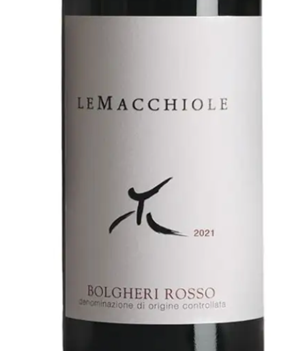
- Vintage: 2021
- Composition/Varietals: 50% Merlot, 20% Cabernet Franc, 20% Cabernet Sauvignon, 10% Syrah
- Region/appellation: Bolgueri DOC
- Vinification: Harvest period: from 3rd week of August to middle of September. Fermentation and maceration for about 15 days in steel tanks. Aged for 10 months, 70% in oak barriques 3rd and 4th use, 30% in concrete vats.
- Alcohol: 14.5%
Tasting notes: Intense fresh fruity notes on the nose and a slimmer texture, with firm yet very gentle tannins and an acid backbone that brings an amazing balance to the wine.
On the nose, sweet, slightly tart aromas of cherries and blackberries are balanced by a stony, spicy earthiness. That interplay between tart fruit and sanguine earthiness continues on the palate, creating the sensation of a breath of fresh spring air after the rain, before chalky tannins and bright acid usher in a bitter, peppery finish.
Pure and expressive, this red wine features cherry, raspberry and blackberry flavors augmented by iron, spice and light herb accents. Sleek and elegant, with a succulent profile and excellent persistence on the finish.
Wine #4. Caiarossa Rosso di Toscana 2019 (IGT)
Producer: Caiarossa winery was created in 1998 on the rolling hillsides of Riparbella at Podere Serra All’Olio, situated southeast of the city of Pisa. The estate is part of an area owned for centuries by the De Medici family. The winery is located in the Val di Cecina region, on 16 hectares of mild slopes with views of the sea. From roughly 40 hectares of vines, it produces a range of regional Tuscan wines that largely fall under the Toscana IGT classification. The vines comprise three main vineyards: the original Podere Serra all’Olio at Caiarossa, Le Lame – the most southerly part- and an extensive parcel on the slopes of Monte di Nocola, known as Nocolino.
The estate’s flagship Caiarossa Toscana IGT wine was first produced in 2003 and is a blend of seven red grape varieties. In 2004, Caiarossa was acquired by Eric Albada Jelgersma, who was searching for an Italian counterpart for his prestigious historic estate in Margaux Cru Classé properties, Chateau Giscours and Chateau du Tertre.
The Wine: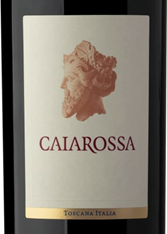
- Vintage: 2019
- Composition/Varietals: 26% Syrah, 24% Cabernet Franc, 23% Merlot, 14% Cabernet Sauvignon, 7% Petit Verdot, 4% Sangiovese and 2% Grenache.
- Region/appellation: Toscana IGT.
- Vinification: The grapes are harvested by hand from the Podere Serra all’Olio vineyard from September 5th through the 21st. All the different plots and varieties are vinified separately in concrete tanks and wooden ‘truncated cones’ (troncoconici di legno), with slow fermentations and soft extractions.
- Aging: Once the malolactic
- fermentation is completed, the wines selected for Caiarossa are blended. Then it ages approximately 14 months in French oak barriques prior to bottling.
- Alcohol: 14.5%
Tasting notes: This Caiarossa vintage displays vibrant, concentrated fruit, framed by an elegant mineral note of ground limestone. The wine expresses aromas of black cherry and sweet blackberry, as well as presenting delicious notes of tobacco leaf and dried leather. But the notes of candied cherry and raspberry are revealed with such distinction, they highlight the warmth of this vintage. Tannins are very present but their texture is smooth and the finish long, extending over some beautiful sour notes.
The Caiarossa 2019 Caiarossa is a complex blend featuring Syrah, Cabernet Franc, Merlot, Cabernet Sauvignon, Petit Verdot, Sangiovese, and Alicante. The wine is balanced and fresh with thick layers of dark fruit, crushed stone, tobacco and exotic spice.
References:
https://italianwinecentral.com/region-province/toscana/
https://www.wine-searcher.com/regions-italy
https://winefolly.com/videos/super-tuscan-wines/
The Wine Bible, Karen MacNeil, Workman Publishing, New York, 2015.
- CV Members Rating
The tasting took place before revealing their prices. 15 participants rated them from Acceptable to Exceptional.
The combined results established the preference order during the tasting as
follows:
– Caiarossa Rosso di Toscana IGT, 2019 was rated the Best Wine and the white Terre di Talamo
– ‘Vento Teso’, Viognier, 2022 the Best Buy. The Best Buy among the reds was Batzella Bolgheri ‘Tam’ Super Tuscan, 2017.
The following Table presents the details of ratings and combined
results.
.o0o.
Wine Jokes from WINCARTA
You know that red meat pairs well with an Amarone. You know that a Muscat complements a nice piece of fish. But, do you know what goes best with wine of any hue?
Laughter.
No matter the wine, it is best served with good times. In fact, we’d argue that nothing tastes better than that feeling you get with good company and good conversation. Lots of psychological factors affect the taste of wine. Perhaps a good joke will help too.
When the wine flows, so too does the conversation. But, if you find it running dry, here are some of our favorite wine jokes you can use to get back on track.
Your dad’s wine jokes
- What did the grape say when the elephant stood on it? Nothing, it just let out a little wine.
- I’ve trained my dog to bring me a glass of red wine. It’s a Bordeaux collie.
- I’m a wine enthusiast. The more wine I drink, the more enthusiastic I get.
- I was having wine with my wife when she said ‘I love you so much, you know. I don’t know how I could ever live without you.’ I said, ‘Is that you or the wine talking?’ She said, ‘It’s me talking to the wine.’
- Love the wine you’re with.
- What do you call a wine hangover? The grape depression.
- What’s the secret to enjoying a good bottle of wine? Open the bottle to let it breathe. If it doesn’t look like it’s breathing, give it mouth-to-mouth.
- If you can drink away your hurt, it must have been champagne.
- Wine improves with age. I improve with wine.
- How do you decide how much wine to drink? Take it on case-by-case basis.
- What do you call a grape that is an anti-diuretic? Pinot More.
- Did you know wine doesn’t make you fat? It makes you lean…against tables, chairs, floors, walls and ugly people.
- It’s funny how 8 glasses of water a day seems impossible but 8 glasses of wine is a sign of a good meal.
- The first thing on my bucket list? To fill the bucket with wine.
- We have an open-door policy. Show up with wine, and we’ll open the door.
For a more serious approach to wine, check out our beginner’s guide to wine tasting.
.o0o.

 Club del Vino - Washington DC area