 Tasting No 265 – May 28, 2024 – Campania’s Volcanic Wines, Italy

- Tasting Overview
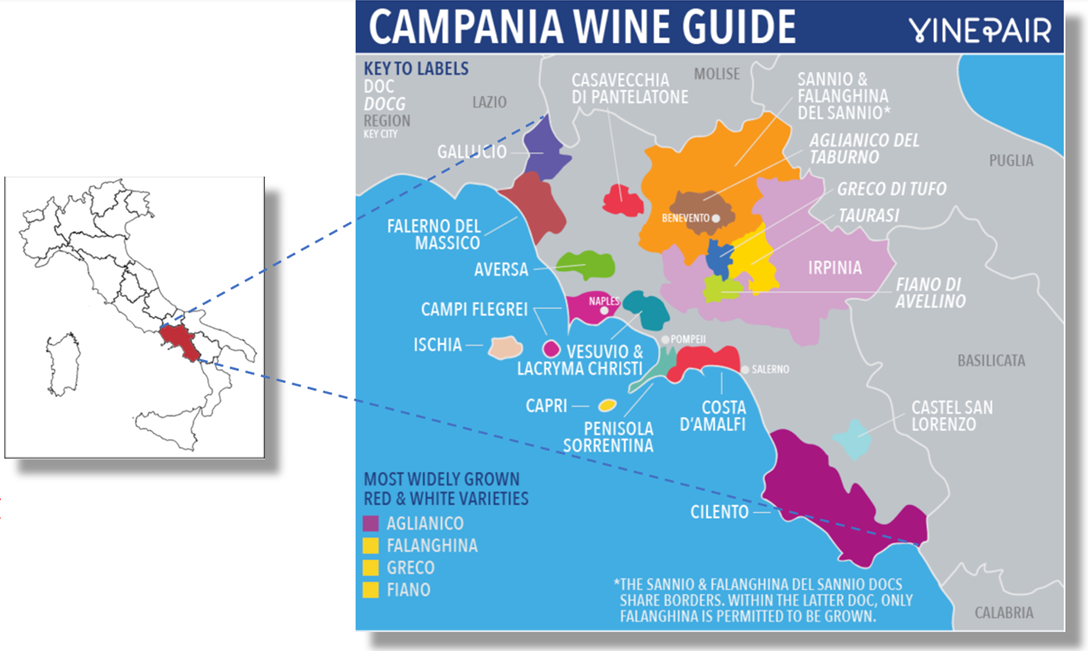
The main objective of this tasting is to explore wines from the Campania region, particularly the unique and intriguing indigenous wines grown in the same volcanic soils that buried Pompeii.
Type of tasting: Open
Presenters: Cristian Santelices, Jorge Claro y Luis Uechi
Participants: R. Arroio; M. Averbug; R. Connolly; C. Estrada; J. Estupiñán; J. García; A. and Claudia Perazza; J. Requena; R Santiago; G. Smart; L. Uechi; R. Gutiérrez (guest) and E. Bernal-Labrada (guest).
These are the wines:
- Feudi di San Gregorio, Falanghina del Sannio DOC, 2021
- Mastroberardino, Lacryma Christi Del Vesuvio Rosso, 2022
- Donnachiara, Taurasi Aglianico DOCG, 2019
- Mastroberardino, Radici Taurasi Riserva DOCG, 2017
- Menu
- Caprese Salad w/Garden Pesto on the side (Pairs particularly well with the aromatic and acidic Falanghina wine of Campania)
- Traditional Lasagna (great to pair with Piedirosso and Aglianico)
- Grilled lamb chops w/brown sauce (great to pair with Aglianico and Piedirosso)
- Dessert, coffee, tea
-
The Campania Wine Region
Campania – its name comes from “Campania felix”, a Latin phrase roughly meaning “fertile / happy land” – is the wine region that forms the shin of Italy’s boot, facing the Tyrrhenian Sea, best known for its impressive coastline and tourism. Tourists know Campania for the city of Naples (Napoli, the spiritual home of Pizza), the ruins of Pompeii, the towering Mount Vesuvius and its hillsides lined with lemon groves, olive trees and grapevines, the isle of Capri, and the beautiful Amalfi Coast.
Although this southern region doesn’t yet enjoy the same reputation for great wines as Tuscany, Piedmont, Lombardy, Veneto or Sicilia, Campania produces unique and intriguing indigenous wines, many of which are grown in the same volcanic soils that buried Pompeii.
Terroir and Production Areas. The region boasts a rich volcanic soil that is highly nutritious and perfect for grape cultivation. This soil is primarily made up of dark volcanic sand, pumice, and lapillus, which give the wine its smoky and mineral notes. It is also rich in potassium, which enhances the wine’s sweetness. To take full advantage of the sun’s rays, the vineyards are situated at an elevation of 400 – 700 meters above sea level. The region enjoys a Mediterranean climate, featuring hot and dry summers and mild, wet winters. The frequent breezes from the mountains and the Tyrrhenian Sea create the ideal microclimate for vines to flourish. The region’s soils and climate, with long warm growing season, combine to produce powerful and concentrated red wines and aromatic, minerally white wines from native varieties.
In 2022, Campania had 25,600 hectares of registered vineyards, producing almost 1.5 million hL of wine (49% white and 51% red) – 19% of it at the DOP and 11% at the IGT level. The region accounts only for a tiny fraction (~0.6%) of Italy’s DOP wine production, but includes 4 DOCGs (5% of Italy’s 77 official DOCG appellations); 15 DOC (4.5% of Italy’s 332 official DOC appellations) and 10 IGTs (8.5% of Italy’s 119 IGTs). (See more information regarding the various classifications of Italian wine labels in the following links: “Decoding Italian Wine Labels: Understanding BIO, IGP, DOP, IGT, DOC, DOCG, and VdT” and “The Pyramid of Italian Wines”.
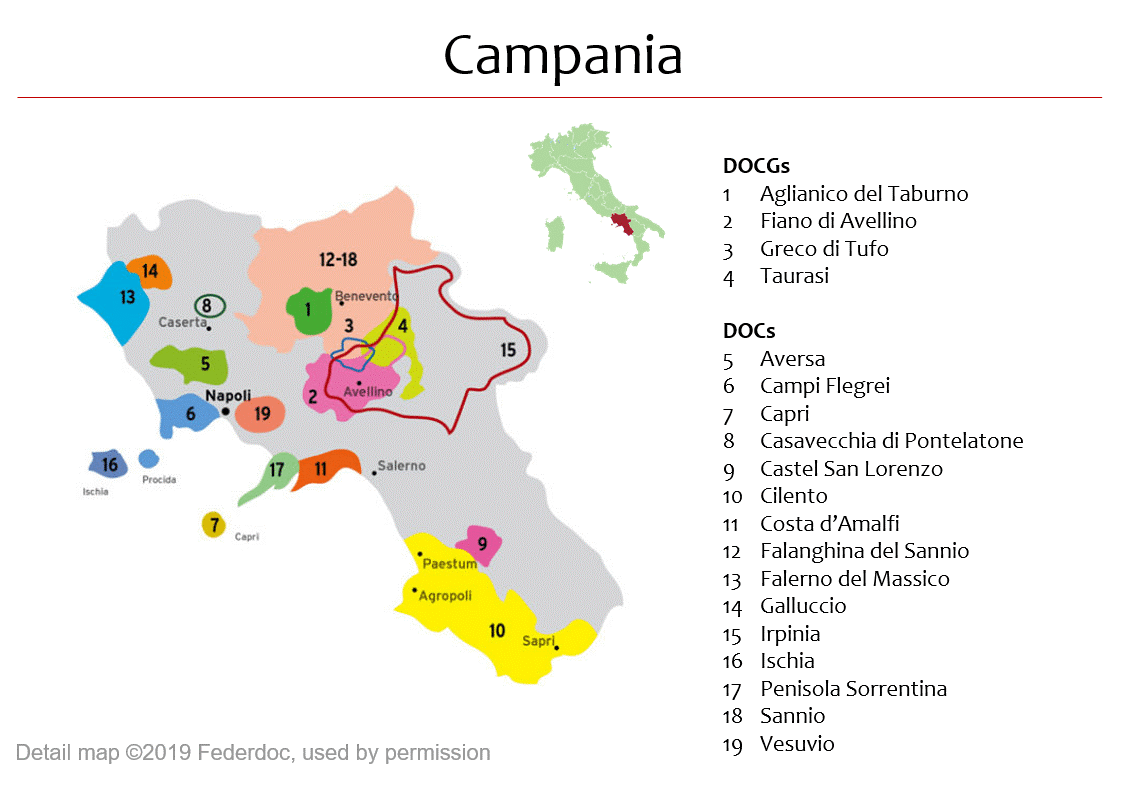
The region’s 4 DOCGs are Taurasi and Aglianico del Taburno for red wines, and Fiano di Avellino and Greco di Tufo for whites. These highest quality designations are all around Avellino, where the soils are filled with tuff or volcanic rocks. Intriguing wines made from Falanghina and Piedirosso are also particularly noteworthy.
The main grapes are Aglianico, Piedirosso (reds), Falanghina, Fiano, Greco, Biancolella, Asprinio and Coda di Volpe (whites). White and rosé wines have aromas of almond, peaches, pineapple, and citrus, and are consumed young. Red wines need aging to develop mineral and smoky aromas and flavors of red fruit.
History of Viticulture in Campania. Campania has strong historical links to wine and vine, dating back to the 12th Century BC, and is one of Italy’s very oldest wine regions. The considerable influence of ancient empires, including the Greeks, Romans and Byzantines, means some of this region’s varieties have historical legends attached. The area was the playground of the Roman elite and famous for producing Falerno (Falernum), a strong white wine popular in the classical Roman period, produced from Aglianico grapes and one of the most ancient wines in Italy.
In this context, it is worthwhile a note on the Vesuvio sub-region – also known as Mt. Vesuvius- that is home to wines of explosive flavor and historical controversy: the area has an ancient winemaking tradition that thrived during the Roman Empire. The sub-region’s wines were exported outside Italy and favored by the Romans, especially the Emperors. Wine-making practices in the area improved during this period of enological splendor. Vesuvio’s legendary eruption of 79 AD destroyed the wealthy, coastal towns of Pompeii and Herculaneum, though vines and enological tradition remained rooted. Today, Lacryma Christi del Vesuvio DOC is the wine produced with the native grapes of Mt. Vesuvius, which were already being cultivated prior to ancient Roman times, and are red, white, or rosé with similar colors and flavors to classic Campania wines.
During the early part of the first millennium, the Villa Augustea situated at the foot of Mount Somma – near Mt. Vesuvio – was a major center for wine production. Pagan farmers would gather at the hall of this location to ceremoniously stomp by feet communal grapes, which were then stored in “dolios”, amphora clay vessels, to age. Dolios of Vesuvio wine have been discovered in parts of northern Africa and even India, revealing that Vesuvio wine production was once prized throughout Europe and the known wine world. Vesuvius’s slopes were home to many vineyards which produced wine. This suggests that there was extensive cultivation in the area. Bacchus, the god of wine, was a common theme in many Roman art pieces, including frescoes found in houses of Pompeii that were preserved after the volcanic eruption. The DOP denomination comes from an emblematic place for the history of wine production in this area: ancient Pompeii. The archaeological remains are a testimony to its origins and great tradition. Currently there are sustained efforts to inspire a reawakening among Vesuvian producers by reestablishing traditional winemaking techniques, native grapes, and historic terroirs – for instance, the one leading by The Vesuvio Wine Protection Consortium.
Among the most prized Vesuvio wines, the tittle Lacryma Christi del Vesuvio is an ancient wine made popular by monks in the Middle Ages. With a history that dates back to ancient Roman times, there are many myths surrounding the name of this wine. One such legend relates the simple story of when Jesus ascended into heaven, and on casting his eyes over the beautiful Bay of Naples, he wept tears of joy, which fell upon Mount Vesuvius causing vines to grow. Another myth tells of Christ weeping onto the land over the casting out of Lucifer and the fallen angels. In a variation of this tale, angry that they were forced to leave, Lucifer and the fallen angels took a piece of Heaven with them which landed on Mount Vesuvius, leading to tears of sadness from God. The Lacryma Christi del Vesuvio received the DOC name only in 1983 despite its centuries-old history. Wine is produced with native grapes in the province of Naples within the Vesuvius National Park. The varieties Caprettone and Coda di Volpe are used (minimum 85%) for Lacryma Christi Bianco and other white grape varieties recommended for the province of Naples, and Piedirosso used for Lacryma Christi Rosé and Rosso (minimum 85%) and Aglianico.
Today’s wine styles: Aglianico is the dominant red grape variety (34% of total winegrape production) and Falanghina in its whites – can range from fruit forward and youthful to robust and well-structured. The whites are known for their aromatic characters, often redolent of the local flora. The reds have big personalities that require a little aging.
Despite being ensconced in tradition, dynamic and innovative methods have helped improve the quality of Campania’s wines, specifically through better vineyard management, harvesting methods and cellar techniques. A particularly notable name in the world of Campania wine is the Mastroberardino family (See more details on wines #2 and #4 below).
Reference
https://italianwinecentral.com/
https://www.totalwine.com/discover/learn/campania
https://www.wine-searcher.com/grape-varieties
https://vinepair.com/wine-geekly/intro-guide-campania-italian-white-wine-map/
-
Information on the Wines
Wine #1. Feudi di San Gregorio, Falanghina del Sannio DOC, 2021
The Producer: Feudi di San Gregorio winery was established in 1986 in Sorbo Serpico, a small village near Mount Vesuvius in Campania’s Irpinia region. They specialize in using indigenous grapes to create unique and modern Mediterranean flavors. The Falanghina wine, named after the ancient vine cultivation method in Sannio that used Falangs (“poles”), is perfect as an aperitif and can be paired with various appetizers, simple fish and vegetable dishes, and fresh cheeses.
The wine:
- Vintage: 2021
- Varietal: 100% Falanghina
- Classification: Falanghina del Sannio DOC
- Country/Region/Subregion: Italy – Campania – Sannio
- Viticulture: The vine cultivation follows an ancient method that used Falangs (poles)
- Vinification: Grape clusters carefully hand picked by hand and transported in 18kg crates to winery at 50°F (10°C); clusters gently pressed, cold settling process at 57° ̊F (14°C) that lasts for 24-48 hours. Cold fermentation for about 5 months in stainless steel vats between 61-64°F (16-18°C); no malolactic fermentation. Aged for 5 months in stainless steel tanks in contact with its lees with an additional month in bottle prior to release.
- Alcohol: 13%
Tasting Notes: Upon first sip, this wine has a medium-intensity mouthfeel accompanied by crisp minerality. Hints of spice, light almond, and a slightly bitter orange peel character can be detected. The pretty floral notes and soft fruit flavors are fresh throughout the finish, and they are in perfect balance with the mouthwatering acidity.
Style: crisp, fresh; aroma with floral notes, like white blossoms, and delicate apple and pear; Color is straw yellow with brilliant green reflections.
Reference:
https://www.uncorked.com/Feudi-di-San-Gregorio-Falanghina-2019/0022200102019.html
https://www.feudi.it/en/taste-our-wines/falanghina
https://www.vinology.com/falanghina/
Recommended Video on Falanghina: https://www.youtube.com/watch?v=EmuM0cKCtGk
Wine #2. Mastroberardino, Lacryma Christi Del Vesuvio DOC, 2022
The Producer: Mastroberardino Societá Agricola SRL is one of Campania’s most renowned wineries. It was established in the 1870s in the town of Altripalda and the family’s vineyards spread across several parts of Campania’s Irpinia region, near the base of Mount Vesuvius. Antonio Mastroberardino, the 9th generation of his family, brought international recognition to their winery in Irpinia. After returning home from World War II, he rebuilt his family’s business from ruins and dedicated plantings to three nearly extinct ancient Campanian grape varietals: Fiano, Greco, and Aglianico. His decision has since shaped all Campanian wine production efforts and sparked a resurgence in the production of high-quality red and white wines in Southern Italy. Today, the winery is recognized as the most important guardian of the viticultural and oenological heritage of the Roman age. The winery has been appointed by the “Presidenza della Repubblica” to reintroduce vine growing in the ancient city of Pompeii.
The wine:
- Vintage: 2022
- Varietal: 100% Piedirosso
- Classification: Lacryma Christi Del Vesuvio DOC
- Country/Region/Subregion: Italy – Campania – Vesuvio
- Vinification: The grapes are carefully hand-harvested in October, are vinified with maceration on the skins for approximately 6 days, then fermented in stainless steel tanks at controlled temperatures (25°-28°C). The wine is aged for about 6 months in small oak barrels, and refined in the bottle for one month before release for sale.
- Alcohol: 12.5%
Wine overview: Mastroberardino Lacryma Christi Del Vesuvio Rosso is a ruby-red wine, known for its intense aroma of cherries, plums, raspberries, and black pepper. The wine has refined light tannins and a bright acidity, which gives it a refreshing and fruity character.
Crafted by the renowned winemaker Massimo Di Renzo, this wine is an excellent representation of the Vesuvio DOC terroir. The vineyards are located below Mount Vesuvius and are nourished by the mineral-rich volcanic ash and lapilli. This results in loose soils rich in minerals and well-draining, which contributes to the unique characteristics of the wine.
Style: Dry, notes of cherries, plums, raspberries, and black pepper; Color is ruby-red.
Pairings: salumi, tomato, and meat-based sauces, or pizza Margherita.
Ref:
https://www.empirewine.com/wine/mastroberardino-lacryma-christi-rosso-2022-h55962/
https://www.wine-searcher.com/regions-vesuvio
Recommended Video on Lacryma Christi del Vesuvio: https://www.youtube.com/watch?v=ZLzpZ90ztXw
Wine #3. Donnachiara, Taurasi Aglianico DOCG, 2019
The Producer: Taurasi Aglianico DOCG is a fine red wine produced by Donnachiara SRL, a female-led winery established in 2005 in Montefalcione. The company – with over 150 years of expertise and modern production since 2005 – has a family-driven commitment to quality and a deep sense of responsibility to unearth Irpinia’s potential. Donnachiara is a female-led winery established in 2005 in Montefalcione. The company has a family-driven commitment to quality and a deep sense of responsibility. With over 150 years of expertise and modern production since 2005, Donnachiara is more than just a business. Led by CEO Ilaria Petitto, the winery is focused on unearthing Irpinia’s winemaking potential.
The wine: 
- Vintage: 2019
- Varietal: 100% Aglianico
- Classification: Taurasi Aglianico DOCG
- Country/Region/Subregion: Italy – Campania – Taurasi
- Vinification: grapes are hand picked in November, carefully selected, and softly pressed. Maceration on the skins for 20 days followed by malolactic fermentation for about 12 months in French barriques, and refined in the bottle for 12 months before release for sale.
- Alcohol content: 13.5%
Style: Dry, with elegant estructure and great persistence; aroma with notes of blackberry, blueberry, smoke, and coffee; Color is ruby-red with purple notes.
The grape overview: Aglianico is an ancient grape variety that originated in Italy where it was first planted near modern-day Pozzuoli. From there, it spread to other parts of Campania. Wine made from Aglianico was known as Falernian and was highly regarded by the Romans. Until the 15th century, the Aglianico grape was known as Elenico, which means Greek in Italian. The name was later changed to Aglianico, which might have come from the Latin phrase “vita hellenica,” meaning Greek wine. There are 3 biotypes of Aglianico: Taurasi, Vulture and Taburno (each sub-region has a decidedly different expression of the wine, but the volcanic soils are what ties them all together). Aglianico has an uncle-nephew relationship with Syrah. The Aglianico grape thrives in volcanic soil at altitudes of 300-500 meters. As a black, late-ripening grape, it is also used in Campania as a blending grape.
Tasting notes: The wine has blackberry, blueberry, smoke, and coffee notes. It will become a great wine with more bottle age and can last for 15 to 20 years. The 2019 vintage had great climatic conditions, a large crop, very good acidity, and won many awards.
There are many who believe that the three great grape varieties in Italy are Nebbiolo, Sangiovese and Aglianico. Wines made from the Aglianico grape are full-bodied with good fruit, tannins, and hints of blackberries, leather and smoke. Elegant structure with great persistence. Pair with pasta, steak, roast game, and long-aged cheese.
Reference
https://www.honestgrapes.co.uk/products/donnachiara-taurasi-2019
https://www.donnachiara.com/taurasi/
https://charlesscicolone.wordpress.com/2023/11/06/tasting-aglianico-taurasi-from-donnachiara-winery/
Recommended Video on Aglianico: https://www.youtube.com/watch?v=-oFGe7DM5-8&list=WL
Wine #4. Mastroberardino, Radici Taurasi Riserva DOCG, 2017
The Producer: (See Wine #2)
The wine: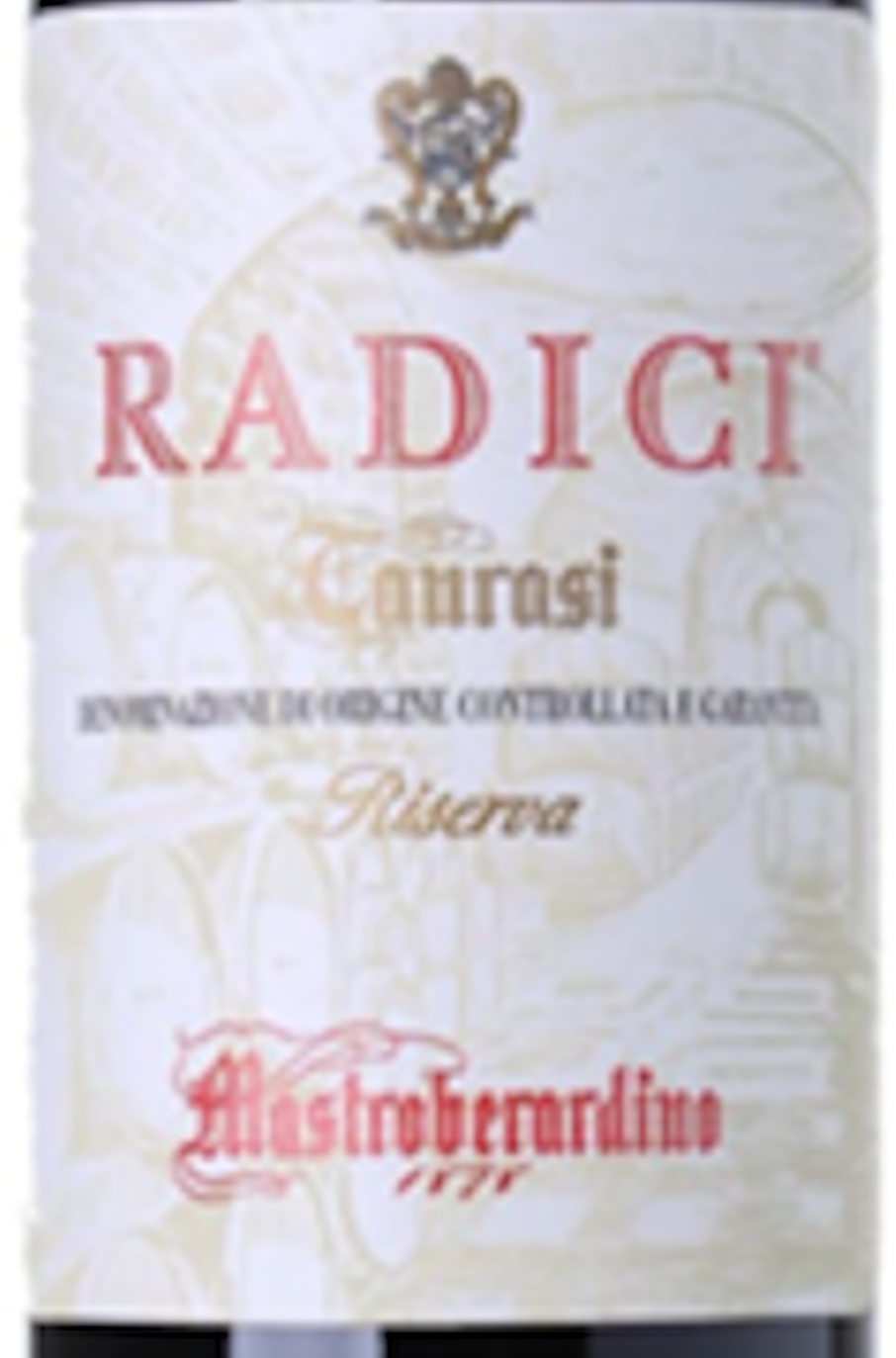
- Vintage: 2017
- Varietal: 100% Aglianico
- Classification: Radici Taurasi Riserva DOCG
- Country/Region/Subregion: Italy – Campania – Taurasi
- Alcohol: 13.5%
- Ageing: Grapes are manually picked at the end of October and early November. The vinification process is classic, with a maceration period of around 25 days on the skins, at a controlled temperature of 22° – 24°C. The wine is then aged for approximately 30 months in French and Slavonian oak barrels, followed by at least 40 months of aging in the bottle.
Wine overview: The 20 year “Mirabella Eclano vineyards” are South-West facing, at an altitude 500-650m. Deep and sandy loam soils include traces of limestone, clay, and some volcanic matter and are well-draining. The red wine is made using the classic vinification process.
Tasting notes: The wine is a deep ruby red with intense flavors of cherry, wild berries, spice, plum, black cherry, and strawberry. It pairs well with mature cheeses, truffles, mushrooms, ragout, and roasted red meats.
Style is full, complex estructure, this elegant wine has flavors of plum, black cherry, strawberry and intense spices; aroma notes of cherry, violet, wild berries, and a distinctive spicy aroma; color: Intense ruby-red
Reference:
https://www.plummarket.com/store/2017-mastroberardino-radici-taurasi-riserva-docg-campania.html
https://ny.eatalyvino.com/wines/Mastroberardino-Taurasi-Radici-2017-w13777116g
- CV Members Rating
The tasting took place before revealing their prices. 13 participants rated them from Acceptable to Exceptional. The combined results established the preference order during the tasting as follows:
Mastroberardino, Radici Taurasi Riserva DOCG, 2017 was rated the Best Wine and the white Feudi di San Gregorio, Falanghina del Sannio DOC, 2021 the Best Buy. The Best Buy among the reds was Donnachiara, Taurasi Aglianico DOCG, 2019. The following Table presents the details of ratings and combined results.

.o0o.
Laughing a little:


 Club del Vino - Washington DC area